Imaginary interview with Edgar Allan Poe
by Charactorium · Edgar Allan Poe (1809 — 1849) · Literature · 5 min read
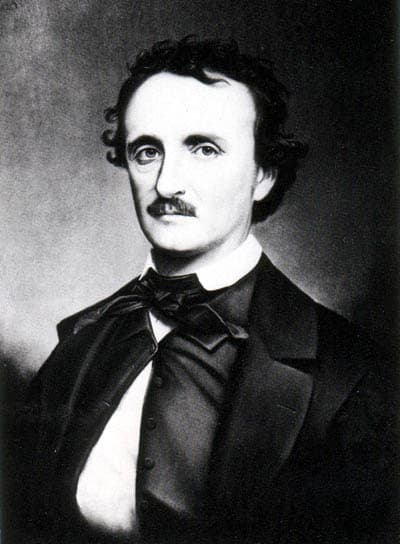
October 1845. In the cramped office of the Broadway Journal in New York, the lamp still smokes. Edgar Allan Poe receives us between two proof sheets, his dark collar impeccable despite the poverty of the place, a tortoiseshell cat curled up on a pile of heavily revised manuscripts.
—How did you come up with the idea of a character who solves a crime by the sheer power of thought?
It all started from a conviction: the human mind can be sharper than any knife. In 1841, in The Murders in the Rue Morgue, I created the Chevalier Auguste Dupin, a man who does not run, does not search, but observes and deduces. The Paris police were floundering; he saw. I call this ratiocination — that patient work of analysis that dismantles an enigma like taking apart a clock. Today they tell me I invented a new genre; I do not know. I only know that a monkey had committed those murders, and it took a man cold enough to admit it when all common sense cried impossible.
Dupin does not run, does not search: he observes and deduces, and that is what terrifies.
—In The Purloined Letter, your detective finds the solution where everyone else has searched in vain. What did you want to demonstrate?
That men lose themselves digging when the evidence is right before their eyes. In The Purloined Letter, in 1844, the police turn over furniture, probe table legs, dismantle armchairs — and the letter is there, carelessly slipped into a card rack, in plain sight. Dupin finds it because he puts himself in his opponent's head instead of searching his drawers. Crime is not a matter of hands, you see; it is a matter of mind against mind. I have always thought that the surest concealment is not the secret vault, but the full light, where no one thinks to look.
—The Raven made you famous across the country. How did you write that poem?
Coldly. People imagine the poet seized by inspiration, pen trembling — nonsense. The Raven was calculated verse by verse, like a mathematical problem. I first chose the effect: melancholy. Then the refrain, that sonorous and despairing 'Nevermore.' Then the bird that repeats it without understanding. I wrote an entire essay on it, The Philosophy of Composition, in 1846, where I state without mincing words: 'Nothing is more clear than that every plot, worth the name, must be elaborated to its dénouement before anything be attempted with the pen.' You start with the end. My manuscript is crossed out to the bone — every word cost its effort.
People imagine the poet seized by inspiration — nonsense. The Raven was calculated like a mathematical problem.
—That poem brought you glory. Did you reap the fortune one imagines?
Nine dollars. That is what I was paid for The Raven. Nine dollars for verses that half of America now recites at its dinners. I am recognized in the street, invited to the Lyceum to read it aloud before packed halls — and I return at evening to a lodging where the stove barely warms. Such is the condition of the man of letters in this country: fame crowns you with one hand and leaves you starving with the other. I knew glory and hunger the same winter, and believe me, the former does not feed.
—You often write at night. Can you describe those hours of work?
The night belongs to me. The day is for proofs, criticisms, editors to be chased; but when all sleep, I settle by the light of a candle, and that is when the tales come. Virginia would sometimes play the piano, her voice rising, frail, through the wall, while I traced sentences about decay and dread. Our cat, Catterina, would climb onto my shoulder and stay for hours, a warm presence in the cold. There is something frightening about writing about death while tuberculosis slowly consumes the woman singing in the next room. My best pages were born on those nights.
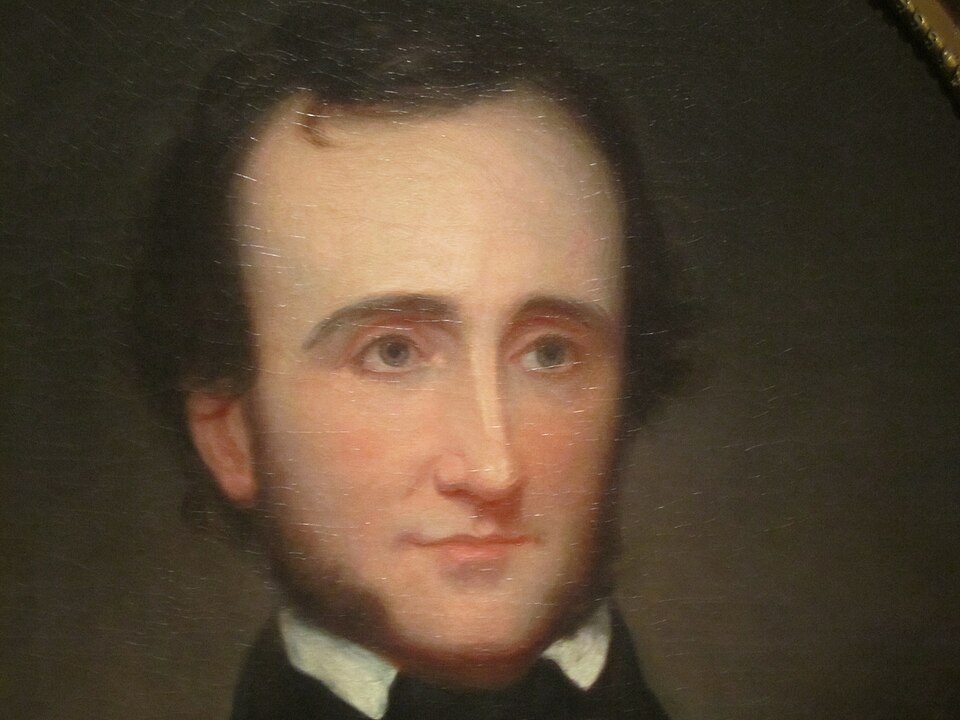
—They say your cat inspired one of your most terrifying stories. Is that true?
The Black Cat, published in 1843. How can I deny that Catterina had something to do with it? She curls up against me, faithful, gentle — and from that tenderness I drew its exact opposite: a man who loves his pet, then mutilates it, then kills it, consumed by what I have called the spirit of perverseness, that inclination to do evil for the sole reason that it is forbidden. I do not invent horror; I track it down at the bottom of the ordinary heart. The same hand that strokes the animal on the shoulder can hold the rope. That is what frightens me, and what I wanted the reader to feel within himself.
The same hand that strokes the animal on the shoulder can hold the rope.
—You edited several magazines. What did this editorial work mean to you?
Bread, first of all. From 1835, in Richmond, I became editor of the Southern Literary Messenger, and I understood that in this America, the magazine makes and unmakes the writer. The penny press, the literary magazines springing up on every street corner — that is our true theater. I published my tales there, but also criticisms so sharp that I was nicknamed the tomahawk. I did not forgive mediocrity. My dream, my obsession, was to found my own magazine, where I would be master. I died, I think, without ever having achieved it — always in the service of another's magazine.
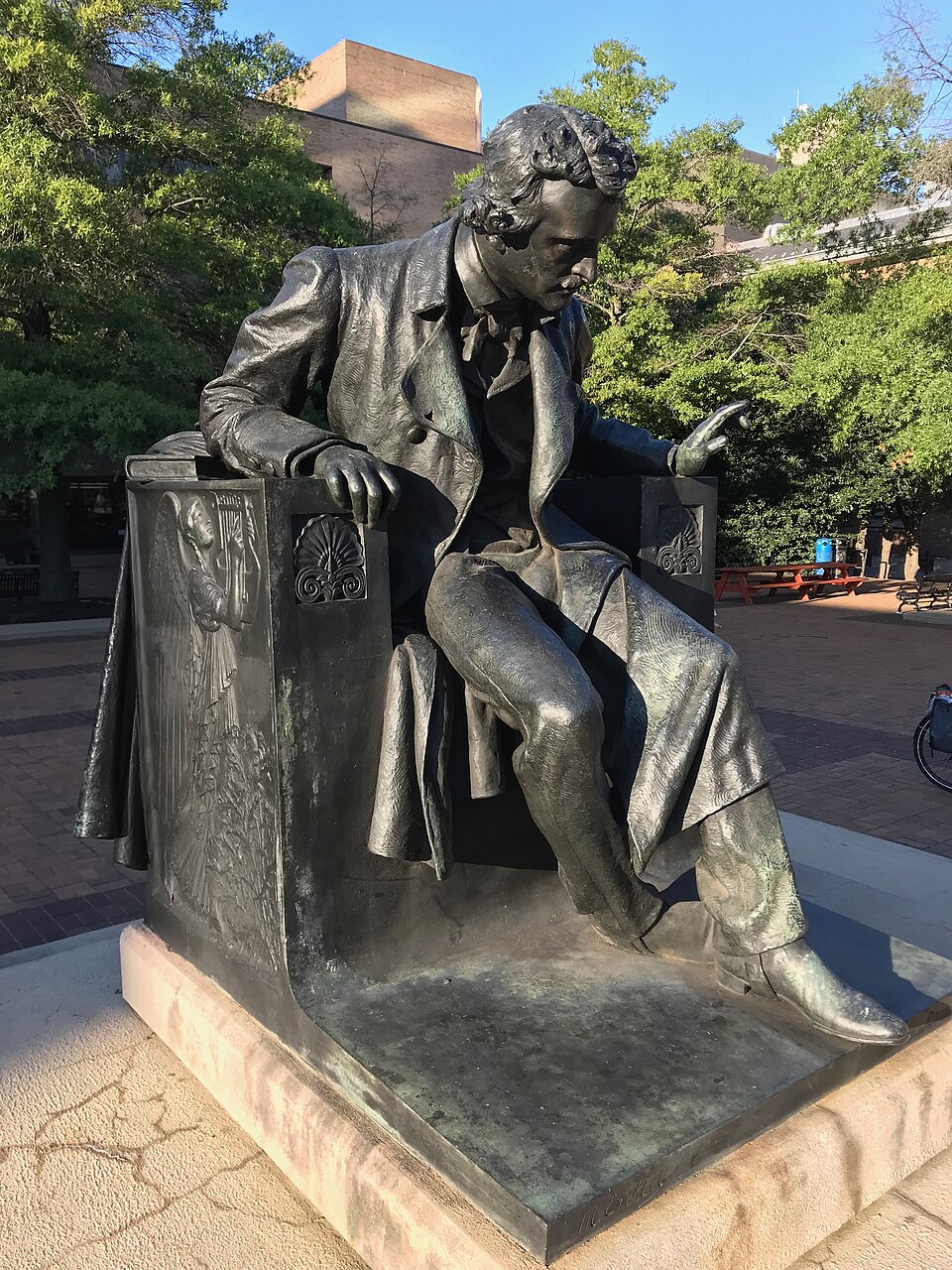
—Did this precariousness accompany you from the start of your adult life?
From the very beginning. In 1827, a young man abandoned by John Allan, my foster father, I wrote a letter from Richmond that I am not ashamed of today: 'I am in the greatest necessity, not having tasted food since yesterday morning. I have no where to sleep at night, but roam about the Streets.' That is where I come from: a boy wandering, belly empty, in a city that does not want him. Later, The Gold-Bug won me a hundred-dollar prize in 1843 — a fortune for me, the largest sum I ever earned from my pen. But ease never lasted. All my life, I wrote as one rows against the current.
All my life, I wrote as one rows against the current.
—You long struggled with alcohol. How would you describe that battle?
A single glass is enough to undo me. It is not the drunkenness of a jovial drinker; it is a nervous fragility that the slightest alcohol turns into an abyss. I once joined temperance societies, I promised, I swore abstinence before witnesses — and I relapsed, again and again, especially after tuberculosis took Virginia from me in 1847. In my time, people spoke much of laudanum, that opium tincture swallowed to soothe pain and sorrow. I will not deny having sought respite there. Pain wants to be silenced, by any means, and that is precisely where a man loses himself.
—If you had to imagine how your own end would be told, what would you say?
Ah, that is a tale I would not have disowned. Imagine: a man found delirious in the streets of Baltimore, in October, dressed in clothes not his own, unable to say what happened to him. He dies four days later without having cleared up the mystery. He is buried in Westminster Cemetery. No detective, not even my Dupin, would unravel that enigma — for perhaps there is no solution, only vertigo. If I could believe that I would still be read a century from now, I would like my death to remain what it was: a final tale without a denouement, faithful to everything I have written.
I would like my death to remain a final tale without a denouement.
This imaginary interview was generated by artificial intelligence from sources documented in Edgar Allan Poe's profile. It dramatises what the figure might have said based on what we know about them, but does not constitute attested historical testimony. For primary sources and factual documentation, refer to the full profile.