Kids interview El Cid
by Charactorium · El Cid · Mythology · 4 min read
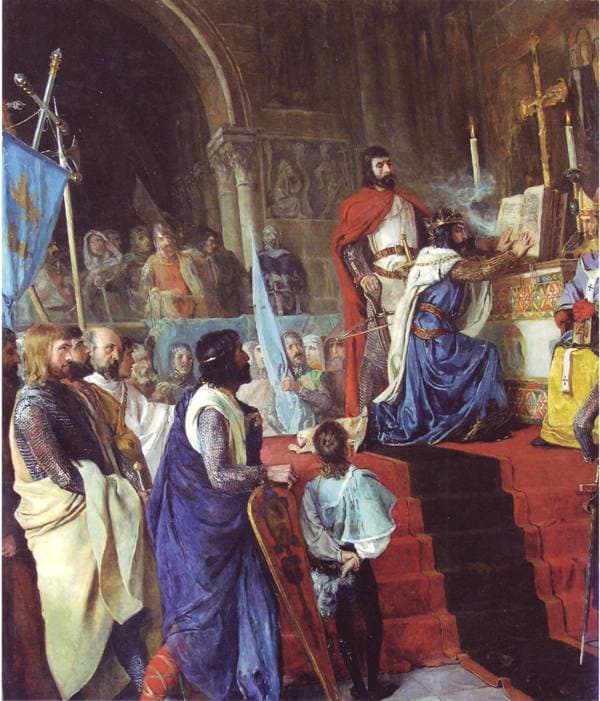
Two young visitors on a school field trip push open the heavy door of a great hall in Valencia. There, standing near his sword, an old knight awaits them with a smile. His name is El Cid, and he has agreed to answer all their questions.
—Is it true that a king banished you from your home? What had you done?
Yes, my child, and it broke my heart. In 1081, I had led a razzia — a quick raid to take cattle and riches — against the lands of the king of Toledo. The problem was that I hadn't asked my king, Alfonso VI, for permission. Furious, he banished me from Castile. Imagine having to leave your home, your family, without knowing where you would sleep the next day. I became a mercenary: a warrior who hires himself out to the highest bidder. I learned a hard lesson that day.
A landless warrior has nothing left but his word and his sword.
—But then, did you really work for a Muslim king?
Yes, and there's no shame in that, you know. For years, I served Al-Muqtadir, the Muslim king of Zaragoza. I defended his city and fought his enemies, whether they were Christians or Muslims. In my time, it wasn't always a war of beliefs. It was mostly lords fighting over lands and cities. Imagine a great game where everyone looks for allies, no matter their god. I was loyal to my honor and to those who trusted me. That's what mattered.
—What was the Reconquista? We hear about it at school.
It was the great movement of my time, child. The Reconquista was when the Christian kingdoms of the north gradually retook the lands held by Muslims in the south of Hispania. In 1085, my king Alfonso VI captured Toledo, a huge victory. But the following year, in 1086, fearsome warriors arrived from North Africa: the Almoravids. At the battle of Sagrajas, they defeated us. Imagine horsemen emerging from the desert, to the sound of enormous drums that made the horses' hearts tremble. War became much harder that day.
Taking a city takes a day; holding it takes a lifetime.
—And did the king who banished you take you back afterwards?
Yes! In 1088, Alfonso VI called me back. When an enemy as strong as the Almoravids threatens, you need your best warriors. You know, it's strange to be friends with a king who once betrayed you. You learn to serve without quite forgetting. I took up my horse and banner again and went back to fight for Castile. But this time, I had an idea in my head: I wanted to conquer a great city just for myself, on the coast. That city was called Valencia.
—How do you take an entire city? Did it take long?
Very long, my child, and it's terrible. To take Valencia in 1094, I laid a siege. That means you surround the city and prevent any food from entering. You wait and wait until the inhabitants have no strength left. Imagine a city locked up, without bread arriving, for months. It's not glorious like a battle on horseback. It's patient and cruel. But the day the gates opened, I entered the most beautiful city on the coast. It was mine.
You don't take a great city by force, but by patience.
—And afterwards, were you the king of Valencia?
Not king, no, but almost! I governed Valencia as an independent prince for five years, until my death. Me, the exiled landless knight, now commanded an entire city by the sea. Soon after, I won the great battle of Cuarte against the Almoravids, right in front of my walls. You see, the little banished warrior had become a lord that kings respected. That's what I want you to remember: what you are at birth does not decide what you will become.
What you are at birth says nothing about what you will become.
—They say your sword had a name. Is that true?
Yes! My sword was called Tizona. In my time, a great sword was like a living companion. You gave it a name, you took care of it like a faithful friend. Tizona shone in all my battles, and poets still speak of it. Imagine a blade so renowned that enemies trembled just knowing it was drawn. A good sword, in my day, was worth a castle. It told who you were. Mine said: here is a man who cannot be made to retreat.
—Is that story true about you being placed dead on your horse?
Ah, you already know that legend! They say that at my death, in 1099, my men tied me upright on my horse, in armor, to present me one last time before the enemy. Seeing the Cid advance, proud, the besiegers supposedly fled in terror. Did it really happen? Tradition says so, and I respect it. What this story tells is that my strength did not end with my death. Imagine a knight so feared that even his lifeless body made an entire army retreat.
A well-earned name continues to fight when the arm rests.
—Why are you called El Cid? That's a strange name.
You're right to find it curious! My real name is Rodrigo Díaz de Vivar. But I was nicknamed El Cid, and this word comes from the Arabic as-sayyid, which means 'the Lord'. You see, even my nickname tells you about my world: a country where Christians and Muslims lived side by side, exchanging words, objects, ideas. A Castilian knight bearing an Arabic name was not a contradiction in our time. It was simply the Hispania of my day, mixed and talkative.
—And how is it that people still talk about you today?
Thanks to a poem, my child! It's called the Cantar de Mio Cid, written shortly after my death. It is one of the oldest great works in the Castilian language. The jongleurs — artists who sang from town to town — recited my exploits in the evening, before the fire. Imagine a time without books for everyone: stories traveled by voice, from mouth to ear. That is how I passed from man to legend. A warrior is not remembered for his victories, but for the stories sung about him.
You survive not by your battles, but by the songs made about them.
Read further
This imaginary interview was generated by artificial intelligence from sources documented in El Cid's profile. It dramatises what the figure might have said based on what we know about them, but does not constitute attested historical testimony. For primary sources and factual documentation, refer to the full profile.