Imaginary interview with El Cid
by Charactorium · El Cid · Mythology · 5 min read
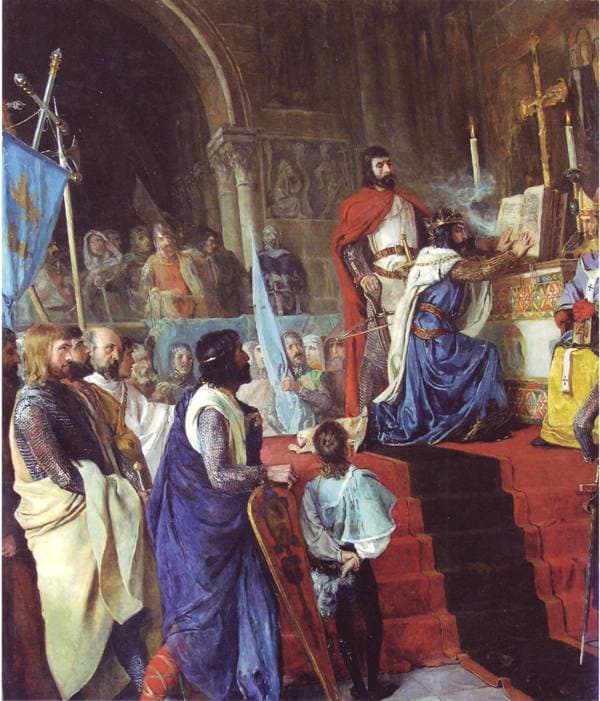
Valencia, the year 1097. Under the vaults of a palace wrested from the Almoravids, a man with a face tanned by twenty years of campaigns receives the interviewer between war councils. Tizona rests against the wall, and behind the arrow slits, the Mediterranean port murmurs its commerce. Rodrigo Díaz de Vivar agrees to speak of exile, of the blade, and of the Arabic name he was given.
—They say everything changed one day in 1081. What happened that a knight of the king found himself on the road?
I had led a raid on the lands of the taifa of Toledo without asking permission from Alphonse VI. The king saw it as insolence, and perhaps he was right: a mercenary does not ask, he takes, and I still had blood too hot for a man kept on a leash. Exile drove me from Castile as one drives away a dog, but a dog knows where to sniff out a need for fangs. I understood that morning that my sword was worth more than the favor of a prince who could take it away with a word.
My sword was worth more than the favor of a prince who could take it away with a word.
—You then served a Muslim lord, Al-Muqtadir of Zaragoza. How does a champion of Christendom justify such an alliance?
Justify? You sound like a cleric. In Zaragoza, I fought for nearly ten years for the taifa king Al-Muqtadir, and mostly against other Muslim princes torn among themselves. Do you think the banners of Hispania are so simple to read — on one side the crescent, on the other the cross? I was paid in gold and respect, and I gave in return what I know how to give: victory. A warrior without a lord is nothing; but a warrior who chooses his lord according to his honor, that is what exile made of me.
"Do you think the banners of Hispania are so simple to read?"
—Yet you also fought for Alphonse VI, at Sagrajas in 1086. How does one go from one camp to the other without denying oneself?
In the year 1086, the Almoravids crossed the strait, coming from Africa with a faith as hard as their desert, and everything changed. Those people did not negotiate, did not ally: they wanted to erase. At Sagrajas, I took my place again alongside the Christian kings, not out of sudden devotion, but because a man recognizes when the wind becomes a storm. The Reconquista, you say? I saw lands, fortresses, men to protect. The vassal serves his suzerain; but when fire comes, even the exile returns to line up behind the strongest wall.
—Would you say the wars of your time were wars of religion?
They will tell it that way, I am sure, and the minstrels will make me a saint on horseback. The truth is muddier. I feasted with emirs, I swore homage to lords of both faiths, I collected tribute from cities that others said were enemies of God. My very name, El Cid, comes from the Arabic as-sayyid, 'the lord' — it was my former adversaries who gave it to me, out of respect. A land where the victor bears the title bestowed by the vanquished is not a land of holy war. It is a land of power, and power has no religion.
It was my former adversaries who gave me my name, out of respect.
—Let's talk about Valencia, where we are. What does this conquest of 1094 mean to you?
Look at these walls. Valencia, the year 1094, after a siege so long that the very stones seemed starved. When the city surrendered, I no longer entered as the mercenary of another: I entered as lord, master of a state that owed its existence only to my blade. Neither Alphonse, nor Zaragoza, nor the emir — I. For five years I governed this Mediterranean city as a prince governs his own, raising tribute, dispensing justice, keeping the port open to trade. The exile from Castile had carved out a kingdom with what he had: his patience and his steel.
The exile had carved out a kingdom with what he had: his patience and his steel.
—That same year, you crushed a much larger army at Cuarte. How do you explain it?
At Cuarte, near Valencia, the Almoravids came in droves to take back what I had taken. Numbers are an intoxication: they make the enemy deaf and slow. I hid my horsemen, I feigned, I waited — war is a siege even in open country, you starve the adversary's pride before striking. When my cavalry fell on their flank, they were no longer fighting, they were fleeing. They will say I was invincible. I tell you: I was only less eager than others to die, and better on a horse.
—Your sword, Tizona, is almost as famous as you. What does a blade represent for a man like you?
A blade is a biography you carry at your side. Tizona has drunk at Zaragoza, at Valencia, at Cuarte; it knows my story better than the clerics who will write it on parchment. A mercenary can lose his land, his king, even his name — he loses his sword only with his hand. The minstrels will sing that it frightened the enemy before being drawn, and they will not be entirely wrong: a reputation sometimes cuts more throats than iron. But make no mistake, it is heavy, it chips, it demands sharpening. Like the man who wields it.
A blade is a biography you carry at your side.
—Poems are already being composed about you. How do you feel about being sung about in your own lifetime?
The minstrels come in the evening, in the great hall, and tell my deeds while I share bread with my men-at-arms. It is a strange thing to hear your own life become a ballad, distorted, magnified, embellished. If I could imagine that I would still be read a century from now — this Cantar they already recite — I know they would remember not the man, but the symbol: honor, loyalty, the return to grace. The Rodrigo who sleeps poorly before battles, that one will disappear. The effigy remains. Perhaps it is the fate of any man loved too much: to end up truer in verse than in flesh.
Perhaps it is the fate of any man loved too much: to end up truer in verse than in flesh.
—There is a troubling story: your body, propped up dead on your horse to frighten the enemy. What do you say to that legend?
That is something I can neither confirm nor deny, isn't it — since I would have to be dead for that. But I know my people, and I know Valencia. If the Almoravids tighten the siege and I fall, do you think they will announce the news? They will tie me to my saddle, upright, Tizona in hand, and have me ride through the gates one last time. Fear routs armies that iron cannot touch. May my corpse still serve the defense of my city — there is no finer end for a man who never knew how to rest.
May my corpse still serve the defense of my city.
—And after you? Have you thought about what would become of Valencia and your people?
A man who has known exile does not delude himself with eternity. Valencia is a city held at arm's length, against a tide from Africa that does not ebb. My wife Ximena has the heart of a captain; I know she will hold these walls as long as a hand can hold a banner. But a stronghold without its lord is a fruit waiting to be plucked — I do not deceive myself about that. If the city must fall again, let it at least be said that it was once taken by an exile who started with nothing, and defended to the end by his own. The rest belongs to God and the minstrels.
Read further
This imaginary interview was generated by artificial intelligence from sources documented in El Cid's profile. It dramatises what the figure might have said based on what we know about them, but does not constitute attested historical testimony. For primary sources and factual documentation, refer to the full profile.