Kids interview Elizabeth Anscombe
by Charactorium · Elizabeth Anscombe (1919 — 2001) · Philosophy · 4 min read
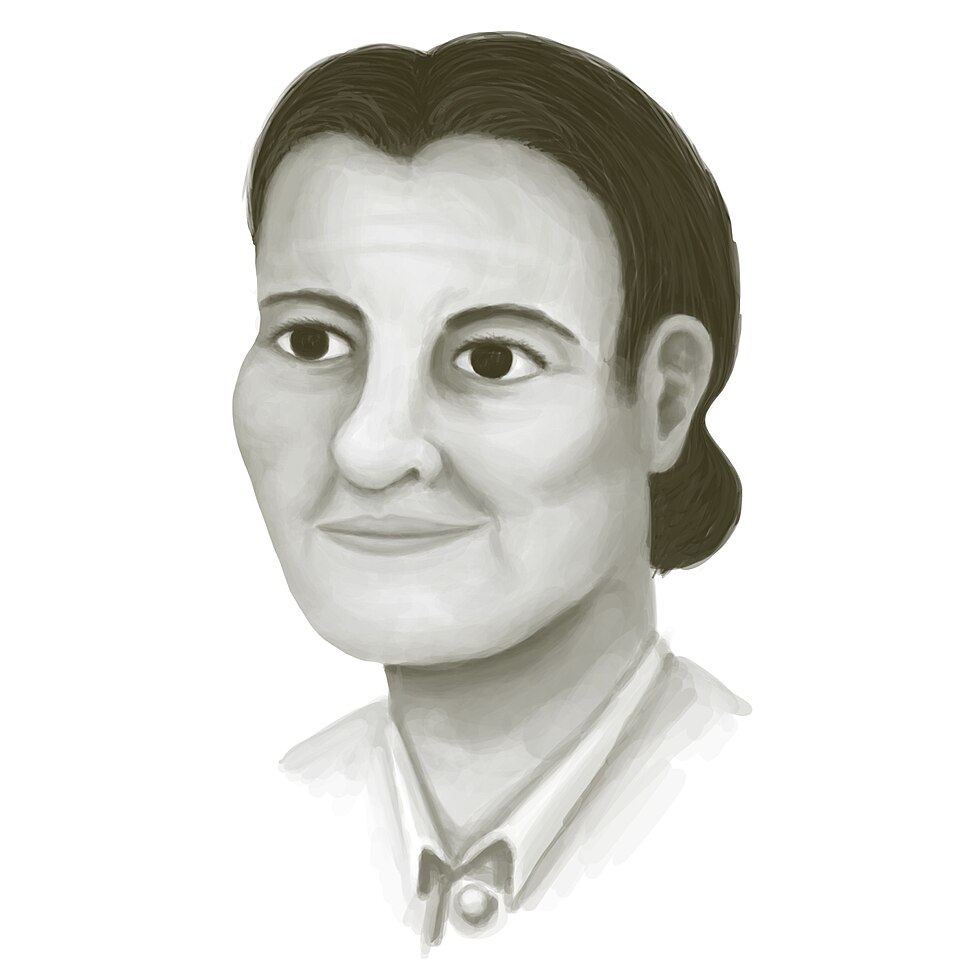
That morning, two twelve-year-old students push open the door of a cluttered office somewhere in Cambridge. An old lady with a monocle is waiting for them, an unlit cigar in her hand. Elizabeth Anscombe motions for them to sit down, and the conversation begins.
—If someone passed you on the street, what would they notice first?
You'd probably see me with a monocle screwed into my eye. And a cigar in my hand, even during my lectures! Picture a lady smoking like an old sea captain, at a time when that was simply not done for a woman. It surprised a lot of people. But I didn't care. I wore dark, simple clothes, never fashionable. You know, I wasn't trying to please. I was trying to think straight. The rest — pretty dresses, polite drawing-room manners — didn't interest me for a second. People found me blunt, sometimes a bit rude. That was true.
—How old were you when you met Wittgenstein?
I was just over twenty. It was in 1942, at Cambridge. I went to his seminars — you know, those tiny classes where you argue every step. Picture a silent room, a man thinking out loud, and long silences where no one dares to breathe. He didn't teach like other professors. He searched in front of us, live, as if he were thinking for the first time. I was fascinated. And he, usually so suspicious, trusted me. That's rare, coming from a master. We became friends. That friendship changed my whole life.
—Is it true he entrusted you with all his papers when he died?
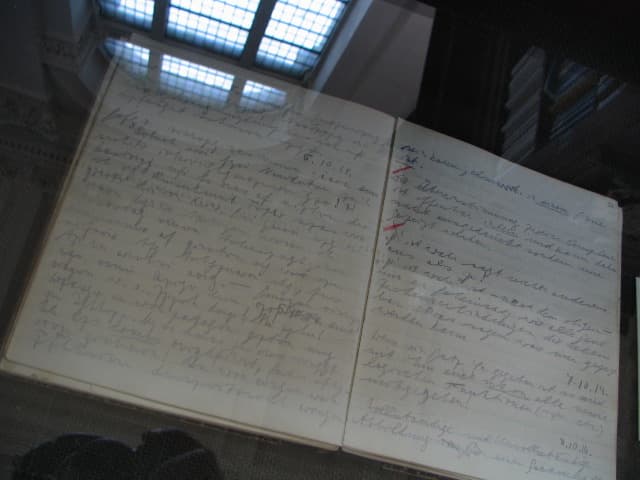
Yes. When he died, in 1951, he chose me to look after his writings. They call that being an literary executor: the person responsible for carrying out a deceased person's last wishes. Except here it wasn't about money. It was whole notebooks, covered in tight handwriting, never published. Imagine piles of notebooks you have to decipher almost word by word. I spent years on it. I translated his great book, the Philosophical Investigations, published in 1953, into English. Real drudgery. But without it, the world would never have read his thought.
—What's that story about voting against a president?
Ah, that! In 1958, my university, Oxford, wanted to give an honorary degree to Harry Truman, the American president. The same man who had ordered the dropping of the atomic bomb on Hiroshima. Tens of thousands of civilians — families, children — gone in an instant. And we were going to applaud him? I said no. Almost alone against everyone. I wrote a little piece, Mr Truman's Degree, to explain why. Deliberately killing innocent people to win a war is not self-defence. It is murder. I could not honour that.
Deliberately killing innocent people to win a war is not self-defence; it is murder.
—Weren't you afraid of falling out with everyone?
Of course I was. Imagine: you raise your hand, all alone, in a big hall full of important people looking at you sideways. It's intimidating. But there's an old idea, the doctrine of just war: you may defend yourself, yes, but never by deliberately targeting innocent people. Some acts are wrong in themselves, no matter what, regardless of the outcome. We call them intrinsically evil acts. For me, crushing entire cities of civilians was one of them. So I preferred to displease all of Oxford rather than keep silent and betray my conscience.
—Is it true you invented a word?
Yes, a rather scholarly word: consequentialism. I coined it in 1958, in an article called Modern Moral Philosophy. Consequentialism is the idea that an action is good or bad only according to its results. If it ends well, then anything is allowed to achieve it. You see the danger? With that reasoning, you could justify anything — even killing an innocent — as long as it 'works out'. I found that false and dangerous. I gave it a name so that we could better criticize it. Naming an idea is already beginning to fight it.
Naming an idea is already beginning to fight it.
—So how do you know what is right?
You ask the big question! In my time, many scholars talked about 'duty' and 'moral obligation' as rules fallen from heaven. I found those words a bit empty, uprooted. I thought we needed to go back to Aristotle, a very ancient Greek philosopher. He didn't ask 'What rule should I follow?' but 'What kind of person do you want to become?' We call that virtue ethics: courage, honesty, justice are cultivated like a garden, day after day. You don't become a good person all at once. You become it by habit, by small repeated actions. That's what seemed true to me.
—They say your religion meant a lot to you?
Enormously. I was Catholic, and deeply so. I converted young, as a student at Somerville College, Oxford. Every morning I went to mass before starting work. I always kept a rosary on me — you know, that little string of beads you pray with. For me, believing and thinking were not two separate things. My faith nourished my philosophy, and my philosophy illuminated my faith. The two walked together, hand in hand. Imagine a tree: prayer was the roots; my books were the branches. Without roots, no branches.
—You defended a papal decision even when it got you into trouble?
Yes. In 1968, the pope issued a text, Humanae Vitae, which reaffirmed the Catholic ban on certain ways of limiting births. Many people were furious, even among Catholics. And I defended it publicly. I was criticized very harshly. But you know, I had seven children, and a philosopher husband too, Peter Geach. I wanted my life and my ideas to say exactly the same thing. It would be too easy to think one thing and live another, in secret. I preferred to remain consistent, even when it cost me dearly.
—If we had to remember one thing about you, what would it be?
That thinking is a serious matter. It's not word games to amuse scholars. When you decide to do something, you always have a reason — not just a cause that pushes you like a marble. Understanding that difference is understanding what it means to act. That's the whole subject of my book Intention, published in 1957. And remember this, my child: never be afraid to be the only one saying no when you feel it's right. I smoked my cigars, I said what I thought, and I regretted neither.
Never be afraid to be the only one saying no when you feel it's right.
This imaginary interview was generated by artificial intelligence from sources documented in Elizabeth Anscombe's profile. It dramatises what the figure might have said based on what we know about them, but does not constitute attested historical testimony. For primary sources and factual documentation, refer to the full profile.