Imaginary interview with Elizabeth Anscombe
by Charactorium · Elizabeth Anscombe (1919 — 2001) · Philosophy · 6 min read
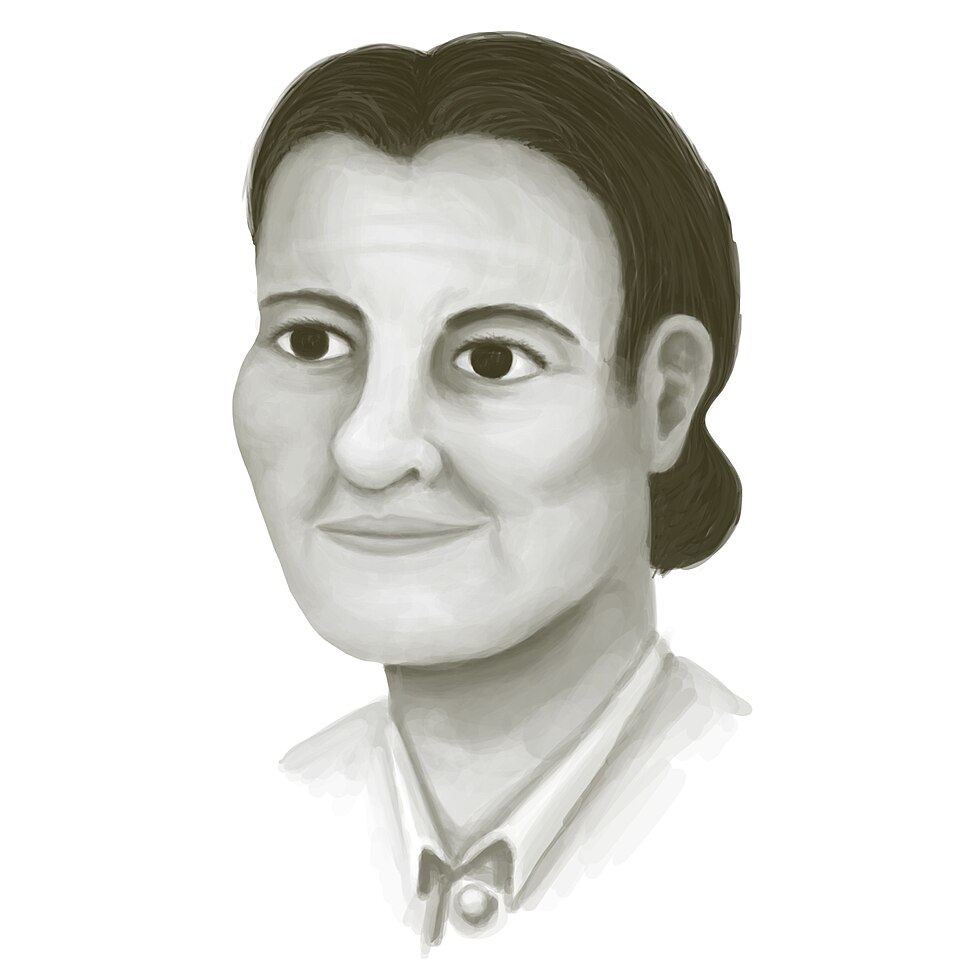
Cambridge, an autumn afternoon in 1985. In a cluttered office smelling of stale tobacco, a woman with a monocle welcomes us, a half-smoked cigar between her fingers. She speaks little but strikes home: every sentence of Elizabeth Anscombe seems cut with a knife into the very stuff of thought.
—You are often presented as the philosopher who put intention back at the center of everything. How did you come to this subject?
It all started from a child's question, actually: why did you do that? When I wrote Intention, in 1957, I realized that people constantly confused two things. I am asked why my arm went up, and I can answer with a cause — a nerve, a reflex. But if I am asked why I raised my arm, something quite different is expected. As I wrote then, « the question 'why?' is not a request for causes; it is a request for reasons ». Grasping this difference is grasping what separates a man who acts from a stone that falls. All moral responsibility lies in that gap, and it is surprising that it was neglected for so long.
What separates a man who acts from a stone that falls lies in a single question: why?
—This distinction between reason and cause, how did it change things for the philosophers of your time?
You see, my colleagues at Oxford and Cambridge wanted to reduce everything to mechanisms, as if describing the workings of a watch sufficed to tell the time. Yet when I act intentionally, my own action is known to me without observation: I do not need to watch myself act to know what I am doing. That seems trivial and it is a seismic shift. Later, in my inaugural lecture on causality, in 1971, I pushed further: it is taken for granted that every cause entails a law-like necessity, and that is false. Causality is not necessity. Once you have seen that, many inherited certainties from Hume begin to tremble, and you breathe a little easier.
—You coined a word destined for great success: 'consequentialism'. In what state of mind did you write it?
A state of annoyance, I confess. In 1958 I published a short article, Modern Moral Philosophy, where I argued something scandalous for the time: that we should throw overboard all the vocabulary of 'moral obligation' until we have a serious psychology to support it. I named consequentialism this mania of judging an act solely by its results. It has a fatal flaw: it erases the idea that there are acts one does not do, ever, whatever the benefit. My remedy was not new, I confess — we had to return to Aristotle, to a virtue ethics, to the idea that a good life is recognized by dispositions of character and not by a calculation of gains.
Consequentialism erases the idea that there are acts one never does, whatever the benefit.
—Why do you hold so strongly to the idea that an act can be absolutely forbidden, no matter what?
Because without it, everything becomes negotiable, and the man who negotiates everything ends up allowing everything. There are things a right-minded person refuses even to consider: deliberately killing an innocent is one. That is what tradition calls an intrinsically wrong act. The consequentialist will always tell you: 'that depends on the number of lives saved'. And he is right in his way, that is precisely the trap — his logic is impeccable once you have accepted his premise. But the premise is corrupt. When I taught this at the blackboard, before students eager to contradict me, I told them: first show me why you believe no act is forbidden in itself, and then we will discuss consequences.
—Let us come to the episode that made you famous far beyond philosophy: your opposition to Harry Truman's honorary doctorate. What happened?
Oxford wanted, in 1956, to drape in ermine the man who had ordered Hiroshima and Nagasaki. This was presented as diplomatic courtesy. I saw it as obscene complacency. So I voted against, almost alone, and then wrote a pamphlet, Mr Truman's Degree. I wrote what I thought without mincing words: « Mr. Truman's decision to use the atom bomb is objectively the decision of a mass murderer. » Some found the word excessive. But calling things by their right name is not exaggerating. Choosing to kill innocent civilians as a means to one's ends is murder, and murder does not cease to be murder because a state deems it necessary. They were honoring a man; I was looking at the dead.
They were honoring a man; I was looking at the dead.
—Many after the war considered these bombings regrettable but inevitable. In the name of what did you reject this argument?
In the name of something very ancient: the doctrine of just war, as thought by Saint Augustine and Saint Thomas. It sets a boundary that neither victory nor fear authorizes crossing: one never targets the innocent. An army, an arsenal, a war factory, yes. But an entire city, its children, its sick, chosen precisely to terrorize the enemy? That is the innocent taken as a target, hence murder. My contemporaries answered that the war ended faster. Perhaps. That changes nothing: the good one hopes for does not wash away the evil one commits. I put that in black and white in my pamphlet, knowing it would earn me enmities. I already had many; one more hardly mattered.
—Wittgenstein entrusted you with his manuscripts. How did you experience such a burden?
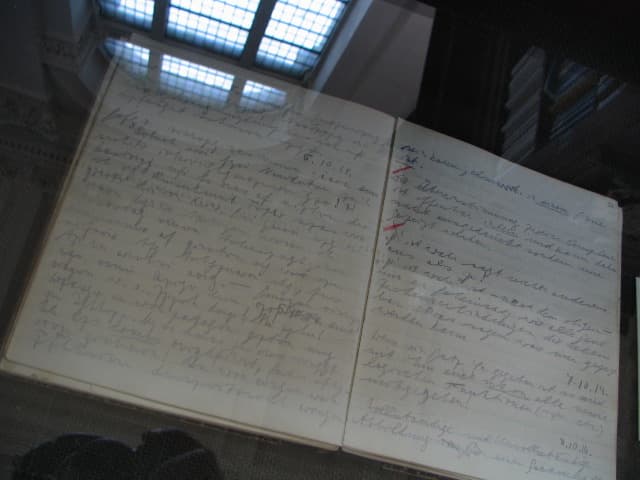
As an overwhelming honor. I had attended his seminars at Cambridge from 1942, and he trusted very few. At his death, in 1951, he made me one of his literary executors. Imagine crates of notebooks covered in dense handwriting, in German, where thought corrects, erases, and starts over. I spent years bent over those notebooks, deciphering, translating. In 1953, I gave the English-speaking world the Philosophical Investigations — his philosophy of ordinary language, finally readable. This was not a work of glory but of a servant: one had to efface oneself entirely so that his voice could pass through without mine distorting it. The hardest part, believe me, is not thinking; it is keeping silent to let another speak.
The hardest part is not thinking; it is keeping silent to let another speak.
—You also wrote an introduction to his Tractatus. What did you hope to convey to your readers?
That this terrible little book, the Tractatus logico-philosophicus, was not a logician's game but an attempt to delimit what can be spoken of and what must remain in silence. In 1959, I published my An Introduction to Wittgenstein's Tractatus because I saw brilliant students drowning in it for lack of a guide. They read it as a treatise on pure logic, forgetting that at bottom it is about ethics, about the mystical, precisely through all it refuses to say. My role was to hold the lamp in that narrow corridor. Wittgenstein himself distrusted commentators; I strove to be one who illuminates without chattering. All my work as editor and interpreter lay in that restraint.
—You are described with a monocle, a cigar, a feared frankness. Was this look a statement?
An indifference, rather. I never wasted a minute wondering whether a woman could wear a monocle or smoke a cigar; I did it, that's all, and let conventions sort themselves out. People attributed a harshness to me in class; I would rather say I hated lazy argument and let it be known. A sloppy reasoning has no sex, no rank, it only deserves to be dismantled. My students found me intimidating; some, I hope, understood that this exactingness was a form of respect. You only rough up those you take seriously. The rest — fashion, manners — always seemed to me an expenditure of attention that philosophy could put to better use.
You only rough up those you take seriously.
—Your Catholic faith ran through your entire work, even to publicly defending the encyclical Humanae Vitae. How did you hold together the philosopher and the believer?
Seamlessly, I hope. I converted at Oxford, young, and began my days with Mass until the end. For me, reflecting on intention, on the act one chooses, or praying the rosary, were not two worlds. When Pope Paul VI published Humanae Vitae in 1968, I defended it, even against Catholics who thought me backward — the same analysis of the human act that had served me against Truman applied here. People objected my life: mother of seven, married to philosopher Peter Geach, in a noisy house where arguments flew between meals. But that was precisely the coherence I sought: that a life not contradict what the mind holds true. A philosophy one is not willing to live is mere chatter.
A philosophy one is not willing to live is mere chatter.
This imaginary interview was generated by artificial intelligence from sources documented in Elizabeth Anscombe's profile. It dramatises what the figure might have said based on what we know about them, but does not constitute attested historical testimony. For primary sources and factual documentation, refer to the full profile.