Imaginary dialogue between Thomas More and Erasmus
by Charactorium · Erasmus (1466 — 1536) · Philosophy · 5 min read
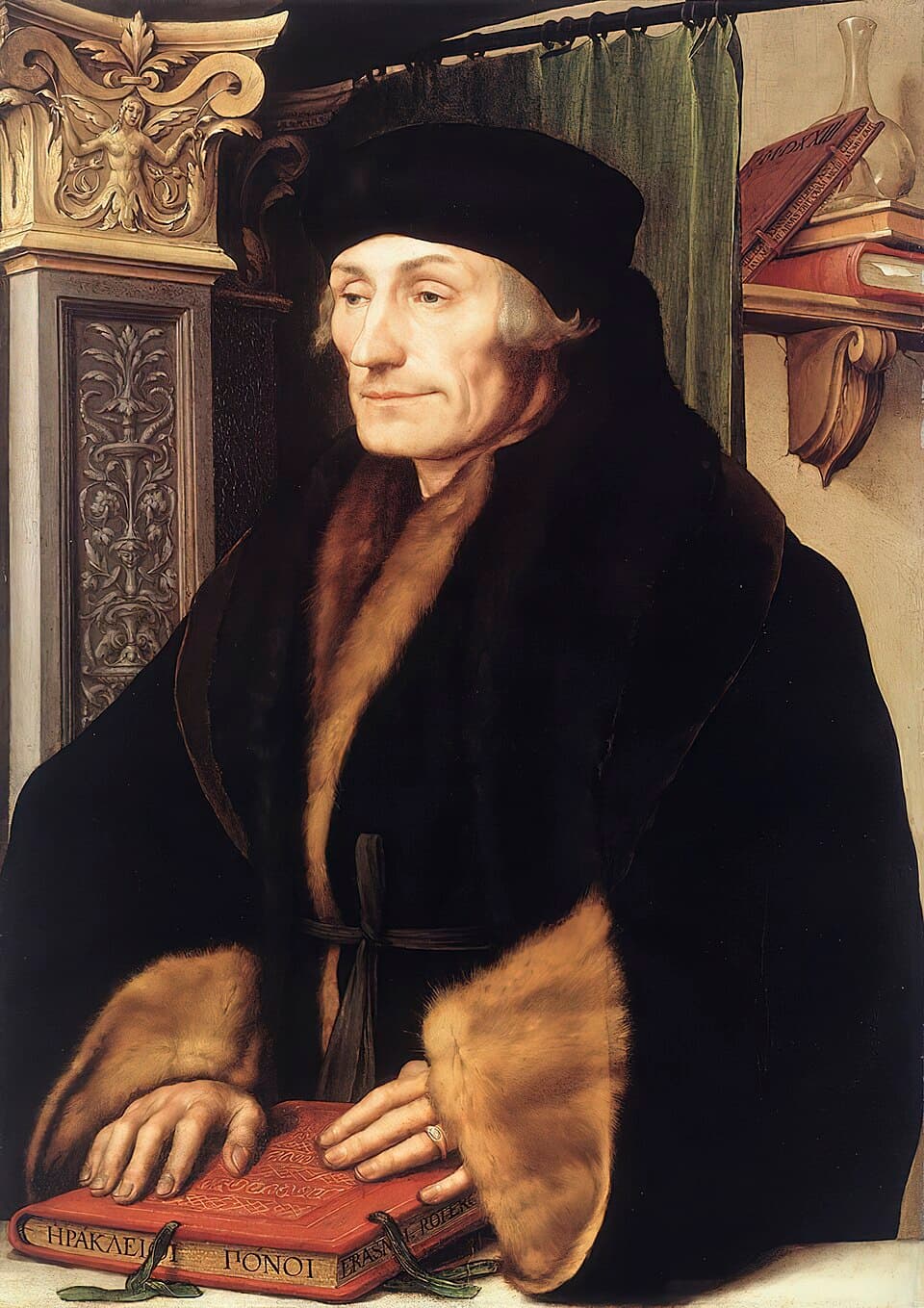
It is in the great house of Bucklersbury, in London, that I find my friend Erasmus in this summer of 1509. The fine rain patters on the windows and the smell of fresh ink still lingers near the desk where he has just set down his pen. We have known each other for ten years now, since that first English stay when we laughed together at fools and pedants. I come that day with an old friend's curiosity: to understand the man hidden behind the pages I see him blackening under my own roof.
—My dear Erasmus, for eight days now you have been writing feverishly at my house, ill and bedridden. What is it that keeps your pen so busy?
You who have taken me in under your roof, Thomas, you know how my kidneys have been paining me since the journey from Italy. Confined to this bed, without my books left behind on the road, I had only my mind to amuse me. So I let Folly herself speak, praising herself and unmasking human follies. It is a game, a convalescent's pastime, but irony carried me further than I intended. In a few days the thing was nearly done. Do not laugh too hard: illness sometimes has more wit than health, and I believe this jest will suit you, who so love to laugh at serious things.
Illness sometimes has more wit than health.
—You know that my name, More, sounds like Moria, folly in Greek. Should I feel targeted by this title, Moriae Encomium?
How could I hold it against you, my friend, when it was your very name that inspired the title? Moriae Encomium, the Praise of Folly — it was only fitting that this wink should come back to you, the wisest man I know and yet the most cheerful. You are the man for all seasons, able to jest amid the most serious affairs. I merely lent my pen to your own humor. That Folly bears your name is no mockery: it is a tribute. For one needs a grain of that folly to remain human among so many who take themselves terribly seriously.
One needs a grain of that folly to remain human among so many who take themselves seriously.
—You, who know Greek better than anyone, tell me: why toil over New Testament manuscripts rather than over more pleasant letters?
Because, Thomas, one cannot build true piety on a corrupt text. The Vulgate of Saint Jerome, venerable as it is, drags along a thousand copyist errors accumulated over the centuries. I want to go back to the source, compare the ancient Greek manuscripts, restore Christ's own words before they were muddled. It is philology applied to Holy Scripture: a patient, almost goldsmith's work on every word. You have seen me collating those sheets until my eyes wear out. I know some will cry scandal at touching the sacred text. But correcting is not profaning: it is restoring divine speech to its first purity.
Correcting is not profaning: it is restoring divine speech to its first purity.
—And this edition, who will bear the risk before the printer and the Church? Do you already have a workshop worthy of the enterprise in mind?
I hold in my heart the workshop of Basel, where the printer Froben works with a care I have found nowhere else. There they respect Greek, they correct proofs with me, they do not sacrifice scholarship to haste. Printing, you see, is the greatest gift God has given our century: what I correct once will be read from Krakow to Seville. But this gift can also spread error as quickly as truth. That is why I watch over every sheet like a mother over her infant. You may find me too scrupulous. But one poorly rendered Greek word, and the faith of a thousand readers is led astray.
Printing is the greatest gift God has given our century.
—Every morning at my house, a messenger brings you letters from all over Europe. How do you bear the weight of such a vast correspondence?
It is my joy as much as my burden, Thomas. I answer princes, theologians, unknown young students, from morning till night, until my wrist aches. My goose quill rarely rests. But through these letters sealed with wax, I weave something I believe in more than any kingdom: a community of scholars across borders and wars, a Republic of Letters where only intellect and friendship count. You yourself are one of its dearest citizens. As long as learned men speak to one another thus, from one end of the world to the other, I will never quite despair of humanity.
A Republic of Letters where only intellect and friendship count.
—Is it not strange, my friend, to know that you are more present through your letters in a hundred houses than in your own, you who have no home?
You touch a sensitive point, Thomas. Yes, I live in others' homes — in yours today, at Froben's tomorrow, in some college after. I have never owned a roof that was mine. But perhaps this is my true homeland: not a country, but this network of learned friendships where I am at home everywhere. A well-turned letter crosses the Alps faster than I could on my tired feet. So I am at a thousand hearths without moving from my desk. A free man belongs to no city; he belongs to all who love good letters.
I have no homeland except this network of friendships where I am at home everywhere.
—I have seen you refuse fish at my table and shiver under two cloaks in the middle of summer. Does your poor body tyrannize you so much?
Alas, my host, you have observed me well. I have the most delicate stomach in Christendom: fish turns my stomach, yet monastic fasting condemned me to it. I had to obtain from the Holy Father a dispensation to eat meat and lighten my habit, otherwise I would have died of Lent rather than sin. Cold pierces my bones even before your hearth, hence this cap you rarely see me without. My mind would run across Europe, but this frail body holds me back like a restive horse. So I work in the morning, in the hours when I feel least ill, and give thanks for pain-free days.
My mind would run across Europe, but this frail body holds me back like a restive horse.
—This dispensation for meat and clothing, some in the cloister will see it as a favor of indulgence. How do you answer those who murmur?
Let them murmur, Thomas! I have never believed that God rejoiced to see me vomit a herring to please Him. True religion lies not in what one eats or in the color of a robe, but in charity and purity of heart. Those who make abstinence the supreme virtue confuse the shell with the fruit. I took the habit young, almost against my will, driven by poverty and hasty guardians. If a dispensation allows me to serve letters and piety instead of languishing sick, I consider it a blessing. Holiness is not weighed by the number of fish swallowed.
Holiness is not weighed by the number of fish swallowed.
—The Christian world seems about to split into two accusing camps. You who advocate concord, where will you stand if the rupture comes?
In the middle, Thomas, and I already know what it costs. When passions flare, the one who calls for moderation is hated by both sides: too bold for some, too lukewarm for others. Yet I believe that all of Christ's religion comes down to few things: peace, concord, and freedom of judgment on the rest. Let us define as few dogmas as possible, and leave each to his own judgment. I neither want to light the fire nor bless it. My weapon remains the pen, not the pamphlet that sets peoples against each other. They will reproach me for my caution; I call it, myself, fidelity to the Gospel of peace.
He who calls for moderation is hated by both sides.
—If you ever had to take up the pen against an over-ardent reformer, on what ground would you choose to do battle?
On the ground of human freedom, Thomas. If one teaches that the human will can do nothing, that everything is already decided by a blind grace, then what is the point of effort, virtue, the education to which I have devoted my life? I prefer the opinion of those who attribute something to free will, but as much as possible to grace. That, I believe, is where the real quarrel would lie. Not out of love for combat — God knows I hate dispute — but because a man deprived of all choice is no more than a led beast. I will not leave the Church of my fathers; but I will defend to the end that man remains responsible before God.
A man deprived of all choice is no more than a led beast.

This imaginary interview was generated by artificial intelligence from sources documented in Erasmus's profile. It dramatises what the figure might have said based on what we know about them, but does not constitute attested historical testimony. For primary sources and factual documentation, refer to the full profile.