Kids interview Erasmus
by Charactorium · Erasmus (1466 — 1536) · Philosophy · 5 min read
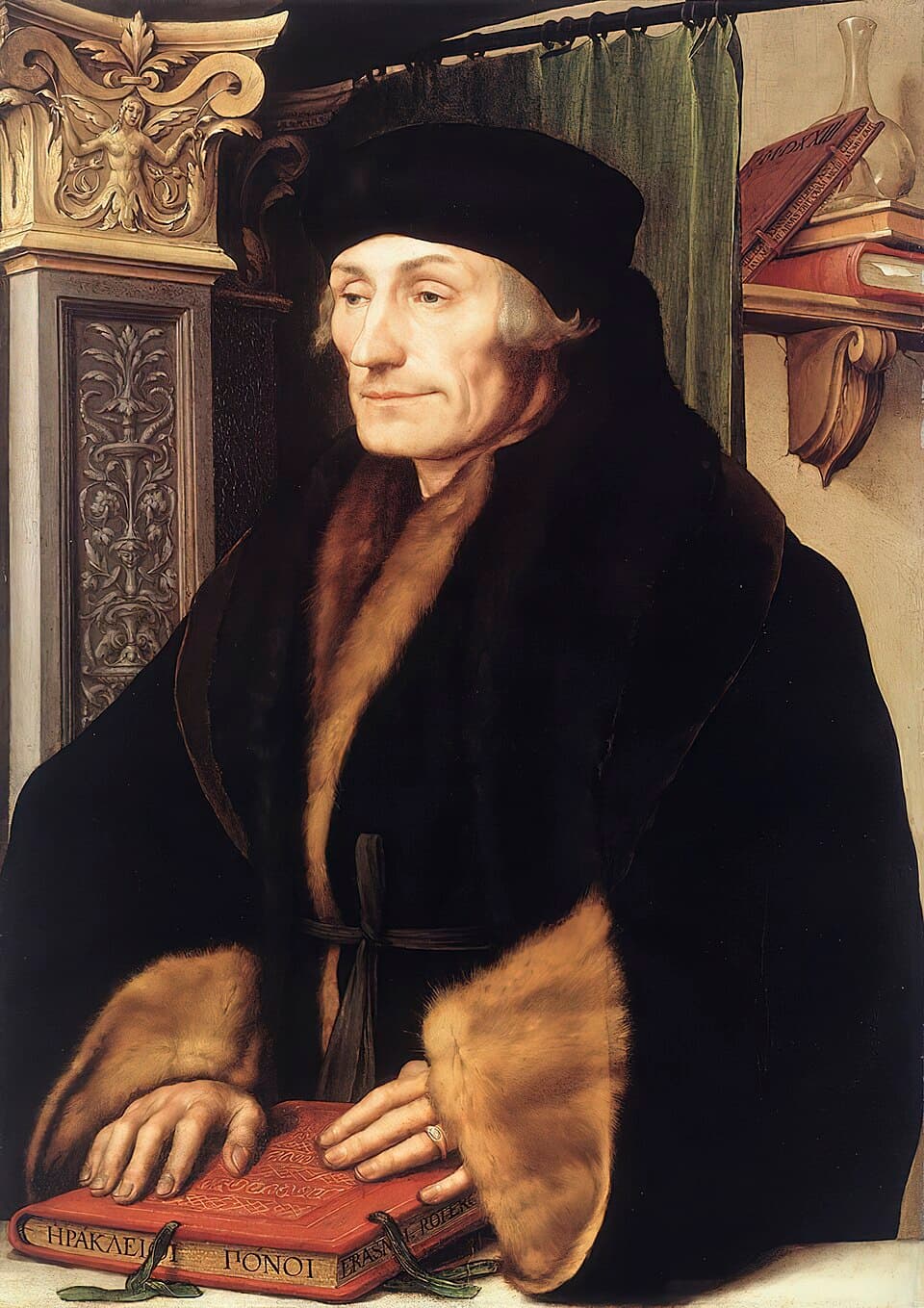
Two twelve-year-old visitors, on a school trip, have an appointment with an old scholar in a black robe, in a Basel house full of books. The fire crackles, a quill dries in the inkwell. The man smiles: he likes it when children ask questions.
—Is it true you wrote your most famous book in just one week?
Yes, my child, and I still laugh thinking about it. I had just arrived from a journey, tired, my back broken by the horses. I was staying with my English friend Thomas More, in 1509. To amuse myself, in about eight days I wrote the Praise of Folly. Imagine: I let Folly herself speak, and it is she who boasts! The Latin title, Moriae Encomium, hides a little wordplay on my friend More's name. It was my way of winking at him. We mocked kings, monks, everyone — laughing, but to say serious things.
I let Folly speak, and it is she who tells the truths.
—Were you really friends with Thomas More? What was it like?
Ah, he was a precious friend, like few in a lifetime. When I arrived in England around 1499, I met him and John Colet. With More, we laughed a lot, talked for hours, wrote to each other constantly. You know, I kept a huge correspondence all my life — over three thousand letters preserved. Back then, no quick messages: you wrote on paper, folded it, sealed it with a bit of hot wax, and a messenger left on horseback for days. Receiving a letter from More was like finding his voice in the silence.
A friend to write to is a voice that crosses borders.
—Why did you want to redo the Bible when it already existed?
Good question, and it is cleverer than it looks! The Bible they read, the Vulgate, was a Latin translation by Saint Jerome, a thousand years earlier. But through repeated hand-copying, errors had crept in. I wanted to go back to the source. So I searched for old Greek manuscripts of the New Testament, compared them word by word. This patient work is called philology — the art of finding the most accurate text. In 1516, I published my Novum Instrumentum. Imagine correcting a book no one had dared touch for a thousand years!
To understand a text, you must go back to its source.
—How did you compare old books without making mistakes?
With enormous patience, my child, and many candles burned! I spread before me several Greek manuscripts, handwritten, sometimes damaged. I read a sentence here, the same there, and I searched: which one told the truth? I had known Greek and Latin since school. I spent my mornings bent over my desk, a cap on my head against the cold. Then I took my sheets to my printer Froben, in Basel, so he could check the proofs. Without printing, my work would have remained a single copy. Thanks to it, thousands of people could read the same corrected text.
An error copied a thousand times remains an error: you must dare to correct it.
—When everyone was arguing about religion, why didn't you choose a side?
You touch on the greatest sorrow of my life. When Martin Luther revolted against the Church in 1517, many wanted me to follow him. Others wanted me to condemn him. I refused to howl with the wolves. I found some things right in Luther, but I did not want to tear the Church in two. So I was hated by both sides: too bold for Rome, too lukewarm for the reformers. You know, staying in the middle when everyone pushes you to choose is sometimes braver than shouting the loudest. But it is also very lonely.
Refusing to howl with the wolves means being alone, but being yourself.
—Were you friends with Luther, and then you fell out? What happened?
We respected each other, but we thought differently on a deep question. Luther said that man decides nothing: everything is already willed by God. I believed we keep a part of freedom, a small flame to choose good. In 1524, I wrote De libero arbitrio, “On Free Will,” to say it clearly. That was the break. Imagine two friends walking together who, at a crossroads, take two opposite roads without being able to meet. It pained me. But I held to this idea: you are not a puppet, my child. A part of what you become depends on you.
You are not a puppet: a part of what you become depends on you.
—Is it true you hated fish? What did you eat then?
Ha! You have been well informed. I had a weak stomach, and fish made me sick. The problem is, in my time, on fast days you had to eat fish and not meat. For me, it was torture! I finally obtained a dispensation from the pope, a special permission, to eat meat without sinning. I liked white bread, a little Burgundy wine cut with water, simple but well-made dishes. I also complained about the cold and the bad inns during my travels. A scholar, you see, is also a finicky stomach and frozen feet.
A great scholar is also a weak stomach and frozen feet.
—What was your morning like, when you woke up?
I got up very early, often before dawn. I loved those quiet hours when the house is still asleep. I said a short prayer, then I sat at my desk, a black cap on my head, several layers of clothes on my back against the biting cold. I had a light meal: bread, a little wine. And I wrote, or corrected manuscripts, for hours. Imagine a room with no street noise, just the scratching of my goose quill on paper and the crackling of the fire. I never owned a house of my own: I stayed with friends or printers.
The silent morning, just my quill scratching: that was my true kingdom.
—Who did you write to in all those letters? Important people?
To all of Europe, my child! I wrote to my friend Thomas More, to kings, to students, and even to Pope Leo X. I also exchanged with Luther before our falling out. Over three thousand of my letters have been preserved. You know, in my time, scholars from all countries spoke to each other like this, across borders, without ever meeting. It was called the Republic of Letters — a kind of country without walls, made only of ideas and paper. I was like a great square where all these voices crossed. Writing, for me, was connecting minds.
The Republic of Letters: a country without walls, made of ideas and paper.
—If we could see you today, what would we notice first?
Probably my black cap and my long dark canon's robe, the one you see in the portraits Holbein painted of me. You would also notice, I think, books all around me, and a quill never far from my hand. But what I would especially like you to remember is not my clothing. It is my dearest idea: learning to read great texts, to think for yourself, without blindly believing. All my life I defended peace and wisdom against stupidity and violence. If you keep the taste for learning and doubting a little, then I continue to live a bit in you.
Keep the taste for learning and doubting: that is how scholars survive.
This imaginary interview was generated by artificial intelligence from sources documented in Erasmus's profile. It dramatises what the figure might have said based on what we know about them, but does not constitute attested historical testimony. For primary sources and factual documentation, refer to the full profile.