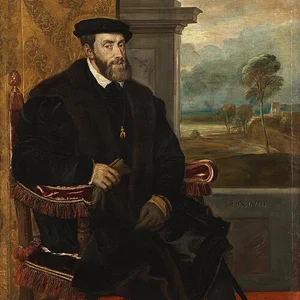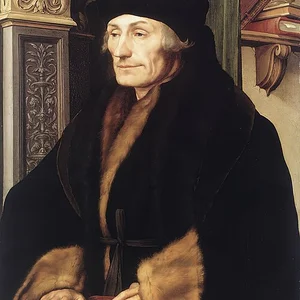

Dutch humanist and theologian (1466-1536), Erasmus is one of the major figures of the Renaissance. A champion of the critical study of ancient texts and religious tolerance, he embodies the humanist ideal of an education grounded in reason and wisdom.
Erasmus(1466 — 1536)
Erasmus
Dix-sept Provinces
7 min read
Frequently asked questions
Famous Quotes
« Ignorance is the root of all evil.»
« The desire to quarrel is the only way in which even the most timid creature can display courage.»
Key Facts
- Publication of The Praise of Folly in 1511, a humanist satire of society's follies
- Critical edition of the New Testament in Greek (1516), revolutionizing the study of biblical texts
- Defense of free inquiry against dogma, while remaining faithful to the Catholic Church
- Influential correspondence with the great European thinkers of the 16th century
- Intellectual founding of Christian humanism (1466-1536)
Works & Achievements
A collection of more than 4,000 commented Greek and Latin proverbs. This monumental work made Erasmus the prince of humanists and a bestseller of the nascent printing press.
A satire in which personified Folly delivers her own eulogy, ironically criticizing the failings of society, the clergy, and princes. Erasmus's most famous work.
The first critical printed edition of the New Testament in Greek, accompanied by a new Latin translation. This philological work profoundly influenced the Reformation and modern biblical exegesis.
Lively and satirical dialogues depicting situations from everyday life. Initially conceived as Latin language exercises, they became a vehicle for social and religious criticism.
A theological treatise defending free will against Luther's determinism. This work marks the definitive break between Erasmus and the Protestant Reformation.
A political treatise dedicated to the young Charles of Habsburg (future Charles V), advocating a government founded on wisdom, peace, and the common good.
Anecdotes
Erasmus was an illegitimate child, born of a priest and a physician's daughter. This birth out of wedlock marked him throughout his life and required a papal dispensation for him to pursue his ecclesiastical career.
During his stay in England in 1509, Erasmus wrote his most famous work, The Praise of Folly, in only about a week, at the home of his friend Thomas More. The Latin title, Moriae Encomium, is moreover a wordplay on More's name.
Erasmus maintained a monumental correspondence: more than 3,000 letters exchanged with the greatest minds of his time have been preserved, from Thomas More to Pope Leo X and Martin Luther. He was considered the center of a genuine European intellectual network.
Erasmus had fragile health and frequently complained about the cold, the food, and the inns during his many travels across Europe. He particularly detested fish, which was problematic for a monk bound by fasting rules, and obtained a dispensation to eat meat.
Martin Luther repeatedly attempted to win Erasmus over to the Protestant Reformation, but Erasmus always refused to leave the Catholic Church. This moderate stance earned him criticism from both sides: too reformist for Rome, too lukewarm for the Protestants.
Primary Sources
Folly speaks: "Without me, no society, no union could be either pleasant or lasting: a people would not long endure its prince, nor a master his servant, if they did not mutually deceive one another."
"All of Christian religion comes down to peace and concord; but this can only be maintained by defining as few things as possible and leaving each person the freedom of their own judgment on many questions."
"Dulce bellum inexpertis — War is sweet to those who have never known it." Erasmus develops this adage into a genuine pacifist essay against armed conflicts between Christian princes.
"I prefer the opinion of those who attribute something to free will, but as much as possible to grace." Erasmus here defends human freedom against the absolute determinism advocated by Luther.
Key Places
Erasmus's birthplace in the Netherlands. Although he left it young, he remained attached to it throughout his life, signing himself 'Desiderius Erasmus Roterodamus'.
The city where Erasmus spent his final years and died in 1536. He worked there with the printer Johann Froben and published his major works.
Erasmus stayed in Leuven on several occasions, home to a prominent university. There he founded the Collegium Trilingue (Latin, Greek, Hebrew) in 1517.
Erasmus stayed with the renowned printer Aldus Manutius in 1508, preparing the expanded edition of his Adages in a stimulating intellectual environment.
Erasmus made several stays in England between 1499 and 1514, teaching Greek at Cambridge and forging a decisive friendship with Thomas More.
Typical Objects

Erasmus's everyday instruments as a tireless letter-writer and author. He wrote or dictated for several hours a day, producing a considerable body of work.

Erasmus was one of the first authors to fully exploit the printing press. He worked closely with the Venetian printer Aldus Manutius and later with Froben in Basel.

Erasmus gathered and compared several ancient Greek manuscripts to establish his critical edition of the New Testament, a philological undertaking without precedent.

A symbol of the vanity of time in many humanist portraits. Erasmus, often ill, was acutely aware of the passing of time.

Erasmus frequently wore a distinctive black cap, visible in the famous portraits painted by Hans Holbein the Younger and Quentin Matsys.

His correspondence with scholars, princes, and popes across Europe formed an intellectual network that foreshadowed the Republic of Letters.
School Curriculum
Vocabulary & Tags
Key Vocabulary
Tags
Époque
Mouvement
Concept
Daily Life
Morning
Erasmus rose early, often before dawn, to take advantage of the quiet hours conducive to study. After a brief prayer, he would settle at his writing desk to write or correct manuscripts, a cap on his head to protect himself from the cold. He ate a light meal of bread and wine diluted with water.
Afternoon
The afternoon was devoted to correspondence, reading ancient texts in Greek and Latin, or visiting his printer Froben to supervise the proofs. He sometimes received visitors — scholars, students, or messengers — who came to seek his advice or bring him news from other humanists.
Evening
In the evening, Erasmus dined frugally, often in the company of learned friends with whom he enjoyed conversing. His fragile health compelled him to retire relatively early. He would sometimes reread a few pages before falling asleep, always mindful not to waste an hour of intellectual work.
Food
Erasmus had a delicate stomach and often complained about food. He avoided fish, despite fasting obligations, having obtained a papal dispensation to eat meat. He appreciated Burgundy wine, white bread, and simple but well-prepared dishes.
Clothing
Erasmus wore the black robe of the Augustinian canons, loose and comfortable, under which he layered several garments to ward off the cold. His characteristic black cap and winter fur are immortalized in Holbein's portraits. He obtained a dispensation exempting him from wearing monastic habit in public.
Housing
Erasmus never owned a home of his own. He lodged successively with friends, in university colleges, or in houses placed at his disposal by patrons. In Basel, he resided with the printer Froben and later in a house on the Nadelberg, surrounded by his books and secretaries.
Historical Timeline
Period Vocabulary
Visual Style
Un style visuel inspiré de la peinture flamande et des portraits d'Holbein, avec des tons sobres et chaleureux, des intérieurs studieux richement détaillés et une lumière douce caractéristique de la Renaissance du Nord.
Sound Ambience
L'atmosphère sonore du cabinet d'étude d'Érasme, entre le silence studieux de l'écriture, le bruit lointain des presses de Froben et les sons d'une ville rhénane du XVIe siècle.
Liens externes & ressources
Références
Œuvres
Adages (Adagia)
1500 (éd. augmentées jusqu'en 1536)
Éloge de la Folie (Moriae Encomium)
1511
Novum Instrumentum omne
1516
Colloques (Colloquia familiaria)
1518-1533
De libero arbitrio (Du libre arbitre)
1524
L'Éducation du prince chrétien (Institutio principis christiani)
1516