Imaginary interview with Erasmus
by Charactorium · Erasmus (1466 — 1536) · Philosophy · 6 min read
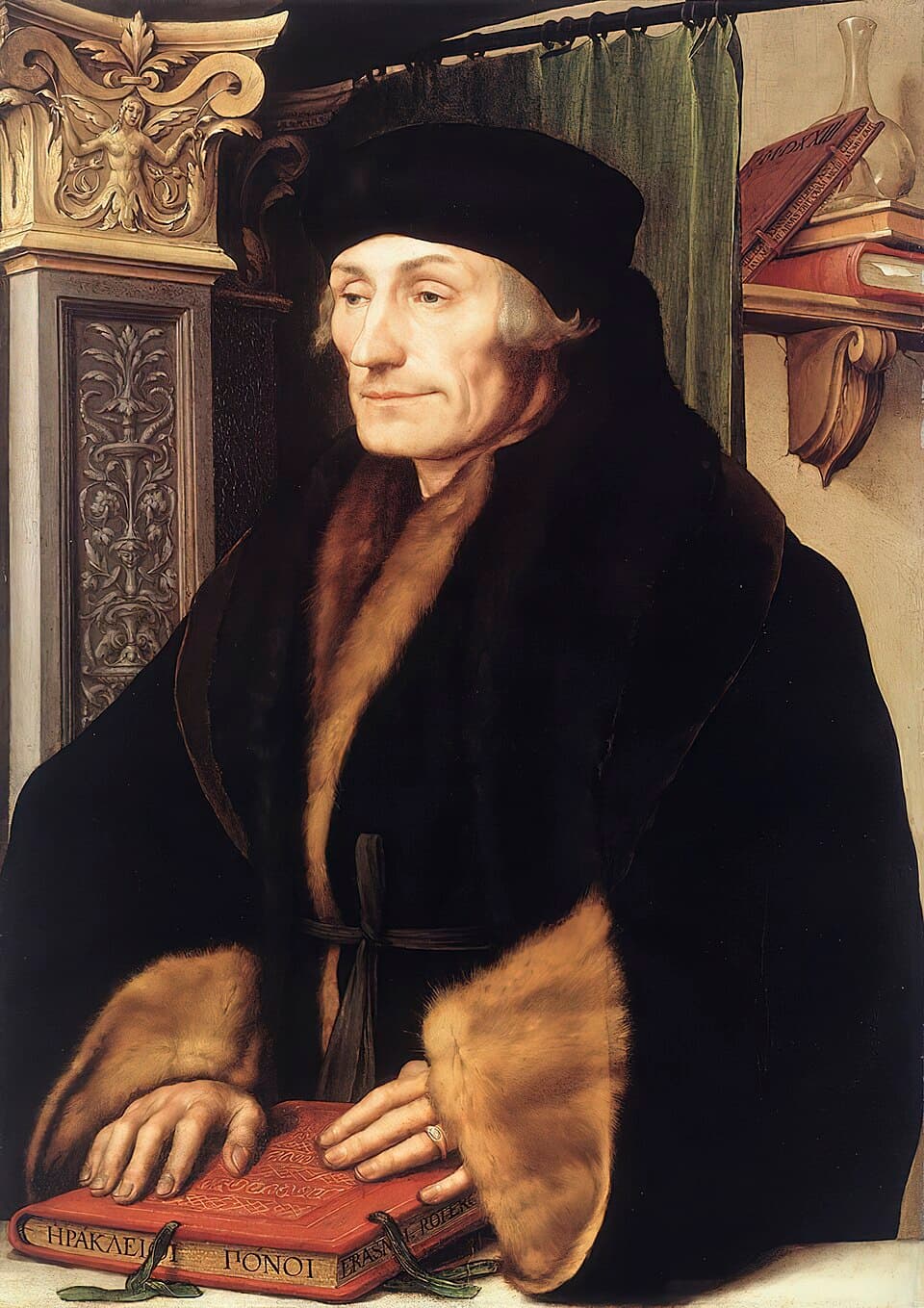
Basel, a winter morning in the house on Nadelberg. The old humanist receives us bundled in furs, a black bonnet pulled down to his eyebrows, his goose quill still wet near the inkwell. Froben's presses rumble at the bottom of the street; between two coughing fits, Erasmus agrees to trace the thread of a life spent traveling, correcting, and writing.
—How was your most famous work, The Praise of Folly, born?
From a journey and a slight fever, truth be told. I was returning from Italy to England in 1509, my body broken by the Alps, and it was while riding that this fancy came to me: to let Folly herself speak, to deliver her own praise. I found refuge with my dear Thomas More, and there, almost without a home or books, I threw it all onto paper in a few days, as a jest, to amuse a friend I had come to visit. The Latin title, Moriae Encomium, is a wink at his name — More, moria, folly. I thought I was writing a trifle between two convalescences; the printers turned it into a wildfire that swept across Europe.
I thought I was writing a trifle; the printers turned it into a wildfire.
—Why did you entrust your satire to Folly rather than to a wise man?
Because a wise man who preaches closes ears, while a fool who laughs opens them all. Under the mask of Folly, I could tell princes, monks, and theologians truths that no doctor would have dared to speak from the pulpit. She herself proclaims: "Without me, no society, no union could be pleasant or lasting: a people would not long endure its prince, nor a master his servant, if they did not mutually deceive each other." That is the whole point: the world holds together by its illusions as much as by its reason. I used the mask like a doctor's bonnet turned inside out — feigned folly to better reveal the real folly of those who think themselves learned.
—You dared to revise the sacred text of the New Testament. What drove you to do that?
The scruple of a philologist, not the pride of a reformer. Saint Jerome's Vulgate had reigned for a thousand years, but it carried with it copyists' errors, misunderstandings accumulated by tired hands. Yet how can one faithfully preach the word of Christ from a corrupted text? So I gathered ancient Greek manuscripts, compared them line by line, and from this labor came the Novum Instrumentum in 1516, the Greek text and, facing it, a new Latin translation. Bent over those parchments by candlelight, I sometimes trembled at what I discovered: one word changed, and an entire dogma totters. Philology was not for me a scholarly game, but a way to restore pure water to the source.
One word changed, and an entire dogma totters.
—What did you reply to those who judged this textual criticism dangerous for the faith?
That they confused the letter with the chest that holds it. Restoring a text is not weakening it, but removing its rust. At Louvain, I tried to arm this method by founding the College of the Three Languages — Latin, Greek, Hebrew — for one cannot read Scripture well without going back to its original languages. The old masters of scholasticism, however, preferred to quibble over Aristotelian subtleties rather than open a Greek manuscript. I countered them with what I call the philosophia Christi: a stripped-down Christianity, reduced to the moral teaching of Christ, not to disputes over syllogisms. Restoring the correct text was already leading the faithful back to that simplicity.
—Do you remember the moment you decided to break publicly with Luther?
It was a slow rupture, long postponed. Luther reached out to me more than once, hoping to win the prince of humanists to his cause; several times I dodged, out of prudence and disgust for factions. But in 1524, I took up my pen for the De libero arbitrio, On Free Will. Everything separated us on this point: he made man a steed ridden by God or the devil, while I refused to erase our share of freedom. I wrote there that "I prefer the opinion of those who attribute something to free will, but as much as possible to grace." That very moderation became an act of war — for in this time of Reformation, to want to hold the middle ground was to be hated by both shores at once.
To want to hold the middle ground was to be hated by both shores at once.
—Didn't this moderate position cost you dearly on both sides?
More than anything else. Rome suspected me of having laid the egg that Luther hatched; the reformers called me lukewarm, a coward who dared not take the step. Since the Diet of Worms in 1521, where Luther was placed under the imperial ban, everyone demanded that I choose my side loudly. But in my Colloquies, I always maintained that "the whole Christian religion comes down to peace and concord; yet this can only be maintained by defining as few things as possible and leaving each person free to judge on many questions." They wanted to make me a deserter. I was only a man who refused to bless the fire, no matter where it came from.
—They say your very birth pursued you all your life. What happened?
I came into the world out of wedlock, son of a priest and a physician's daughter — a stain the Church does not easily forgive. This irregularity barred many doors: to pursue a clerical career, I had to solicit a papal dispensation from Rome, like a beggar claiming his right to exist. I had indeed taken my vows with the Augustinian canons of Steyn in 1487, but the monastic habit weighed on me like a chain. My whole existence, in short, was played out through dispensations wrung out: dispensation for birth, dispensation to leave the frock, dispensation for my table. I learned very early that a free man, in this century, is a man who knows how to obtain the right sealed letters.
A free man, in this century, is a man who knows how to obtain the right sealed letters.
—Your letters are full of complaints about the cold, inns, food. How did you live day to day?
As an eternal guest of others, never at home. I never owned any dwelling of my own; I lodged with friends, in colleges, or here in Basel, under the roof of my printer Froben. My stomach is delicate, fish turns my stomach — yet what torment for a former monk bound to fasting! I had to obtain, once again, a dispensation to eat meat. I rise before dawn, bonnet screwed onto my head against drafts, nibble a little bread and wine cut with water, and work. The inns of Germany, with their smoky stoves and dubious sheets, fed more of my complaints than my poor body. But this ailing body held the pen for sixty years: that is already a miracle.
—How did you become, without court or title, the center of a true European intellectual network?
Through ink and patience, letter after letter. I had neither army nor bishopric, but I had a correspondence — thousands of missives exchanged with the greatest minds, from Thomas More to Pope Leo X, and even Luther. Every morning, my secretaries sealed with wax packets bound for Paris, Rome, London, Venice. This commerce of minds across borders is what I like to call the Republic of Letters: a homeland without walls where one recognizes each other by the love of bonae litterae. A prince rules over lands; I ruled over an unbroken exchange of thoughts. As long as the messengers kept the roads, my paper empire stretched from one end of Europe to the other.
A prince rules over lands; I ruled over an unbroken exchange of thoughts.
—What role did printing play in your work and fame?
It was my true ally, more reliable than any patron. Without the presses, my Adages would be but a notebook of proverbs forgotten in a chest; thanks to them, this collection of thousands of ancient sayings swept across Europe and made me, they say, the prince of humanists. I worked closely with the workshops: at Aldus Manutius's in Venice in 1508, I corrected proofs amid the clatter of compositors, then with Froben here. In one of those adages, Dulce bellum inexpertis — war is sweet to those who have not known it — I slipped an entire plea against princes who bloody Christendom. Printing gave me what no preacher had ever had: a thousand paper mouths repeating my words at once.
This imaginary interview was generated by artificial intelligence from sources documented in Erasmus's profile. It dramatises what the figure might have said based on what we know about them, but does not constitute attested historical testimony. For primary sources and factual documentation, refer to the full profile.