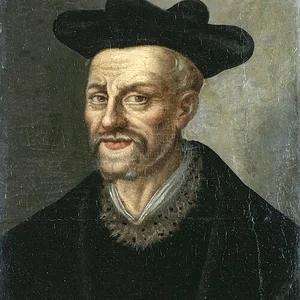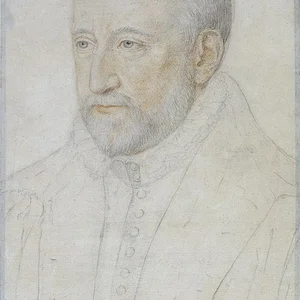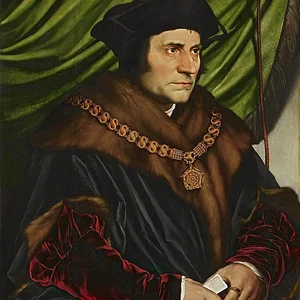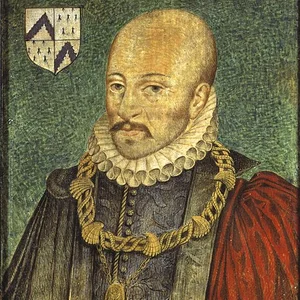

French Renaissance writer and philosopher (1533–1592), Montaigne is the author of the Essays, a landmark work of French literature blending personal reflection and humanism. Mayor of Bordeaux, he contributed to the rise of modern critical thinking.
Michel de Montaigne(1533 — 1592)
Michel de Montaigne
royaume de France
7 min read
Frequently asked questions
Famous Quotes
« What do I know?»
« Friendship is a virtue necessary to life»
« Death is the condition of change and regeneration»
Key Facts
- 1580: Publication of the first edition of the Essays, a work of personal reflection on a wide range of subjects
- 1581–1585: Mayor of Bordeaux, a role he carried out with moderation and humanity
- 1588: Publication of an expanded edition of the Essays with new chapters
- Development of the method of doubt and self-analysis as a philosophical approach
- Promotion of religious tolerance and critique of dogmatism during the Wars of Religion
Works & Achievements
First publication of the Essays in Bordeaux, the founding work of a new genre: the literary essay. Montaigne takes himself as his own subject, exploring the human condition through his personal experiences and reflections.
Third book added in the fifth edition, considered the most philosophically accomplished. It addresses themes such as experience, vanity, and the art of living.
Expanded edition published after Montaigne's death by Marie de Gournay, his "adopted daughter", incorporating the numerous handwritten additions Montaigne had made in his own copy.
An account of his long European journey, written partly by a secretary and then by Montaigne himself. A valuable document on the customs, thermal baths, and daily life of the era.
Montaigne published and wrote the preface for the works of his late friend Étienne de La Boétie, thereby contributing to the dissemination of the latter's political and humanist thought.
Anecdotes
Montaigne had about fifty sentences in Greek and Latin, drawn from the Bible and ancient philosophers, carved into the beams of his round library tower. These maxims accompanied him daily in his reflections and still adorn today the room where he wrote the Essays.
In 1588, Montaigne was briefly imprisoned at the Bastille by the Catholic Leaguers while on his way to Paris. He was released the very same day thanks to the intervention of Queen Catherine de' Medici, a testament to the respect he enjoyed at court.
Montaigne had suffered from kidney stones since the age of forty. Far from complaining bitterly about it, he travelled to Italy partly in search of curative thermal baths, and meticulously recorded his symptoms in his Travel Journal with an almost scientific curiosity.
When his close friend Étienne de La Boétie died in 1563, Montaigne was devastated. He would later explain their absolute friendship with the words: "Because it was him, because it was me." This phrase has remained one of the most celebrated definitions of friendship in all of French literature.
Montaigne was elected mayor of Bordeaux in 1581 while he was travelling in Italy. He accepted the position reluctantly and was re-elected in 1583. During a devastating plague epidemic in 1585, he left the city to protect his family, which earned him criticism — but he addressed the matter candidly in his Essays.
Primary Sources
"Let all things be proposed to him; nothing shall be concealed from him, leaving to his choice. He will have no Tutor keeping a register of his hours."
"Because it was him, because it was me."
"Every man carries the entire form of the human condition within himself."
"I looked for a long time at this beautiful country, walking among the vines and gardens, and felt better for the waters of Lucca."
"One must live among the living. Let death find me planting my cabbages, caring little about it, and even less about my unfinished garden."
Key Places
Family home and retreat of Montaigne from 1571. It was in the château's round tower that he wrote the greater part of the Essays.
City where Montaigne served in the Parliament for thirteen years and of which he was mayor between 1581 and 1585. It represents his involvement in public and political life.
Montaigne stayed in Rome during his journey to Italy (1580–1581) and was received in audience by Pope Gregory XIII. He was also granted Roman citizenship there, an honour of which he was very proud.
Italian spa town where Montaigne stayed to treat his kidney stones. He recorded his impressions there in his Travel Journal with an almost clinical precision.
A renowned humanist institution where Montaigne studied from 1539 to 1546, receiving an education grounded in Latin, Greek, and the ancient authors.
Typical Objects

Montaigne's daily instrument in his tower-library, the goose quill served him to write and annotate the Essays, often in response to his readings of the Ancients.

Montaigne owned about a thousand volumes, arranged in an arc in his tower in Périgord. He could see all his books from his central armchair, which symbolized his intimate relationship with knowledge.

Montaigne was appointed knight of the Order of Saint Michael by the king in 1571, a distinction he was proud of and wore at official ceremonies.

Montaigne traveled almost exclusively on horseback, whether for his parliamentary duties or his grand journey to Italy. He considered horsemanship a noble virtue and an indispensable exercise for the body.

During his journey in search of treatment for his kidney stones, Montaigne regularly frequented Italian and German thermal baths, drinking and bathing in the mineral waters he described in meticulous detail.

A timekeeping instrument found in noble Renaissance households, it symbolizes Montaigne's philosophy of attentiveness to the present moment and the passage of time.
School Curriculum
Vocabulary & Tags
Key Vocabulary
Tags
Époque
Mouvement
Daily Life
Morning
Montaigne rose relatively late compared to the habits of his era, around eight or nine o'clock. He began his day with a light snack before climbing up to his tower library to read and write, making the most of the morning light.
Afternoon
In the afternoon, he sometimes received visitors — neighboring gentlemen or passing scholars. He also allowed himself rides on horseback across his lands in Périgord, which he considered beneficial for the health of both body and mind.
Evening
In the evening, Montaigne dined with his family or with guests, in a convivial and cultured atmosphere. He enjoyed lively conversations at the table and sometimes spent the evening hours rereading his own texts to annotate and enrich them.
Food
Montaigne ate heartily and without great ceremony. He enjoyed the cuisine of Périgord — poultry, game, orchard fruits — and drank wine from his own vines, but with a certain moderation he also advocated in his writings.
Clothing
As a provincial nobleman, Montaigne wore the black doublet and trunk hose typical of the second half of the sixteenth century, complemented by a white ruff at the collar. He donned his chain of the Order of Saint-Michel on official occasions.
Housing
Montaigne lived in his family château in Périgord, whose round tower he had converted into a personal library. The estate, surrounded by vineyards and woodlands, blended noble comfort with a certain rustic simplicity he proudly claimed as his own.
Historical Timeline
Period Vocabulary
Visual Style
Le style visuel de l'univers de Montaigne évoque la Renaissance française tardive : sobriété élégante du noir et blanc des vêtements nobles, chaleur dorée de la bibliothèque en pierre, et lumière douce du Périgord.
Sound Ambience
L'univers sonore de Montaigne, c'est le silence studieux de sa tour-bibliothèque, ponctué du grattement de la plume, du crépitement du feu et des bruits champêtres de son domaine périgourdin.
Liens externes & ressources
Références
Œuvres
Les Essais (Livre I et II)
1580
Les Essais (Livre III)
1588
Les Essais (édition posthume dite « de l'exemplaire de Bordeaux »)
1595
Journal de voyage en Italie par la Suisse et l'Allemagne
1580-1581 (publié en 1774)
La Boétie : De la servitude volontaire (édition et préface)
1571