Imaginary dialogue between Michel de Montaigne and Étienne de La Boétie
by Charactorium · Étienne de La Boétie (1530 — 1563) · Literature · Philosophy · 6 min read
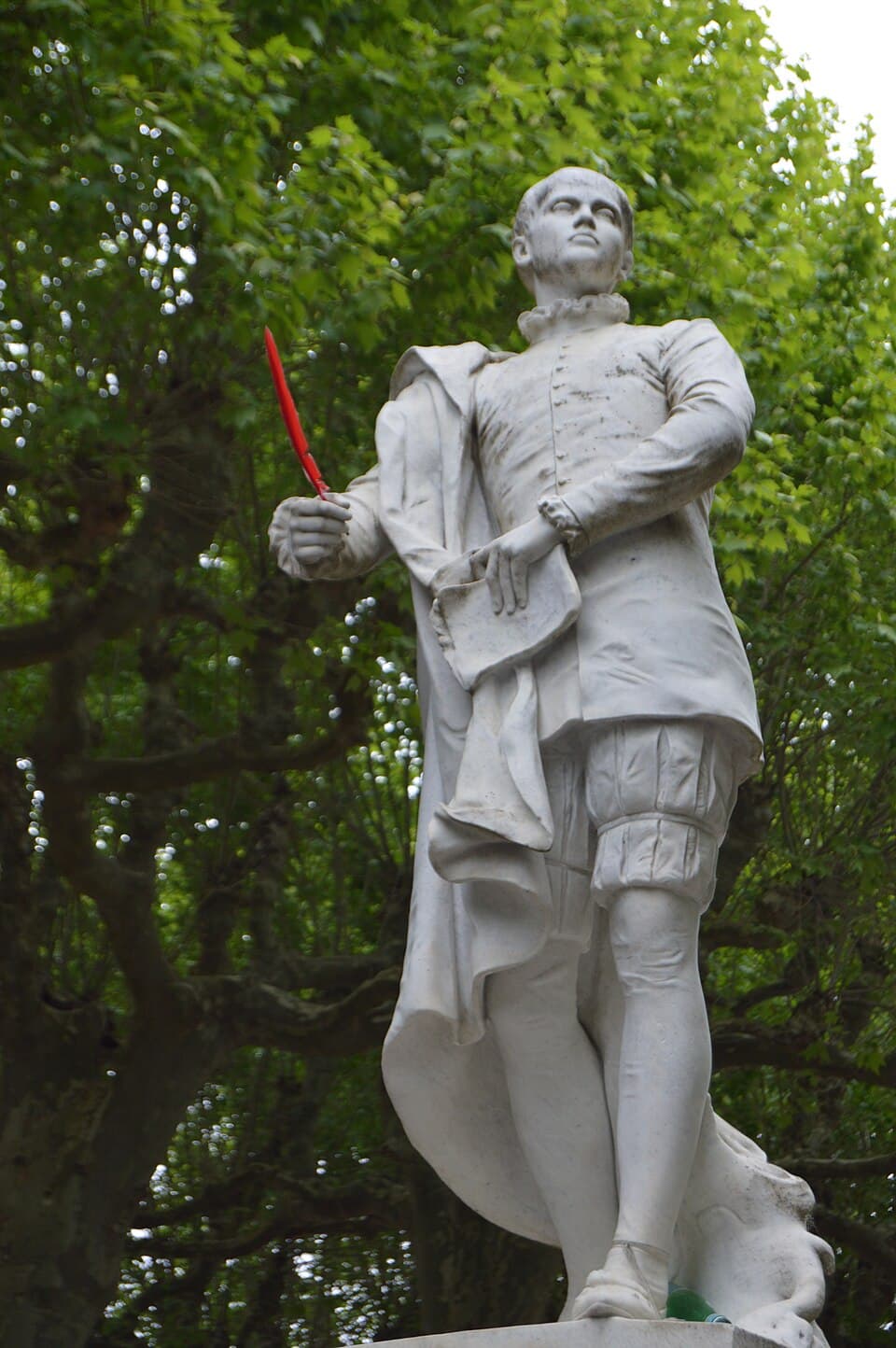
It is in the cool of a late afternoon in the summer of 1562 that I find Étienne in his study, in Bordeaux, the shutters half-closed against the heat. On the walnut table, an inkwell, a few pages of a translation of Xenophon, and a vellum-bound manuscript I know well. It has been four years since we became close, and I never tire of pressing this friend to reveal the man behind the magistrate and the poet. He is already smiling at the sight of me arriving with my questions.
—Étienne, that Discourse you entrusted to me, you compare the tyrant to a colossus. Explain to me: why do a people themselves carry the one who crushes them?
You touch there, my friend, on what has tormented me the longest. See clearly: the tyrant often has only two eyes, two hands, a single body — nothing more than the humblest inhabitant of his cities. His entire strength is given to him by the peoples themselves. Think of that colossus: if you only stop supporting it, it collapses under its own weight. Servitude is not wrested by arms; it is consented to, through habit, cowardice, a strange fascination with power. Men are born free, and yet they forget even the taste of liberty. It is this forgetfulness, more than soldiers, that makes tyrants.
Be resolved to serve no longer, and you are free.
—It is whispered that you wrote this text very young, barely out of childhood. Does that bother you, or do you take some pride in it?
I hardly know what to think of it, Michel. I was sixteen or eighteen, the age when one believes that ideas can move the world with a word. The text was never published under my name — it passed from hand to hand, copied by learned friends, slipped under the cloak in our humanist circles. Sometimes I wonder if I should burn it, for a young man speaks there with an assurance that the mature man would qualify. But I also fear that one day heated minds might seize it for their cause, and make it say what I did not intend. A piece of writing, you see, escapes its author like a bird escapes the hand.
A piece of writing escapes its author like a bird escapes the hand.
—You have sat in parliament since you were twenty-three, and now L'Hospital sends you to reconcile Catholics and Reformers. Does that robe weigh on you in these times of discord?
It weighs on me and honors me at the same time. When I put on this black robe and donned the square cap, I thought I would dispense justice and register edicts — a grave but peaceful task. Today the kingdom is tearing itself apart; Wassy has seen bloodshed, and I am sent to Agenais to bring words of peace between men who no longer listen to each other. I still believe that a wise edict, like that of January, can contain fury if each party acts in good faith. But I harbor no illusions: religious hatred is a beast that reason calms with difficulty. I serve the king and concord, knowing that concord, in these times, is the most thankless work there is.
Religious hatred is a beast that reason calms with difficulty.
—I see you there every morning bent over your Greeks. Tell me, Étienne, what do these Ancients — Plutarch, Xenophon — give you that your own time does not?
They give me perspective, my friend, and company that never betrays. I am currently translating Plutarch's Rules of Marriage and Xenophon's Oeconomicus — texts that speak of governing oneself and one's household before governing cities. The Ancients experienced all human passions before us; reading them is consulting witnesses wiser than our contemporaries. And then there is poetry: my sonnets, which you know, follow the paths of Petrarch, where love is expressed in chosen images. Political thought and the amorous verse are not so far apart — both seek to speak truth about what the human heart desires. My days pass between these two fires.
The Ancients experienced all human passions before us.
—Allow me, as your friend, a more intimate question. Do you remember our first meeting, four years ago? What did you recognize in me that day?
How could I forget? We knew each other by reputation before we knew each other by sight, and from the first words it was as if we had been seeking each other all our lives. You, who are well placed to know, Michel, it was not one of those ordinary acquaintances formed by interest or habit. In my sonnets I wrote that in you I had found the other half of myself — that was not a poet's figure, but the most exact thing I could say. Our souls blended in a union so entire that one can no longer find the seam that joined them. I have never been able to explain this friendship otherwise than through you and me. There is no other reason.
In you I have found the other half of myself — that was not a poet's figure.
—When you return from parliament in the evening, and we dine together, I often feel that you carry the weight of the kingdom. What worries you most?
What worries me is that men have come to prefer their faction to their country. In parliament, I see families of the nobility of the robe, like mine, who should serve the law, dividing according to which side they pray on. Justice itself is infected by the fever. In the evening, when we talk by candlelight, I take comfort in thinking that there remain minds like yours, capable of looking over the walls of the camps. But I do not know how long reason will hold. An edict of toleration is a paper dam before a river in flood. I fear, Michel, that we have not finished counting the dead.
An edict of toleration is a paper dam before a river in flood.
—Your adversaries will say that preaching no longer to serve is to call for revolt. What do you reply to those who judge you dangerous?
I reply that I call for no violence, and it is quite the opposite that moves me. I do not say that the colossus must be overthrown, struck, or shaken by arms — I say only that it suffices to stop supporting it, and it will fall of its own accord. See the difference: revolt sheds blood; the simple refusal to serve sheds none. It is a liberation through conscience, not through the pike. What I want to awaken is the desire for freedom that sleeps in every man since he traded it for the tranquility of obedience. If this seems dangerous to the powerful, it is because they know deep down how much their greatness depends on a small thing: our mere consent.
The simple refusal to serve sheds no blood.
—You have confided to me that you wish one day to bequeath me your books and papers. Why do you care so much that these verses and translations come to me, of all people?
Because a book, like a friendship, is only worth what the hands that receive it make of it. My translations, my sonnets, my Latin verses are not works thrown to the public for glory — they are fragments of myself, hours of study and thought. To whom entrust them but to one who will read even the silences? My library is what I hold dearest after the living I love. I know you will take care of it, that you will know how to distinguish what deserves to last from what must remain in the shadows. Knowing you as the keeper of these pages gives me the feeling that a part of me will continue to converse with you when words fail me. It is my way of not quite leaving you.
A book, like a friendship, is only worth what the hands that receive it make of it.
—If your Discourse were ever to see the light of day, under your name, would you accept it, or do you fear the use that might be made of it?
That is a fear that haunts me, I admit. This text was the impulse of a very young man in love with liberty; it had no other design than to think aloud. But I can already guess how factions might seize it — not to love liberty, but to arm their quarrel and strike at the king under cover of philosophy. A piece of writing that is twisted becomes a thing foreign to its maker. If it must be published, I would want it read for what it is: a meditation on human freedom, not a factional firebrand. But I harbor few illusions, Michel. Ideas, once released, go where the passions of the time carry them, and no author holds the reins of his own thought.
A piece of writing that is twisted becomes a thing foreign to its maker.
—One last one, my friend. When our conversations end and night falls over Bordeaux, what do you wish, deep down, will remain of you?
Little, and much at once. I do not dream of statues or renown among the crowds — those vanities pass like the smoke of the candles we extinguish in the evening. What I would like to remain is the idea that a man can stay free inside, even when everything around him presses him to bend. And then, more simply, I would like to remain in your memory as you knew me: not the counselor in his robe, nor the author of a discourse, but the friend with whom you spoke until our thoughts merged. The rest — the verses, the translations, the edicts — is only the bark. What we exchanged, you and I, that is what I consider my true legacy. Keep it better than my books.
A man can stay free inside, even when everything presses him to bend.
This imaginary interview was generated by artificial intelligence from sources documented in Étienne de La Boétie's profile. It dramatises what the figure might have said based on what we know about them, but does not constitute attested historical testimony. For primary sources and factual documentation, refer to the full profile.