Kids interview Grace Hopper
by Charactorium · Grace Hopper (1906 — 1992) · Technology · Sciences · 5 min read

Two 12-year-old students, on a field trip, have the chance to meet Grace Hopper. Intimidated at first, they sit down near her. She smiles at them and pulls a funny little copper wire out of her pocket.
—How old were you when you joined the Navy?
I was 37 years old, my child. At first, they told me no. I was too old, and too thin according to them—I was a few kilos short on the scale. Can you imagine? Rejected for a few kilos! But I insisted, and I got a waiver. I joined the WAVES, the women's branch of the Navy, in 1943. And you know what? I never really left. I served until age 79. In the end, I was the oldest officer in the entire U.S. Navy. So never believe those who tell you you're too this or too that.
Rejected for a few kilos, I stayed for forty years.
—How did it feel to wear a military uniform?
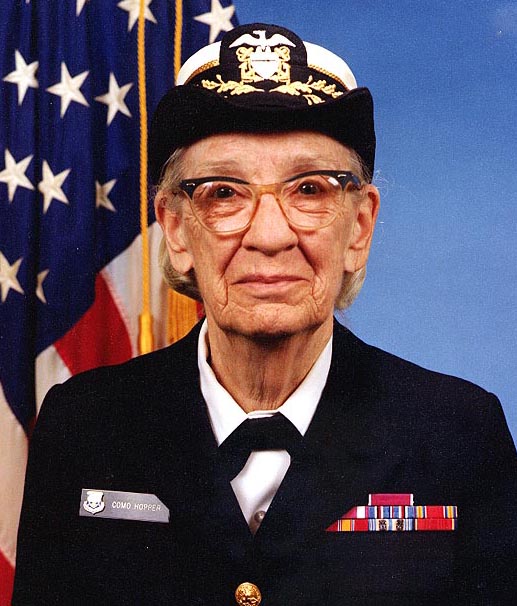
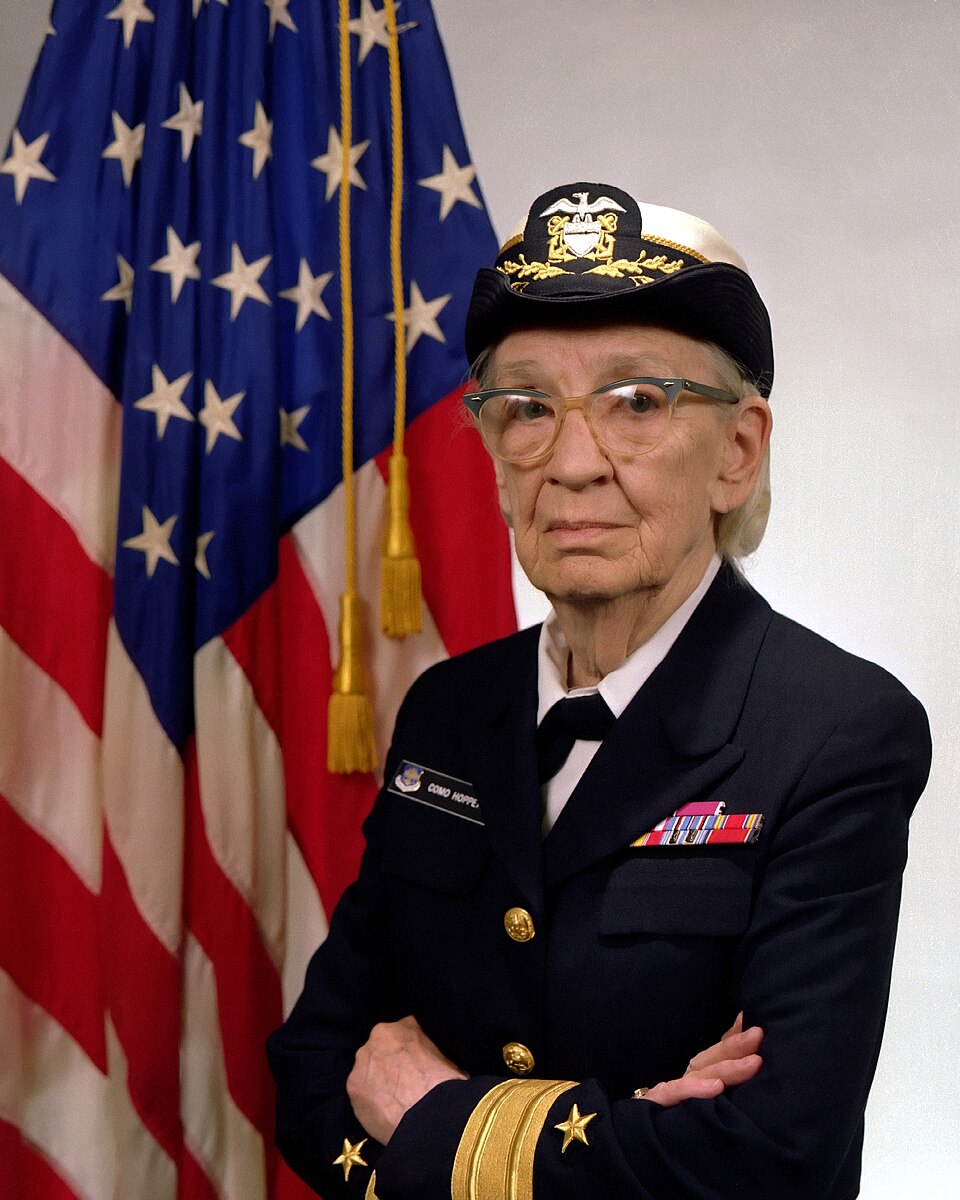
I was proud of it, you know. I wore that uniform for over forty years. In the end, I had the gold stripes of a rear admiral—that's a very high rank. President Reagan himself promoted me, in 1983. In my day, a woman with that rank was extremely rare, almost impossible. Imagine a large room full of men in uniform, and me, a little gray-haired lady in the middle. The uniform reminded me every morning that I had earned my place. When I passed away, I was buried at Arlington, with full military honors. That was my greatest pride.
My place in that room of men, I earned it stripe by stripe.
—Is it true you found a real insect in a computer?
Absolutely true! Imagine a huge machine, the Mark II, made of little parts called relays—switches controlled by a magnet. One day in 1947, the machine broke down. We searched and searched... and there, we found a moth stuck inside! A real one, with wings. We carefully removed it and taped it into our logbook, with a note: « First actual case of bug being found ». Ever since, when a program goes wrong, we say it has a bug. That moth is even preserved in a big museum today.
The first bug in history had real wings.
—Why did you keep the moth instead of throwing it away?
Because we were scientists, my child, and every detail counts! When a machine breaks down, you have to write down why, to understand. So we noted everything in our logbook: « 15:45 — Relay #70 Panel F (moth) in relay ». We even taped the culprit onto the page. It was evidence, you see, not trash. And it made us laugh: for once, the breakdown wasn't a calculation error, but a real little animal! Always keep a record of your mistakes. That's how you learn, and sometimes, how you make history without knowing it.
Always keep a record of your mistakes: that's how you learn.
—What's the hardest thing you ever accomplished?
Making a machine speak almost like a human being. In my day, everyone told me the same thing: a computer can only do addition, nothing else. « They told me computers could only do arithmetic », I used to say. I didn't believe it. I wanted us to be able to write programs with words, not just 0s and 1s. So in 1952, I created the first compiler, the A-0: a program that translates almost-human words into machine language. And you know what hurt me most? I had succeeded... and no one wanted to believe it or use it.
They told me computers could only count. I taught them to read.
—Why did you want machines to understand words?
Because I was thinking of people, my child. In my day, to talk to a computer, you had to write in machine code: strings of incomprehensible numbers, very difficult. Only a few scholars could do it. I wanted to open the door to everyone! So I created a language with real English words: FLOW-MATIC, then the famous COBOL, around 1959. Imagine: an accountant, a secretary, could finally write a program almost like a sentence. It was a small revolution. Even today, banks use it. When you make a complicated thing accessible to everyone, you truly change the world.
Making the computer accessible to everyone was opening a closed door.
—What's that little wire you're holding?
Ah, you noticed! Come closer, I'll give you one. This copper wire is about thirty centimeters long. And do you know what it represents? The distance light travels in one nanosecond—a billionth of a second. That's a tiny amount of time, almost nothing! For years, from 1970 to 1986, I gave hundreds of lectures with these little wires. Students could finally touch time with their hands. Because even light doesn't go any faster: that's why a computer has a limit. They called me Amazing Grace. But my real talent was making the invisible visible.
Hold this wire: it's the path of light in one billionth of a second.
—Why did you give lectures everywhere instead of staying put?
Because I loved explaining, plain and simple! Knowledge kept to oneself is useless. For over fifteen years, I traveled to universities, military bases, companies. Always with my little copper wires in my pocket. I believe you remember better what you can touch and see. A long scholarly speech is forgotten; a wire in your hand, never. I loved seeing the eyes of young people light up when they suddenly understood. That's why they nicknamed me Amazing Grace. And frankly, receiving two curious children like you today is still my greatest reward.
Knowledge kept to oneself is useless.
—Why was it important for everyone to use the same language?
Good question, really! Imagine every computer manufacturer invents its own language. One machine would never understand another's program. What a waste! So I fought for standardization: making sure COBOL spoke the same everywhere, on all machines. In 1968, we established common standards, the ANSI and ISO standards. That way, a program written here worked over there, on another manufacturer's machine. It was like inventing a common language so everyone could understand each other. And it still works: COBOL still runs the world's banks. Building bridges lasts longer than building walls.
A common language for machines: a bridge, not a wall.
—Were you already thinking about the future when you worked?
All the time, my child! Before the U.S. Congress, in 1959, I said we were too focused on immediate results. We had to think about the future of computing and make it accessible to everyone. Many just wanted it to work today. I saw further: the children who would one day use these machines—children like you. That's why I fought for solid, lasting rules. I had a saying I liked: a ship is safe in port, but that's not what ships are built for. You have to go out, dare, make waves.
A ship is safe in port, but that's not what it's built for.
—What did you eat during your long workdays?
Oh, nothing very fancy, you know! Black coffee, lots of black coffee, from morning to night. I got up very early—a Navy habit—and often arrived first at the lab, in the quiet. For lunch, a simple sandwich grabbed from the cafeteria, between two problems to solve. I had no time for cooking, and honestly, it didn't interest me much. In the evening, I worked late, in the silence, where difficult ideas finally come. And before sleeping, I read: mathematics, history, and... detective novels! Yes, even an old admiral likes solving little mysteries.
Black coffee and mysteries: the fuel of a researcher's life.
This imaginary interview was generated by artificial intelligence from sources documented in Grace Hopper's profile. It dramatises what the figure might have said based on what we know about them, but does not constitute attested historical testimony. For primary sources and factual documentation, refer to the full profile.