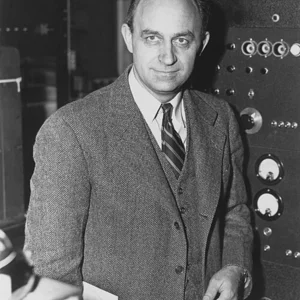
American mathematician and programmer of Hungarian origin, regarded as one of the first programmers in history. She wrote and coded programs for the ENIAC computer, notably for weather calculations and simulations related to nuclear weapons.
Klára Dán von Neumann
Klára Dán von Neumann
6 min read
Frequently asked questions
Key Facts
- Born in 1911 in Budapest into a wealthy Hungarian Jewish family
- Married the mathematician John von Neumann in 1938 and emigrated to the United States
- Began working in 1948 on programming the ENIAC, one of the first electronic computers
- Contributed to coding the Monte Carlo method and simulations for the Los Alamos laboratory
- Created the first numerical weather forecasting program on a computer in 1950; died in 1963
Works & Achievements
Klára coded probabilistic neutron-diffusion calculations on the ENIAC, essential to the development of nuclear weapons. It was one of the first major applications of the Monte Carlo method.
She programmed the calculation that produced the first weather forecast ever obtained by computer, laying the foundations of modern meteorology.
Klára took part in transforming the ENIAC so that it could accept programs stored in memory, a key step toward modern computers.
She helped develop rigorous methods for coding and verifying programs, passing on her expertise to other programmers.
An autobiographical manuscript in which she recounts her life and her pioneering work in computing, a valuable insider's account.
Anecdotes
Born into a well-off Jewish family in Budapest, Klára Dán was a top-level figure skater in her youth, Hungary's junior national champion. Nothing seemed to destine her for mathematics: she learned programming on the job, self-taught, once she had settled in the United States.
In 1938, she married the famous mathematician John von Neumann and followed him to the United States, just before World War II swept across Europe. In doing so, she fled the rising antisemitic persecution in Hungary.
For the secret laboratory at Los Alamos, she programmed the ENIAC to simulate the chain reactions involved in the hydrogen bomb, using what became known as the Monte Carlo method. She spent entire nights in front of the machine, hunting down the slightest error among thousands of instructions.
In 1950, she coded on the ENIAC the very first computer-calculated weather forecast in history. Computing a 24-hour forecast took nearly 24 hours of machine time back then: the computer could barely predict the weather faster than the weather itself unfolded!
Klára hated being described as merely her husband's “assistant.” She insisted that programming a machine like the ENIAC, with no keyboard or screen, by plugging in cables and setting switches, demanded extreme rigor and logic.
Primary Sources
In it, she recounts her discovery of the “electronic brain” and the mix of fascination and dread she felt before these machines capable of calculating faster than any human.
The foundational paper on numerical weather prediction explicitly thanks Klára von Neumann for programming and coding the computations on the ENIAC.
Their letters attest to Klára's role as a trusted programmer, discussing codes, machine errors, and the organization of computations for Los Alamos.
Key Places
Klára's birthplace, a brilliant and cosmopolitan capital where she grew up in a well-off family before emigrating.
The town where the von Neumann couple lived, near the Institute for Advanced Study, then a hub of computing research.
The secret laboratory of the atomic bomb project, for which Klára programmed Monte Carlo simulations on the ENIAC.
The place where the ENIAC was built and installed, at the University of Pennsylvania; Klára worked on the machine there.
The military site where the ENIAC was moved for the U.S. Army's ballistics and nuclear calculations.
A seaside resort near San Diego where Klára died in 1963.
Typical Objects

Enormous electronic computer weighing several tons, taking up an entire room and filled with thousands of vacuum tubes. This was the machine that Klára programmed for military and scientific calculations.

Cardboard card with holes punched according to a precise code, used to feed data and instructions into the earliest computing machines. A single punching error could throw off an entire calculation.

Panel covered in cables and plugs that were connected by hand to “program” the ENIAC before the invention of the stored program. Setting up the machine could take days.

Notebooks in which the programmers drew flow charts by hand and wrote out, step by step, the sequence of operations before translating them for the machine.

Small glass bulb acting as an electronic switch; the ENIAC contained nearly 18,000 of them. When a tube burned out, the machine broke down and the faulty one had to be tracked down.
School Curriculum
Vocabulary & Tags
Key Vocabulary
Tags
Daily Life
Morning
In the morning, Klára would head to the ENIAC room or to her desk covered with spreadsheets. She would pick up the previous day's flowcharts, check the punch cards, and plan the long sequences of operations to be handed over to the machine.
Afternoon
Afternoons were often spent standing in front of the enormous computer, plugging in cables, setting switches, and watching the indicator lights. Spotting a single burnt-out tube or a coding error among thousands of instructions could take hours.
Evening
In the evening, the von Neumann house in Princeton was famous for its lively gatherings, where scientists, European refugees, and physicists from the atomic project all mingled. Klára, elegant and witty, held court there between two long nights of calculation.
Food
Her table reflected the comfortable affluence of postwar America blended with Central European tastes: Hungarian cooking, pastries, strong coffee, but also the abundant products of American supermarkets. Receptions came with cocktails and buffets.
Clothing
Klára wore the well-groomed outfits of a cultured woman of the mid-twentieth century: elegant dresses, suits, gloves, and hats for going out. In the laboratory, more practical attire suited the technical work.
Housing
The couple lived in a comfortable house in Princeton, New Jersey, near the intellectual circles of the Institute for Advanced Study. The home combined a scholar's library, a social life, and the atmosphere of European émigrés.
Historical Timeline
Period Vocabulary
Liens externes & ressources
Références
Œuvres
Programmation des simulations Monte-Carlo pour Los Alamos
1947-1948
Première prévision météorologique numérique sur ENIAC
1950
Reconversion de l'ENIAC en machine à programme enregistré
1948
Manuels et procédures de codage
années 1940-1950
The Grasshopper in Very Tall Grass (mémoire inachevé)
vers 1963