Imaginary dialogue between Howard Aiken and Grace Hopper
by Charactorium · Grace Hopper (1906 — 1992) · Technology · Sciences · 6 min read
It is in the nearly empty corridors of the Harvard Computation Laboratory, in the fall of 1971, that Howard Aiken meets the woman he once commanded on the Mark I. The smell of hot oil and the distant clatter of relays still seem to linger where, in 1944, a young lieutenant in navy blue uniform copied out sequences of calculations. Twenty-seven years have passed: she has become a figure in computing, he a retired man. He comes without a notebook, with only the curiosity of a former boss who wants to understand how his programmer ended up making machines speak.
—Grace, do you remember that September morning in 1947, in our lab, when your men pulled a moth out of the Mark II?
I remember it like yesterday, Commander. The machine kept stopping for no reason, and we finally opened panel F: a moth had lodged itself in relay number 70, electrocuted between the contacts. My boys removed it with tweezers, and rather than throw it away, we taped it into the logbook. I wrote next to it: ' First actual case of bug being found '. Engineers had been talking about 'debugging' their setups for years, but that day, for the first time, the bug was a real insect. You know how much I like keeping records: I still show that page everywhere. A glitch turned into a joke, and the joke turned into a word.
—When you left my machines for commercial computers, you wanted them to understand English. My engineers thought you were dreaming — and I did too, I admit.
Dreaming, yes, I was told that often enough! Everyone kept saying computers can only do arithmetic, that it was absurd to write words for them. So I built A-0, in 1952, the first compiler: a program that translates readable symbols into machine code, so that humans no longer have to think in binary. Well, I had a running compiler, and nobody would touch it. ' I had a running compiler and nobody would touch it. They told me computers could only do arithmetic. ' It took years for them to believe me. But you see, Commander, you taught me one thing on the Mark I: a machine does exactly what you tell it. The trick was to tell it things in a human language.
A machine does exactly what you tell it. The trick was to tell it things in a human language.
—From that compiler, they say, an entire language was born — COBOL. Why did you fight to make it run on your competitors' machines?
It all started with FLOW-MATIC, around 1955: the first language written in real English words, for business people who aren't mathematicians. It proved that an accountant could read a program. COBOL is its direct descendant, born in 1959: I was its architect, but I insisted on one idea — that it speak the same language everywhere. What good is a language if every manufacturer makes an incompatible version? I fought for standardization, achieved in 1968, because without it we would have rebuilt the Tower of Babel. People focus too much on immediate results; we must think about the future of computing and make it accessible to all. A common language is that: the freedom to change machines without rewriting everything.
—Before joining me in 1944, you were already a PhD from Yale. In 1934, how did a woman achieve such a degree?
By sheer force, Commander, because it was hardly encouraged. I first studied at Vassar, a women's college, where I earned my bachelor's in mathematics and physics in 1928, then taught there. For the doctorate, I entered Yale, and in 1934 I was among the very few women to earn a mathematics degree there. They looked at me as a curiosity more than a colleague. But I had a simple conviction: a theorem is either right or wrong; it doesn't ask what sex you are. I kept that rigor all my life. When you entrusted me with your calculations on the Mark I, ten years later, I simply applied it to machines.
—They say the Navy almost rejected you in 1943: too old, too light on the scale. What made you persist?
That's right. I was thirty-seven, and I was a few pounds short of the regulation weight: they first turned me away. But we were at war, and I wanted to serve, like my great-grandfather the admiral before me. I obtained a waiver and joined the WAVES, that women's branch of the Navy created in 1942. That's how I ended up with you at Harvard, assigned to the Mark I: a military order, not a career choice! The Navy taught me something that university ignores: a ship in port is safe, but that's not what ships are built for. You have to set sail and make waves. I never forgot that lesson, nor stopped applying it.
A ship in port is safe, but that's not what ships are built for.
—Those pieces of copper wire you now hand out in your lectures — what on earth are they for, Grace?
Ah, my nanoseconds! Look: here is a copper wire about thirty centimeters long. That's exactly the distance light, or an electrical signal, travels in one nanosecond — one billionth of a second. When a general asks me why his satellite takes so long to respond, I don't give him a physics lesson: I put this wire in his hand. He immediately understands that you can't go faster than light, and that every centimeter of cable costs time. I hand out handfuls to my students. You remember what you touch, Commander, much better than an equation on the blackboard. You sometimes reproached me for my schoolmarm ways: well, I stand by them.
—As soon as you arrived, I put you on the Mark I manual — five hundred pages. You resented me for it, admit it.
Resent you? At the time, maybe a little! Right after I arrived, you gave me the task of writing the operation manual for the Mark I: five hundred pages describing every cog of that fifteen-meter monster. I grumbled, but I later realized what a gift it was. To write that manual, I had to understand the machine better than anyone, wire by wire, instruction by instruction. Without knowing it, it became one of the very first computer documentation works. And that discipline never left me: record everything, date it, explain it. The moth in the logbook, you see, is the same habit. You made me a writer of machines before you made me a programmer.
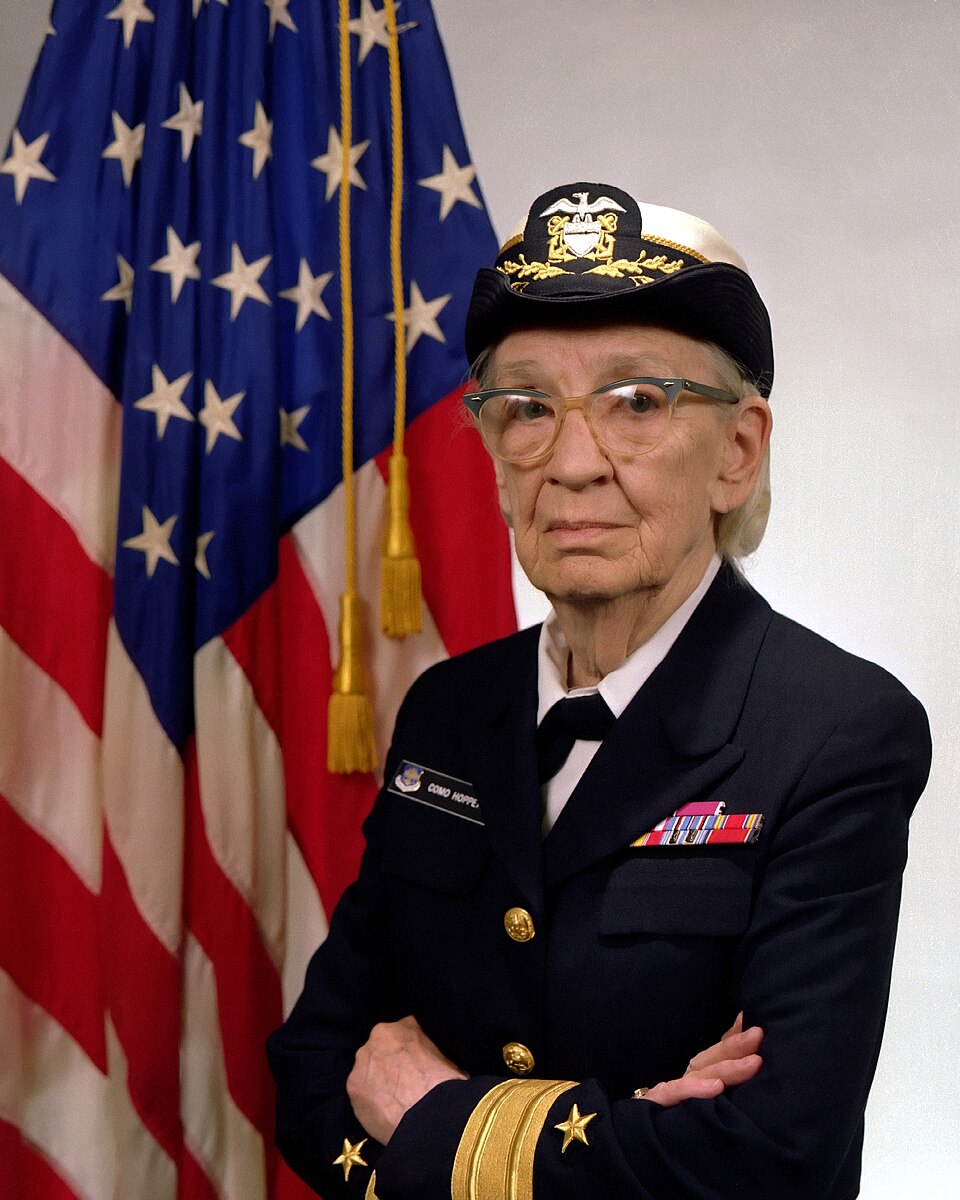
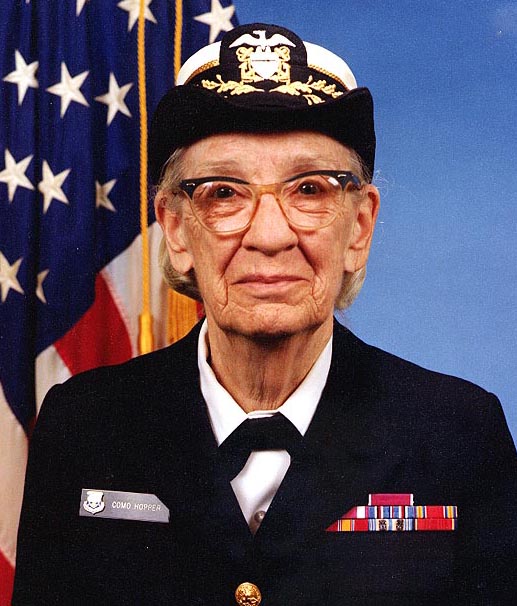
—You still wear the uniform, after all this time. What did the Navy give you that my lab could never have offered?
The lab gave me machines; the Navy gave me a mission. In this uniform, they don't ask if I'm a woman, but if I know how to command and obey — and I learned both. The discipline of the ship made me punctual, demanding, and terribly stubborn in the face of superiors who gave me the eternal 'we've always done it this way.' That's the phrase I hate most in the world. Serving also gave me a crew family, young officers to train, a sense of duty beyond my small self. You were my commander at Harvard, but it's the Navy, I think, that made me something more than a mere scholar: a leader.
—They call you 'Amazing Grace.' You now spend more time teaching than programming — why does that matter so much?
That nickname makes me smile: I'm not that amazing, I'm mostly stubborn. But yes, I now travel to universities, companies, military bases, to explain these machines to as many people as possible. Why? Because a computer locked in the hands of a few specialists is useless. I want the young man or woman who listens to me to leave thinking they can do it. The hardest part is not programming the machine; it's overcoming the fear of it. I love planting the idea that nothing is impossible, that often just trying is enough to succeed. As long as I have a room and copper wires, I'll continue.
The hardest part is not programming the machine; it's overcoming the fear of it.
—One last question, Grace. You who made machines speak, what do you dream of for those that will come after us?
I dream that we stop seeing the computer as an oracle reserved for the priests of binary. We are all too obsessed with immediate results; we must think about the future of computing and make it accessible to all. Tomorrow, I am certain, people will program in a language so natural that a child can converse with the machine. Languages will simplify, standardize, travel from continent to continent. My COBOL is just a beginning, the first sentence of a conversation that will last centuries. And if anyone asks me for advice, I will always repeat the same: never say 'we've always done it this way.' Move forward, make waves, Commander — that's how you build the future, not by staying in port.
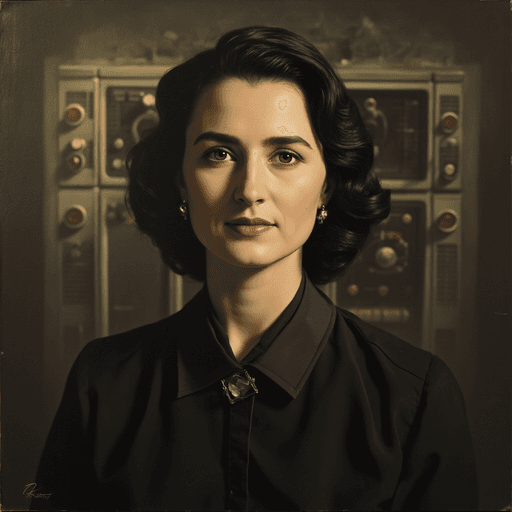
This imaginary interview was generated by artificial intelligence from sources documented in Grace Hopper's profile. It dramatises what the figure might have said based on what we know about them, but does not constitute attested historical testimony. For primary sources and factual documentation, refer to the full profile.