Imaginary interview with Grace Hopper
by Charactorium · Grace Hopper (1906 — 1992) · Technology · Sciences · 5 min read
Washington D.C., one evening in 1986. Grace Hopper has just taken off her US Navy uniform after more than forty years of service. In her office, where technical reports and coils of copper wire pile up, the rear admiral agrees to look back on a life spent teaching machines to speak our language.
—Do you remember the day someone first talked about a real insect in a computer?
September 9, 1947, at the Harvard Computation Laboratory. The Mark II had stopped, as finicky as an electromechanical beast can be. We took apart panel after panel, and there, stuck in relay number 70, was a moth, crushed between two contacts. My boys carefully peeled it off and taped it into the logbook with this note I've never forgotten: “First actual case of bug being found.” That's how, in a Cambridge lab, a moth gave the word “bug” its modern meaning. The page is now at the Smithsonian. I like the idea that a breakdown became a relic.
A moth stuck in a relay gave the word “bug” its modern meaning.
—Yet they kept telling you that a machine could never understand anything but numbers. How did you hold your ground?
I was told a hundred times, and in all good faith: “They told me computers could only do arithmetic.” I had a working compiler—the A-0, in 1952—and no one wanted to touch it. The idea that one program could translate another, that you could write in words rather than binary digits, seemed like a fantasy to them. But I was convinced that one day we would program in plain English, not machine code. From A-0 came FLOW-MATIC, then COBOL. I had to demonstrate, with the machine running, that the computer accepted verbs and nouns. Proof is worth a thousand speeches.
I had a working compiler, and no one wanted to touch it.
—Why were you so determined that non-mathematicians could program?
Because pure arithmetic is a narrow door. As long as you had to write every instruction in binary, on punch cards, only a few initiates could enter the room. With FLOW-MATIC, designed between 1955 and 1959, I wanted a language made of full English words, readable by an accountant, a manager, anyone with a task to entrust to the machine. COBOL is its direct descendant: a language for business, not just for scholars. A machine is worthless if only a handful of the chosen few know how to talk to it. My job, at bottom, was to translate—between man and relay.
A machine is worthless if only a handful of the chosen few know how to talk to it.
—Your students often mention those famous pieces of wire you handed out. What were they about?
A piece of copper wire thirty centimeters long—exactly the distance light travels in one nanosecond, that billionth of a second. Young engineers talked about speed without seeing anything behind the word. So I put this wire in their hand: “Here is your nanosecond. Light doesn't go any farther.” Suddenly they understood that a signal cannot cross a large room without losing precious time, that physics imposes its limits. During my lectures, from 1970 until my retirement, I gave out miles of it. They nicknamed me Amazing Grace; I think it was mainly for those wires.
“Here is your nanosecond. Light doesn't go any farther.”
—What were you really aiming for in all those popular science lectures?
To dispel fear. The computer frightened people—this mainframe that filled an entire room seemed like an inaccessible oracle. I spent my afternoons explaining compilation to my junior colleagues, and my evenings traveling the country repeating the same thing to students, officers, business leaders. The copper wire, the simple pictures—that was my way of making the invisible tangible. A concept you can't touch remains a superstition. I wanted that after listening to me, everyone would leave knowing that a machine is nothing magical—only relays, time, and patience.
A concept you can't touch remains a superstition.
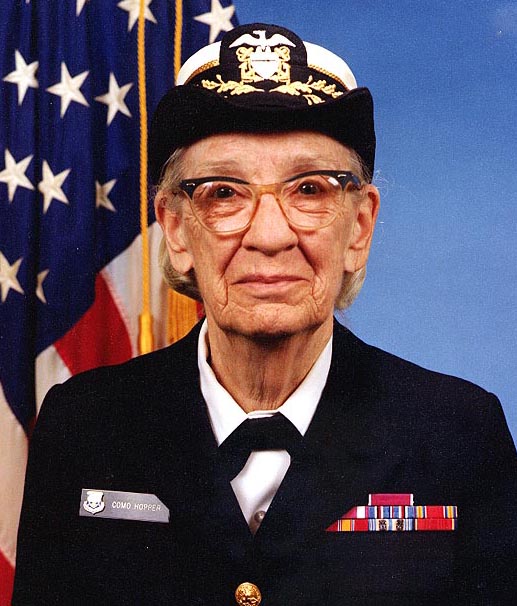
—You enlisted in the Navy at thirty-seven, despite an initial refusal. How did that come about?
In 1943, I wanted to serve. They told me I was too old, too thin for the standards, and more useful teaching mathematics. I insisted, got a waiver, and joined the WAVES, that women's reserve corps created the year before. They immediately sent me to Harvard to program the Mark I under Howard Aiken. I knew nothing about computers; I learned by writing their five-hundred-page manual. The Navy didn't just accept me: it gave me my first machine. I stayed until 1986.
The Navy didn't just accept me: it gave me my first machine.
—You liked, they say, to remind people that a ship in port doesn't fulfill its function. What did you want to convey by that?
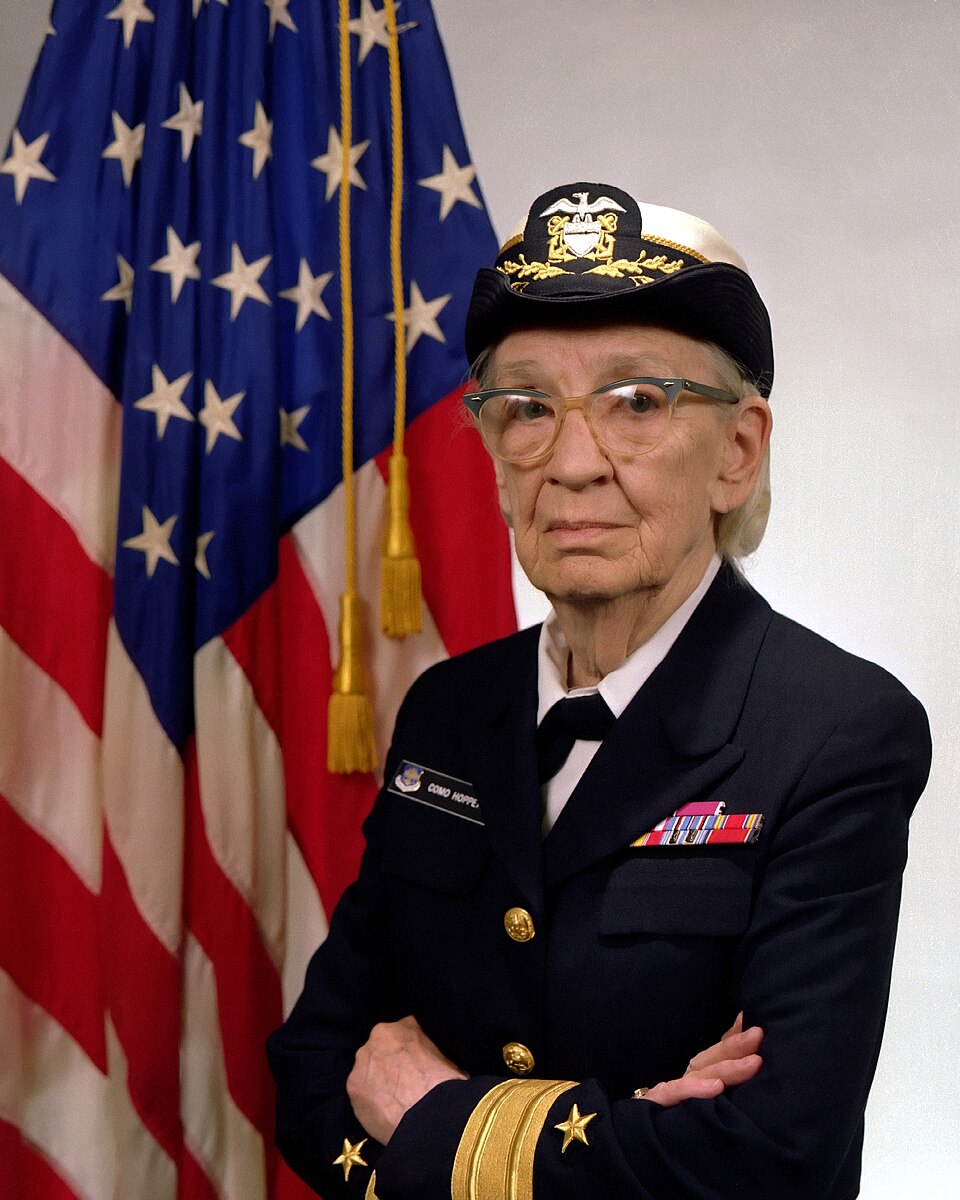
“A ship in port is safe, but that's not what ships are built for. Go out and do things, make waves.” That's what I repeated to young officers. A docked ship risks nothing; it also serves no purpose. I applied that to my own career: promoted to rear admiral by decree in 1983, I wore those gold stripes until seventy-nine, the oldest active-duty officer. The most dangerous phrase in our professions is: “We've always done it this way.” Leave port. Make waves. That's what ships are built for—and what minds are trained for.
“Go out and do things, make waves.”
—Why did you fight so hard for the standardization of COBOL?
Because a language that runs only on one manufacturer's machine is a dead end. From 1968, I campaigned for ANSI and ISO standards, so that a COBOL program written on one piece of hardware would work on another. That's the birth of this idea of computer standardization: making rival machines talk to each other, ensuring that code survives the machine that created it. They thought me stubborn. But without common standards, every company would have reinvented its own Tower of Babel. COBOL still runs banks and administrations today because we refused, early on, to lock it down.
Code must survive the machine that created it.
—Before Congress in 1959, you argued for long-term thinking. What did you mean?
That we were all too rushed. “We're all too focused on short-term results. We need to think about the future of computing and make it accessible to everyone.” That's what I told the legislators. At the time, everyone was chasing the quarter's results, the machine of the moment. I was thinking of decades. A standard, careful documentation—like that five-hundred-page manual I wrote for the Mark I—these are gifts to those who will come after us, whom we will never know. Building computing accessible to all meant building for programmers yet to be born.
A standard is a gift to those who come after us.
—Looking back, what do you take away from this story of the moth, which has become almost a legend?
That a well-observed breakdown is worth a lesson. The word “bug” already existed among engineers for a defect; but on that September 9, 1947, at the Mark II, we held the culprit in our fingers for the first time, a real insect. My boys had the humor to pin it in the logbook. All my life, I wanted people to look the machine in the face, without fearing it or deifying it. A relay jammed by a moth, a copper wire in the hand: these are the small concrete things that demystify the big ones. The legend I leave to the Smithsonian; I keep the method.
A well-observed breakdown is worth a lesson.
This imaginary interview was generated by artificial intelligence from sources documented in Grace Hopper's profile. It dramatises what the figure might have said based on what we know about them, but does not constitute attested historical testimony. For primary sources and factual documentation, refer to the full profile.