Kids interview Hannah Arendt
by Charactorium · Hannah Arendt (1906 — 1975) · Philosophy · Politics · 4 min read

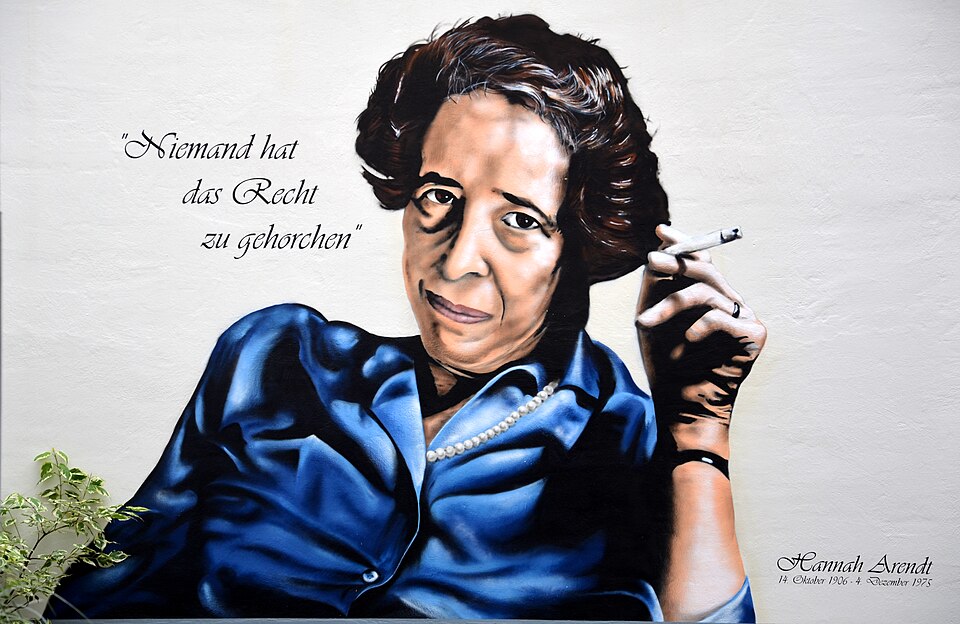
That morning, two young visitors on a school field trip pushed open the door of a New York apartment filled with books. A lady in a dark suit, a cigarette in her hand, greeted them with a big smile. Her name was Hannah Arendt, and she loved it when children came to ask her questions.
—How old were you when the police arrested you? Were you scared?
I was twenty-six, my child. It was in 1933, in Berlin. The secret police, the Gestapo, took me because I had copied down texts full of hatred against the Jews. Yes, I was scared. Imagine being locked up for eight days, not knowing if you'll get out. But the policeman who interrogated me was young and a bit lost. I made up stories, and he let me go. So I fled on foot, through the mountains, to Paris. That day, I understood one simple thing: thinking in your corner is no longer enough. When the world turns mean, you have to act.
When the world turns mean, thinking in your corner is no longer enough.
—What was it like to leave without a country, just with a suitcase?
You know, for a long time I carried just one suitcase with all my belongings inside. Imagine: you no longer have a home, no country that wants you. That's called being stateless — someone no state recognizes. I only had a small refugee paper to travel with. In 1940, France even locked me up in a camp, at Gurs, in the southern mountains. I escaped during the chaos. It's hard, you know, to be from nowhere. But it taught me something immense: having the right to belong to a country is a treasure you don't see as long as you have it.
Belonging to a country is a treasure you don't see as long as you have it.
—Why did you write an entire book about such horrible things?
Because I wanted to understand, my child. How could entire countries become machines for crushing people? I wrote The Origins of Totalitarianism in 1951. Totalitarianism is when the state wants to control everything: what you do, what you say, even what you think at night. Imagine a house where someone watches even your dreams. The worst part is that such a system treats people as if they're useless, as if they're superfluous. That's what I wanted to show so that it never happens again.
Totalitarianism wants to control even what you think at night.
—Didn't you ever want to stop, studying such sad things all the time?
Often, yes. In the evening, I would put down my pen and feel heavy. But look: if no one tells how evil arrives, it comes back in secret. I studied two monsters at the same time, the Nazi regime — the Third Reich — and Stalin's. Both wanted obedient people like little machines, without a mind. I believe exactly the opposite of that. I believe that a human being must keep their own thinking, always. It is even our greatest weapon. Understanding evil is not excusing it: it's learning to recognize it before it grows.
Understanding evil is not excusing it: it's learning to recognize it.
—Did you really see a man who had hurt a lot of people?
Yes. In 1961, I went to Jerusalem for a newspaper, the New Yorker. There, a man named Eichmann was being tried, who had organized the deportation of thousands of Jews. I expected to see a terrifying monster. And you know what I saw? A gray, boring little bureaucrat, who kept repeating that he had just "obeyed orders." It chilled me. He never thought about what he was doing. I called that the banality of evil: the terrible idea that immense horrors can be committed by very ordinary people who have stopped thinking.
The most terrible evil is often committed by people who have stopped thinking.

—Did people agree with you? Or did they get angry?
Oh, many got angry, my child! Very angry. When my book Eichmann in Jerusalem came out in 1963, some thought I was making excuses for that criminal. Not at all! I only said he wasn't a demon, but a hollow man. And that, that is even scarier. Friends distanced themselves from me. It was painful. But I preferred to tell the uncomfortable truth rather than a pretty false story. You see, thinking for yourself sometimes costs friendships. But it's always worth the price.
I preferred an uncomfortable truth to a pretty false story.
—What's the difference between working and acting? To me they're the same!
Good question, I'll help you see! In my book from 1958, The Human Condition, I separate three things. Labor is everything we do over and over to live: eating, cleaning. Work is making an object that lasts, like a table or a book. And action is when you stand up before others to say what you think and decide together. Imagine a large square where everyone speaks as equals. To me, that is the most beautiful and most human of all.
Acting is standing up before others to decide together.
—Did you come up with that idea alone, or did someone help you?
No one really thinks alone, my child. I constantly reread the sages of ancient Greece, especially Aristotle. I had his book, the Politics, full of notes in the margins. Those people would gather in a large square they called the agora to debate. There, they were neither rich nor poor: just equal citizens speaking. That image accompanied me all my life. I took that old idea from very long ago and brought it into my own world. Old books, you see, are friends who still speak to you.
Old books are friends who still speak to you.
—What was it like at your place in the evening? What did your home smell like?
Ah, my evenings! That was my favorite time. I lived in New York, in an apartment overflowing with books, with my husband Heinrich. In the evening, friends would come — writers, thinkers who had come from Europe like me. It smelled of strong coffee and cigarette smoke, because I smoked a lot, I admit. We talked for hours, laughed, argued gently over a simple meal. Those conversations nourished my ideas better than any book. I went to bed late and got up late. For me, talking with friends was already a way of thinking.
Talking with friends was already a way of thinking.
—Is it true you typed your books yourself on a typewriter?
Absolutely! I typed each page myself on my old typewriter, an Olivetti. Imagine a small keyboard that clacks loudly, with no screen, just ink on paper. I also kept a secret notebook, my Denktagebuch, my "thinking diary," where I jotted down my ideas over the years. And you know what's most touching? On the evening of my death, in 1975, my typewriter was left open on the desk, with the last page of a text I never finished. I thought until the very last moment. That, I think, is a beautiful way to go.
I thought until the very last moment.
This imaginary interview was generated by artificial intelligence from sources documented in Hannah Arendt's profile. It dramatises what the figure might have said based on what we know about them, but does not constitute attested historical testimony. For primary sources and factual documentation, refer to the full profile.