Imaginary interview with Hannah Arendt
by Charactorium · Hannah Arendt (1906 — 1975) · Philosophy · Politics · 6 min read

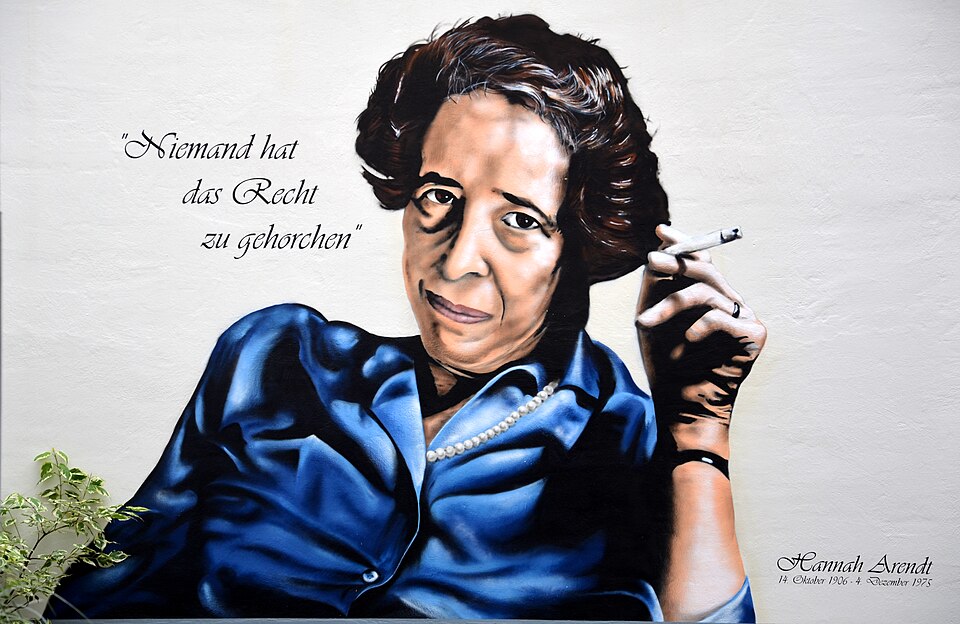
New York, winter 1974. In an Upper West Side apartment cluttered with books, a woman receives us cigarette in hand, the Olivetti still warm on the desk. Hannah Arendt speaks softly, with the accent of Königsberg that never left her.
—What remains in you of that night in 1933 when the Gestapo knocked at your door?
I was arrested for having copied, at the Berlin State Library, the anti-Semitic slogans the regime was spreading. Eight days of interrogation, and an almost kind policeman who understood nothing of what he was reproaching me for. It was then, I think, that I ceased to be a young woman interested only in philosophy. I understood that one could no longer be content to think in one's corner while the world was burning outside. When I was released, I left for Paris through the mountains, with almost nothing. A suitcase. That suitcase, you see, I kept in my mind all my life: it contained all that remained of a country that no longer wanted me.
One could no longer be content to think in one's corner while the world was burning outside.
—You lived years without any nationality at all. How would you describe that condition?
Stateless. The word is cold, administrative, and yet it describes the most brutal experience of the century. At Gurs, in 1940, I was interned as an 'enemy alien'—I who had fled the enemies! A few weeks later, in the chaos of the French defeat, I escaped, then reached the United States thanks to visas that a courageous American, Varian Fry, wrested from the bureaucracy. But for years, my only identity was a refugee document. I learned in my flesh something that declarations of rights always forget: having rights presupposes first belonging to a community that recognizes you. Without that, man is nothing but a naked man—and it is precisely that nakedness that the century trampled.
Having rights presupposes first belonging to a community that recognizes you.
—Why did you devote years to The Origins of Totalitarianism when the war was over?
Because the war explained nothing. Nazism and Stalinism were not old-style tyrannies, where a despot oppresses you but lets you live in fear. They were something else, unprecedented. I wrote in 1951 that totalitarianism does not seek the domination of men, but 'a system in which men are superfluous.' That is the heart of the abyss: making human beings superfluous, interchangeable, disposable. The Third Reich turned people into conditioned reflexes, in camps that were laboratories of this superfluity. My work was not to accuse—History took care of that—but to understand how such a thing could have become possible, so that we could at least recognize it if it returned under another face.
Totalitarianism does not seek the domination of men, but a system in which men are superfluous.
—To understand such evil, isn't that risking excusing it?
I have been reproached for that all my life, and I understand it. But understanding is not forgiving. Understanding means refusing to take refuge in reassuring clichés—'monsters,' 'the devil,' 'the madness of a people.' These words close thought at the very moment it should be opened. At my worktable here in New York, I spent nights rereading the regime's documents, trying to grasp the cold mechanism that made horror function. The danger is not understanding too much; it is giving up understanding, being content with indignation. Indignation is a comfortable feeling. Thought, on the other hand, is restless, it disturbs, it keeps you awake. Yet it is the only thing that arms us against repetition.
Indignation is a comfortable feeling. Thought, on the other hand, is restless, it disturbs, it keeps you awake.
—Do you remember your first impression upon seeing Eichmann in his glass booth in Jerusalem?
I expected a monster. I found a bureaucrat. It was in 1961, I was attending the trial for the New Yorker in Jerusalem, and this man in his glass cage spoke in ready-made formulas, in administrative jargon. He was not stupid; he was incapable of thinking, that is, of putting himself in another's place. From that came the expression that cost me so much: the banality of evil. Not that evil was small—it was immense—but that it could be carried out by a perfectly ordinary man, concerned with his career, proud to obey. I wrote that this 'fearsome banality of evil defies words and thought.' That remains, for me, the most terrible discovery of the trial.
I expected a monster. I found a bureaucrat.

—That phrase sparked a storm, even within your own community. How did you experience it?
With pain, I admit. I was accused of not loving my people, of being cold, arrogant. My old friend Gershom Scholem wrote to me that I lacked love for the Jewish people. I replied to him in 1963 that I had never loved a people or a collective, but persons—and that moreover the only thing occupying me then was indeed 'the Jewish question.' What they reproached me for, basically, was having refused the consolation of simple images: the diabolical executioner, the spotless victim. The truth I had seen in that courtroom was more uncomfortable, and therefore more unbearable. To think against the expectations of one's own friends: that is the solitude that sometimes accompanies honesty.
I have never loved a people or a collective, only persons.
—In Marburg, in 1924, you were Heidegger's student. What does the philosopher owe to that encounter?
Marburg, I was eighteen. Martin Heidegger taught a whole generation that thinking was a living, dangerous activity, not the repetition of an academic catechism. He made philosophy breathable again. I will not hide that there was between us, at that time, something more than a master-student relationship—I was young, and he was a comet. Later, his alignment with the regime was for me a wound and an enigma: how could a man capable of thinking so deeply have been so blind in the world of human affairs? That contradiction haunted me. It taught me, no doubt, that the depth of thought in no way guarantees the soundness of political judgment.
How could a man capable of thinking so deeply have been so blind in the world of human affairs?
—And Karl Jaspers, under whom you defended your thesis, what place does he hold in your life?
Jaspers was the opposite of a comet: a fixed star. It was under his direction that in Heidelberg, in 1929, I defended my thesis on the concept of love in Saint Augustine. But what matters much more than that degree is the friendship that followed, and the decades of letters we exchanged across the ocean. We did not always agree—on post-war Germany, on the Jewish question, our pens sometimes balked. And yet writing to Jaspers was thinking out loud, knowing that a loyal intelligence would answer me without complacency. He showed me that one always thinks better together, in dialogue, than alone in one's tower. That is a lesson I never forgot at my typewriter.
Writing to Jaspers was thinking out loud, knowing that a loyal intelligence would answer me.
—In The Human Condition, you distinguish labor, work, and action. Why does the latter matter so much to you?
Because it is through action that we become fully human. Labor keeps us alive like animals; work fabricates the world of durable objects. But action—the act of speaking and acting among others—that is what reveals who we are. I wrote in 1958 that the Greek public space was 'the space of freedom, where men appear to each other as men.' The Greeks called this the vita activa. On my desk there is always my Politics by Aristotle, annotated to the point of wear, because he was the first to understand that man truly exists only by showing himself to his equals. A life without this shared space is not only sad: it is deprived of the world.
Action reveals who we are; a life without shared space is deprived of the world.
—Do you see this public space threatened in the modern world?
Constantly. The great danger of our time is not open tyranny, but withdrawal: men who care only about producing and consuming, who abandon the agora for private comfort. Yet when the public space empties, only mass solitude remains—and it is precisely that ground, I have shown, that totalitarianism plows to sow its seeds. Freedom is not a good kept in a chest; it exists only as long as it is exercised, together, by appearing before one another. The young people who take to the streets these days, who practice civil disobedience, give me hope: they have understood, perhaps without knowing it, that freedom is an activity, never a possession.
Freedom is not a good kept in a chest; it exists only as long as it is exercised, together.

This imaginary interview was generated by artificial intelligence from sources documented in Hannah Arendt's profile. It dramatises what the figure might have said based on what we know about them, but does not constitute attested historical testimony. For primary sources and factual documentation, refer to the full profile.