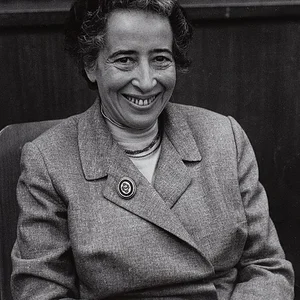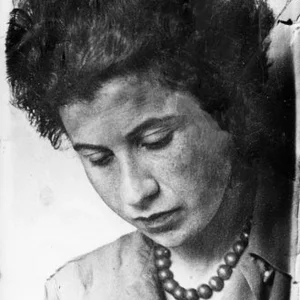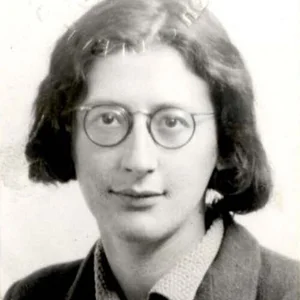

French philosopher (1909-1943) committed to social and spiritual engagement. She combined philosophical reflection with direct action alongside workers and the oppressed, while developing an original mystical thought. Her work, published posthumously, explores the relationships between labor, justice, and transcendence.
Simone Weil(1909 — 1943)
Simone Weil
France
9 min read
Frequently asked questions
Famous Quotes
« Attention is the rarest and purest form of generosity.»
« Affliction is the only source of consciousness.»
« The conception of perfect happiness that could exist after death is one of the most pernicious illusions.»
Key Facts
- 1931: Passes the agrégation in philosophy; begins teaching at secondary school
- 1934–1935: Works in factories (Renault, Alsthom) to experience working-class life firsthand
- 1936: Fights alongside the Republicans during the Spanish Civil War
- 1942: Goes into exile in England; writes her major works (Gravity and Grace, Waiting for God)
- 1943: Dies at 34 from tuberculosis, having refused to eat more than the official ration in France
Works & Achievements
A collection of thoughts and meditations written during the Second World War, exploring the relationship between the soul, the body, and divine transcendence. One of her major works, in which she develops her personal mystical spirituality.
A collection of letters and spiritual reflections written after her mystical experience of 1938, in which she sets out her spiritual journey and her vision of a secular spirituality. This text illustrates her intense spiritual quest and her commitment to the transcendent.
A collection of political and social essays analyzing the mechanisms of oppression and the conditions for genuine freedom. These texts reflect her deep thinking on social justice and human dignity.
A collection of notebooks and essays based on her direct experience of factory work (1934–1935), offering a critical analysis of industrial labor and its dehumanizing effects. It stands as a unique testament to philosophical engagement alongside the working class.
Philosophical and spiritual reflections on eternity and transcendence, developing her original mystical thought. This work synthesizes her vision of a spirituality accessible outside traditional religious structures.
Publication of her personal notebooks written between 1933 and 1943, containing philosophical reflections, social and political analyses, and spiritual meditations. These notebooks offer an intimate and comprehensive view of her evolving thought.
A political and philosophical essay written in exile in England, proposing a reflection on the spiritual and material needs of peoples and a critique of the modern conception of progress. It was her last major, unfinished intellectual project.
Anecdotes
In 1934, Simone Weil left her post as a philosophy teacher to work as a laborer in a Renault factory. For several months, she directly experienced the conditions of factory workers, sharing their exhaustion and suffering. This experience profoundly transformed her thinking and became the foundation of her reflections on the oppression of labor.
During World War II, Simone Weil went into exile in England and joined the Free French government. She died in 1943 in London, at just 34 years old, most likely from tuberculosis worsened by her refusal to eat more than the official ration allocated to occupied France, out of solidarity with her compatriots.
Simone Weil taught herself ancient Greek out of passion and read Homer in the original. Her fascination with Greek civilization led her to reflect deeply on the balance between force and justice in ancient tragedy — a central theme throughout her philosophical work.
In 1936, Simone Weil joined the Republicans during the Spanish Civil War, fighting alongside a column of anarchist militiamen. Although she did not see direct combat (an accident in camp left her injured), the experience deepened her conviction that standing alongside the oppressed was a moral necessity.
Simone Weil's writings were only published after her death, compiled from notebooks and fragments. Her influence grew steadily during the second half of the 20th century, particularly among critical thinkers who recognized in her a prophetic voice on alienation and social justice.
Primary Sources
Affliction is the only source of knowledge. It is above all in this that affliction brings us closer to God. Consequently, a disease of the soul must be treated like a disease of the body.
Everyone is hungry and cold. Everyone is afraid. Everyone feels weak and morally degraded. That is enough to turn human beings into beasts.
I was born in the only country where the Greco-Roman, Hebrew, and Christian traditions had all come together — France. That is why the thought of losing my ability to draw upon this heritage seemed unbearable to me.
Work should be an opportunity for the worker to develop his thought. If it is not, it is a crime against human nature.
Justice is the establishment of something so deeply rooted in nature that its absence constitutes a certain form of death.
Key Places
Birthplace of Simone Weil on February 3, 1909. The capital was the center of her intellectual formation and her early philosophical and labor union activities.
Simone Weil studied philosophy here between 1928 and 1931. It was at this prestigious institution that she received her in-depth philosophical training and developed her critical thinking.
Simone Weil worked here as a factory worker in 1934–1935 to directly experience the conditions of the working class. This experience transformed her thinking and fueled her reflections on labor and oppression.
Simone Weil taught at a secondary school here and became involved with labor movements and the unemployed. This Mediterranean city was a major site of her social engagement and her early spiritual encounters.
Simone Weil joined the French government-in-exile in 1943 to contribute to the war effort. It was also here that she continued her intellectual work on the reconstruction of France.
Simone Weil died here on August 24, 1943, from tuberculosis. This English hospital marks the end of her life at just 34 years old, leaving behind a profound body of work that was largely unpublished during her lifetime.
Typical Objects

Simone Weil was a prolific intellectual who recorded her philosophical reflections in personal notebooks. Published after her death, these journals form an essential part of her legacy and bear witness to her intense work ethic and her commitment to rigorous thought.

To experience firsthand the reality of working-class exploitation, Simone Weil took factory jobs and wore laborer's clothes. These garments symbolize her radical commitment to sharing the condition of the oppressed rather than remaining in an ivory tower of philosophy.

The defining intellectual tool of the twentieth century, the typewriter allowed philosophers and writers to produce their work. Simone Weil used one to compose the essays, letters, and reflections that would make up her posthumous body of work.

Simone Weil developed a singular mystical philosophy inspired by various religious traditions. The spiritual texts she read and annotated reflect her personal quest to reconcile social action with transcendence.

A symbol of working-class activism in the interwar period, these badges represent Simone Weil's involvement in the social and labor movements of her time, including her support for workers' struggles.

Her letters — particularly those addressed to her mother and to fellow intellectuals — reveal the depth of her thinking and her personal convictions. This correspondence has become a major historical source for understanding her life and philosophy.

Although of Jewish heritage, Simone Weil gradually drew closer to Christianity, which profoundly shaped her mystical thought. The cross symbolizes this spiritual dimension of her philosophical and existential journey.
School Curriculum
Vocabulary & Tags
Key Vocabulary
Tags
Concept
Daily Life
Morning
Simone Weil rises early, austere in her habits. She devotes these hours to reading and philosophical reflection, frequently interrupted by the chronic migraines that have plagued her since adolescence. Before heading to work or her various commitments, she eats a frugal breakfast, often refusing to eat properly as an act of solidarity with workers and the poor.
Afternoon
During the 1930s, she teaches philosophy at various French secondary schools, preparing her lessons with rigor while also seeking to shape her students through her social convictions. She devotes considerable time to intensive reading in Greek philosophy, mathematics, and literature — the fields that structure her thinking. Her afternoons are often disrupted by her involvement in labor movements and factory visits, where she seeks firsthand understanding of working conditions.
Evening
In the evenings, Simone continues her studies and writes her reflections in notebooks, developing her philosophical and mystical thought. She frequents Parisian intellectual circles, debating with fellow thinkers, though her uncompromising character often leaves her isolated. She retires early, worn down by her commitments and chronic physical suffering.
Food
Her diet is deliberately ascetic and restrictive — she refuses the comfort of food on ethical grounds and out of solidarity with exploited classes. She lives mainly on bread, cheese, fruit, and simple vegetables, avoiding meat and anything deemed too luxurious. During the Second World War and her exile in England, she reduces her portions even further, which contributes to the deterioration of her already fragile health.
Clothing
Simone Weil dresses in a careless, austere manner, wearing simple, worn dresses or skirts that often fit poorly. Her general appearance is that of a woman wholly indifferent to bourgeois standards of elegance, reflecting her contempt for social vanity. Her hair is usually tied back simply, and she rarely wears accessories or ornaments — visually embodying her philosophical asceticism.
Housing
Simone lives in modest lodgings — apartments or student rooms — often sharing her living space with other intellectuals or activists. Her living quarters are cluttered with books, manuscripts, and philosophical notes, reflecting her total dedication to study and thought. She refuses any comfortable furnishings, viewing housing as a bare necessity rather than a personal refuge.
Historical Timeline
Period Vocabulary
Visual Style
Un style visuellement austère et spirituel fusionnant modernisme géométrique avec réalisme social. Les illustrations privilégient le contraste entre l'univers ouvrier brut et une dimension mystique intemporelle, utilisant nuances de gris, teintes ocre et accents d'or pour symboliser la quête de transcendance au cœur de l'engagement politique.
Sound Ambience
Une ambiance sonore qui capture la tension entre l'engagement ouvrier de Simone Weil et sa quête spirituelle, mêlant les bruits sourds de l'usine aux silences contemplatifs de la méditation, entre la réalité sociale du travail et l'aspiration mystique.
Liens externes & ressources
Références
Œuvres
La Pesanteur et la Grâce
1947 (posthume)
Attente de Dieu
1950 (posthume)
Oppression et Liberté
1955 (posthume)
La Condition ouvrière
1951 (posthume)
Intimations d'Immortalité
1952 (posthume)
Cahiers
1951-1956 (posthume)
L'Enracinement ou Besoins de l'âme
1949 (posthume)