Imaginary interview with He Zehui
by Charactorium · He Zehui (1914 — 2011) · Sciences · 5 min read
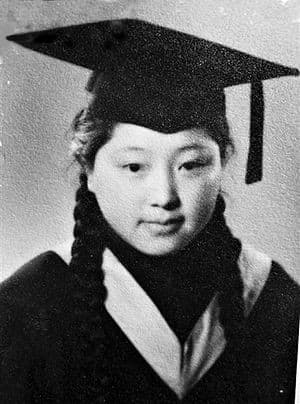
Beijing, a winter morning, in an apartment where the shelves sag under physics journals and tea grows cold near a stack of reprints. He Zehui, small, dressed in a sweater worn to the thread, sits down without ceremony. She speaks softly, with the precision of someone who has spent her life measuring invisible tracks under a microscope.
—What was it like to arrive at the Tsinghua physics department in 1932?
I was eighteen and had one fixed idea: physics. The department director had another fixed idea: that this discipline was not for girls. He would take us aside, the few female students, and politely suggest we go elsewhere—biology, literature, it didn't matter, as long as we freed up the space. At Tsinghua, they didn't throw me out the door; they invited me to leave through the window. I turned a deaf ear. For four years, I worked on my equations like sharpening a tool, and in 1936 I graduated valedictorian of my class. It wasn't pride: I simply wanted a demonstration to answer a prejudice. Numbers, after all, don't know the gender of the person arranging them.
They didn't throw me out the door; they invited me to leave through the window. I turned a deaf ear.
—Where did you find the tenacity to hold firm in the face of this contempt?
Tenacity, for me, never had the air of a revolt. Rather, it was a stubborn patience, the same I later found bending over an emulsion for hours, measuring a trace a tenth of a millimeter long. I come from a family in Suzhou where study was considered a duty, not an ornament. So when I was told a woman would never understand mechanics, I didn't argue: I handed in my exam. Arguing makes noise; succeeding makes silence, and silence carries more weight. I understood very early that the best refutation of an unjust judgment is a clean, verifiable result that can neither be contested nor attributed to luck.
—Why, in 1938, did you choose a science as warlike as ballistics in Berlin?
Because my country was burning. After the Marco Polo Bridge Incident in 1937, Japan was sweeping through China, and I could not stay contemplating spectral lines while my provinces were being bombed. Ballistics—the science of projectile trajectories—seemed the most direct service a physicist could render to an invaded nation. So I left for the Institute of Technology in Berlin, in a Germany itself on the brink, to study how projectiles fly. They looked at me like a curiosity: a young Chinese woman demanding access to a military specialty reserved for men. I insisted until the door gave way. Science, for me, was never a contemplative luxury; it had to serve.
I could not stay contemplating spectral lines while my provinces were being bombed.
—What did it mean to be the first woman admitted to this specialty and then to earn a doctorate there in 1940?
At the time, it didn't flatter me: it was mainly one more administrative obstacle. They didn't open this path for me; I forced it. In 1940, when I defended my thesis in Berlin, I was the only woman in the room, and you'd have thought the diploma itself was surprised to fall to me. But I quickly realized something else: every first opens a breach for those who follow. If a door opens a crack for one, it will never close completely. I wasn't thinking about posterity, only about returning useful. Yet I know today that that small hole in a German wall counted as much, perhaps, as my trajectory calculations.
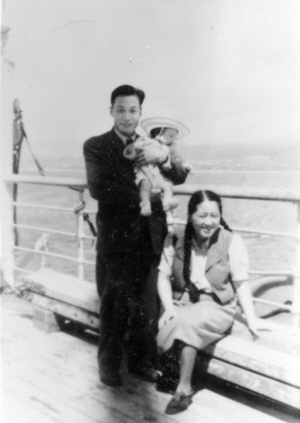
—They say your marriage began with a twenty-five-word letter. Do you remember that message?
War rationed everything, even words. International mail between Germany and France was limited to twenty-five words—not a syllable more. It was in that tiny space that Qian Sanqiang, who had stayed in Paris, fit his marriage proposal. Imagine: declaring your entire life in as many words as a business telegram. There was no room for frills, only for the essential, which, all things considered, makes it truer than a long poem. I said yes, in the same economical format. We married in Paris in 1946. Two physicists who, accustomed to measuring, had learned to say much with very little.
Declaring your entire life in as many words as a business telegram.
—Tell us what you observed, with your husband, in the Joliot-Curies' laboratory.
We bombarded uranium with a radium-beryllium neutron source and recorded what the nuclei left on nuclear emulsion plates. Since Hahn and Meitner, it was known that a heavy nucleus, when struck, splits in two. But under the microscope, we saw nuclei breaking not into two, but into three, and sometimes four distinct fragments, each shard tracing its own claw mark in the gelatin. Tripartition, quadripartition: it wasn't in the program. We had to count, recount, establish the frequency of these rare fissions. Frédéric and Irène Joliot-Curie did not hide their satisfaction; they considered it the finest thing to come out of their laboratory since the war.
Each shard traced its own claw mark in the gelatin.
—The press nicknamed you the "Marie Curie of China." How did you take that label?
With a mix of embarrassment and gratitude. The comparison overwhelmed me: Marie Curie had pioneered radioactivity, and here I was being crowned with her name for a few fragments counted in an emulsion. Western newspapers love catchy phrases; that one, in 1947, sold papers. I preferred they talk about the work, not the person. That said, there was a real lineage in that Parisian laboratory: we worked among the Curies' direct heirs, with the same patient instruments, the same discipline of detail. So if they insisted on that nickname, I accepted it as one accepts an honorable burden: less a crown than a debt to the one who came before me.
—Back in China, how do you build nuclear physics when the country has almost nothing?
You build it with what you have, and you refuse to beg for the rest. In the 1950s, our nuclear emulsion plates came from abroad, expensive, scarce, arriving in drips. I undertook to make them at home, by hand, adjusting the gelatins until we got plates sensitive enough to capture a particle's track. It was obscure work, almost like cooking, but it made us free: a laboratory that depends on a distant supplier is not master of its questions. At the same time, we were building the first laboratories of the Institute of Modern Physics, and I was training young people in that microscope patience. A national science cannot be imported; it is sown, researcher by researcher.
A laboratory that depends on a distant supplier is not master of its questions.
—You were one of the country's greatest physicists, yet you took the bus in old clothes. Why this chosen austerity?
Because I saw no austerity in it. I kept the same clothes for a long time, sometimes patched, I took the bus like everyone else, and I lived in a modest apartment in Beijing. It was not about any displayed virtue: simply, what interested me rarely cost money—an equation, a well-measured track, a student who finally understands. Comfort seemed a distraction, a background noise I could do without. My meals were rice and vegetables; my evenings were shared between journals and physics discussions with Qian Sanqiang. I was elected to the Academy of Sciences in 1980; that changed nothing about the cut of my coat. Recognition is pleasant, but it is not worn on the shoulders.
This imaginary interview was generated by artificial intelligence from sources documented in He Zehui's profile. It dramatises what the figure might have said based on what we know about them, but does not constitute attested historical testimony. For primary sources and factual documentation, refer to the full profile.