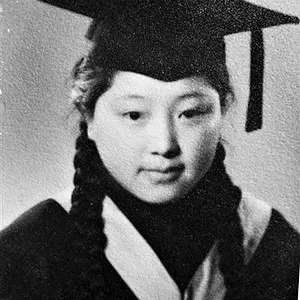

He Zehui was a Chinese nuclear physicist and a pioneer of particle physics in China. Together with her husband Qian Sanqiang, she studied the fission of uranium and helped found nuclear research in China. She is sometimes called the “Marie Curie of China.”
Frequently asked questions
Key Facts
- Born in 1914 in Suzhou (China), into a family of scholars.
- Graduated in physics from Tsinghua University, then earned a doctorate in Germany (Berlin) in 1940 in the field of ballistics.
- With her husband Qian Sanqiang, she observed the ternary and quaternary fission of uranium in Paris (Frédéric Joliot-Curie's laboratory) around 1946-1947.
- Having returned to China in 1948, she took part in founding the country's nuclear research.
- Died in 2011 in Beijing, regarded as a pioneer of Chinese physics.
Works & Achievements
A thesis on ballistics defended in Germany; she was the first woman to earn a degree in this field, determined to help China defend itself.
Together with Qian Sanqiang, she observed uranium splitting into three or four fragments, a major advance in the understanding of fission.
In China she developed photographic emulsions capable of detecting particles, freeing the country from its dependence on foreign supplies.
She helped create the first Chinese nuclear physics laboratories and trained a generation of researchers there.
In the second half of her career, she steered Chinese research toward the study of cosmic rays and high-energy astrophysics.
An official recognition of her pioneering role, she became one of the few women members of the Chinese Academy of Sciences.
Anecdotes
In 1932, He Zehui entered the physics department at Tsinghua University. The head of the department believed that physics was not suitable for women and tried to push the female students to switch majors. He Zehui refused to give in and graduated top of her class in 1936, proving him wrong.
As Japan invaded China, He Zehui deliberately chose to study ballistics (the science of the trajectories of shells) at the Berlin Institute of Technology, in order to help her country defend itself. She became the first woman admitted to this German military specialty.
During the Second World War, international mail was limited to 25 words. It was through these tiny letters that Qian Sanqiang, who had stayed in Paris, proposed marriage to He Zehui, who had remained in Germany. She accepted, and they were married in Paris in 1946.
In 1946-1947, in the Joliot-Curies' laboratory in Paris, He Zehui and her husband observed a uranium nucleus splitting not into two but into three, then four fragments. The Western press was thrilled and nicknamed her “the Marie Curie of China.”
After returning to China, He Zehui lived her whole life with great simplicity: she wore old patched clothes, took the bus and lived in modest housing, even though she was one of the country's greatest physicists.
Primary Sources
The authors describe the observation, in photographic emulsions, of uranium nuclei breaking into three fragments (tripartition) and four fragments (quadripartition) under bombardment by neutrons.
The article details the measurement of the tracks left by fission fragments and establishes the frequency of these multiple fissions, a phenomenon still little known in uranium.
The Joliot-Curies publicly praised the quality of the young Chinese couple's experimental work, regarding their discovery on uranium fission as the most important achieved in their laboratory since the war.
Key Places
City in Jiangsu where He Zehui was born in 1914, into a cultured family devoted to education.
Leading university where she studied physics from 1932 to 1936 and graduated top of her class despite prejudice.
German institution where she studied ballistics and earned her doctorate in 1940, the first woman admitted to this field.
Parisian laboratory of Frédéric and Irène Joliot-Curie where she and her husband discovered the ternary and quaternary fission of uranium.
Research center she helped found, shaping Chinese nuclear physics after her return in 1948.
Typical Objects
Plates coated with a sensitive gelatin in which charged particles leave tracks visible under the microscope. He Zehui used them to observe the fission of uranium.
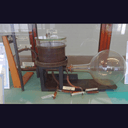
A device filled with supersaturated vapor in which the passage of a particle leaves a trail of droplets. It makes it possible to “see” invisible particles.
📷 CC BY-SA 4.0 · Wikimedia Commons ↗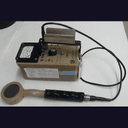
An instrument that detects and counts radiation by emitting a click for each particle it captures. A basic tool of every nuclear physics laboratory.
📷 Domaine public · Wikimedia Commons ↗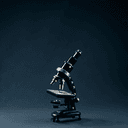
An optical microscope used to examine and measure, micron by micron, the tiny tracks left in nuclear emulsions.
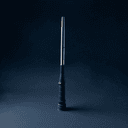
A small source combining radium and beryllium that emits a flux of neutrons. These neutrons were used to bombard uranium to trigger its fission.
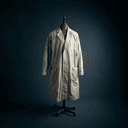
A white coat worn to protect against radioactive products and contamination, a symbol of the patient work of physicists in the laboratory.
School Curriculum
Vocabulary & Tags
Key Vocabulary
Daily Life
Morning
At the laboratory, the morning began early: He Zehui prepared her neutron sources and emulsion plates, checked the equipment and launched experiments bombarding uranium. Precision and patience were her watchwords.
Afternoon
The afternoon was often spent bent over a microscope, measuring one by one the tiny tracks left by fission fragments. This observational work, long and painstaking, could last for hours.
Evening
In the evening, she read scientific journals, analyzed her results and discussed physics with her husband Qian Sanqiang. Family life and research were constantly intertwined.
Food
He Zehui led a frugal life and ate simply, without seeking comfort. In China, her meals remained modest, based on rice, vegetables and ordinary dishes.
Clothing
At work, she wore the white coat of physicists. Outside, she dressed with great simplicity, keeping old, sometimes patched clothes for a long time.
Housing
She lived in modest dwellings, first in Europe and then in an apartment without luxury in Beijing, faithful to her sober way of life despite her scientific fame.
Historical Timeline
Period Vocabulary
Liens externes & ressources
Références
Œuvres
Doctorat en balistique (Berlin)
1940
Découverte de la fission ternaire et quaternaire de l'uranium
1946-1947
Mise au point des émulsions nucléaires chinoises
années 1950
Cofondation de l'Institut de physique moderne
1950-1958
Travaux sur les rayons cosmiques et l'astrophysique des hautes énergies
années 1970-1990
Élection à l'Académie des sciences de Chine
1980