Imaginary interview with Hélène Dorion
by Charactorium · Hélène Dorion (1958 — ?) · Literature · 6 min read
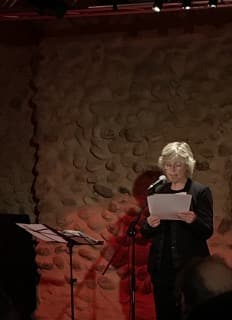
It is in a wooden house set at the edge of the Laurentian forests, on a snowy morning when the light still hesitates, that Hélène Dorion receives us. On the table, an open notebook, a cooling coffee, and silence as the only witness. The poet speaks softly, as one walks in the forest — without haste, listening to what resists words.
—How did you come to writing as a child?
I have been writing since adolescence, at an age when you don't yet know you're writing. I was searching for words to say what ordinary language could not carry — a nameless emotion, a silence too heavy. Even before opening the collections of the great poets, my first book was the landscape: the forests, the snow, the raking light of the Quebec winter sliding over the St. Lawrence. I watched this light cast its shadows and felt that there was a grammar, a syntax of the world that had to be learned to read. Writing very early became my way of responding to that light, of giving something back. Poetry was never a career choice for me: it was the only language that accepted my silences.
—What were you already seeking in your very first collection?
In 1983, L'intervalle prolongé was published, and with it an intuition I have never left. I wrote: "Between two silences, a word — and that is where poetry resides, in that space we dare not fill." Everything was already there: time, silence, the space between beings and things. I have sometimes been classified among the proponents of a poetry of silence, and the word suits me, provided we understand that silence is not an absence. It is a substance. It is what trembles around words and makes them alive. My work since then consists less of filling the page than of respecting that white space, that held breath from which the poem can emerge without being stifled.
—You were born in 1958: how did a Quebec in the midst of change mark your work?
I was born in 1958, two years before what is called the Quiet Revolution began. I grew up in a Quebec that was learning to say its own name, emerging from a long silence to claim a language, a culture, a belonging. The referendums of 1980 and 1995 crossed my adult life like shocks — that nagging question of who we were and where our home was. I do not write militant poetry; I do not plant flags in my verses. But the idea of belonging, of inner territory, comes from there, from this people seeking their place. For me, the political question became an intimate one: to what, to whom, to which landscape do we truly belong?
—What role did publishers like Le Noroît play in this adventure?
For years, I journeyed with Le Noroît, a publishing house founded in 1971 entirely devoted to poetry. Working with such a publisher means belonging to a community of patience: you don't publish poetry to sell it, you publish it so that a voice may endure. That too is the québécitude people talk about — not a slogan, but a tenacious fidelity to a voice that might have disappeared. I have admired poets like Saint-Denys Garneau and Anne Hébert, whose books never leave my desk. Without structures like Le Noroît, these voices would have died out for lack of a place to resonate. I owe much to those behind-the-scenes craftsmen who keep an entire literature alive, collection after collection.
You don't publish poetry to sell it, you publish it so that a voice may endure.
—How are your poems born, on a daily basis?
They are born while walking. I put on my hiking boots and head into the Laurentian forests, without a goal, without a poem in mind — especially without a poem in mind. Walking slowly, observing a turning leaf, the light passing between the trunks, a still lake: that is already writing. I always carry a notebook, because words come like birds, without warning, and you have to jot them down by hand, in the cold, before they fly away. Handwriting anchors words in the body; walking deposits them there. I deeply believe that the poem is not invented at the desk: it is gathered along the way, like picking up a stone or a dried leaf, and only afterward do you discover why you kept it.
—What do your writing mornings look like?
I get up early, often before dawn. That's my favorite hour, when the house and the forest are still asleep and the silence is complete. A simple coffee, a window open to the snow or the changing light, my previous day's notebooks read over in a low voice — that's all I need to enter the space of creation. I have never sought comfort or ceremony; I dress warmly, I live simply, surrounded by books and dictionaries within reach. Morning is the moment when the world has not yet started speaking, when I can hear what, within me, asks to be written. The rest of the day is only the long resonance of those hours.
—Your poetry has often dialogued with other arts. Why this need to cross languages?
Because poetry, for me, touches everything that resists ordinary speech. Some of my texts have been set to music, others have accompanied painting exhibitions — and each time, I felt that the poem found an extension, another flesh. A painter looks at light as I listen to it; a musician works with silence as I work with the white of the page. We seek the same thing by different paths. This circulation between the arts does not distract me from writing: it reveals it to me. When a composer takes my words and makes them sing, I discover in my own poem resonances I had not heard. True art begins where language admits its limits.
—You also take photographs. What are you seeking behind the lens?
Film photography has accompanied me for a long time. I do not claim to be a photographer; I capture moments — a frosted branch, a reflection on the water, the way November light falls in a clearing. These are visual notes, just like the words in my notebook. Often, an image brought back from a walk joins, months later, a poem in the making, and I understand that they were already speaking together. The camera forces me to slow down, to frame, to choose what deserves to be truly looked at — exactly the gesture of the poem. The grain of film, that living imperfection, touches me more than cold sharpness: it retains something of the trembling of the moment, of what is fragile and nevertheless remains.
—In 2021, Mes forêts marked a turning point. What does this collection represent for you?
Mes forêts was published in 2021, and I expected nothing. This collection was born from a lifetime spent walking under the trees; the forest became both an outer and inner space, a place where one gets lost to better find oneself. I wrote: "I am made of forests / that never stop growing / in me, around me, before me." It is, I believe, the most accurate book I have written. When I was told of its selection for the Prix Médicis étranger, in France, I first thought it was a mistake. A Quebec poet on such a list? Poetry travels so little, so discreetly. And yet it had crossed the ocean.
The forest became a space where one gets lost to better find oneself.
—How did you experience this sudden recognition in Europe?
Like a bridge thrown across the Atlantic. That is the image that came to me, and I cannot find a better one. For decades, Quebec poetry lived somewhat in a bubble, read by its own, ignored by the European public. Seeing Mes forêts land in the hands of Parisian readers who did not suspect the existence of our poetry was to see an old dream come true: that the voices of the North, those of my boreal forests, could resonate elsewhere. I did not experience this as a personal consecration. I saw it as an open door for an entire literature, for those who came before me and never crossed the ocean. Recognition, at my age, does not intoxicate: it obligates. It reminds me for whom, truly, I write.
A bridge thrown across the Atlantic.
—What would you say to a twelve-year-old reader opening a poetry collection for the first time?
I would tell them not to be afraid of not understanding everything. A poem is not a riddle to solve; it is a space you enter like a forest, without a map. Let them read slowly, aloud if possible, and welcome the white spaces, the silences between the lines, as much as the words themselves — for it is often there, in that space we dare not fill, that the poem breathes. I believe that what is fragile is not what breaks, but what trembles and endures. Poetry is of that order: it seems helpless, powerless, and yet it holds, crosses time, consoles. If at twelve they keep a single verse within them, that verse will grow with them, like a forest.
This imaginary interview was generated by artificial intelligence from sources documented in Hélène Dorion's profile. It dramatises what the figure might have said based on what we know about them, but does not constitute attested historical testimony. For primary sources and factual documentation, refer to the full profile.