Kids interview Hélène Dorion
by Charactorium · Hélène Dorion (1958 — ?) · Literature · 5 min read
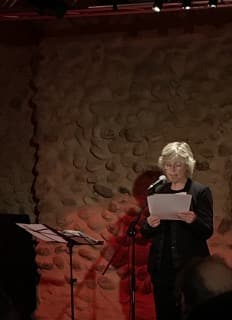
Two students from a discovery class have an appointment with Quebec poet Hélène Dorion. Outside, snow falls softly on the forest. She welcomes them with a smile, an open notebook on the table.
—Is it true that you write your poems while walking in the forest?
Yes, my child, that's exactly right. You know, I don't first write sitting at a desk. I put on my hiking boots and go into the Laurentian forests, close to my home. I walk very slowly. I observe a leaf, the light between the trees, a still lake. And then, words rise within me. So I take out my notebook and jot them down by hand. Imagine you're looking for a hidden treasure: you won't find it by running, but by looking carefully. For me, walking and writing are the same thing.
You don't find words by running, but by looking carefully.
—Why do you write by hand and not otherwise?
What a good question! You see, when I write by hand, I feel the words in my body, in my fingers. It's as if the word and the gesture are one. In the morning, often before the sun rises, I settle down with a simple coffee, a window overlooking the snow. Everything is silent. And then I reread my notebooks from the day before. Later, when the poem is almost ready, I write it out neatly, reread it dozens of times. But the very first breath of the poem is always born from a hand slowly tracing on paper.
Writing by hand means feeling the words in your body.
—What did you write when you were young, my age?
Already poems, believe it or not! I was a child, then a teenager, and I was looking for words to say things that everyday language couldn't express. Do you know that feeling? When something touches you deeply, and you don't know how to explain it? Well, for me, my first great book wasn't a book. It was the nature around me: the forests, the snow, that low light of the Quebec winter. I learned to read the world before reading the great poets. My very first real collection, L'intervalle prolongé, I published in 1983.
My first great book wasn't a book: it was nature.
—What is your very first poetry book about?
It's called L'intervalle prolongé, and I wrote it young, in 1983. Do you know what already interested me? Silence. The passing of time. And especially the space between things and between people. Imagine two people who are silent: between their two silences, there is sometimes a very precious word waiting. For me, poetry lives precisely there, in that space we dare not fill. At twelve, it may seem strange, but think of a pause in a song, just before the music resumes: that emptiness says something too.
Poetry lives in that space we dare not fill.
—What is the book you are most proud of?
Ravir : les lieux, published in 2005, means a lot to me. It talks about a very simple idea that still moves me. Do you think we choose the places where we live? Well, I think the opposite. Places inhabit us before we inhabit them. The city of Quebec where I was born, the great St. Lawrence River, the icy winters: all of that was already in me before I understood why. Imagine a family home: even with your eyes closed, you know where the stairs are, the smell of the kitchen. Landscapes are the same. They shape us in secret.
Places inhabit us before we inhabit them.
—What is Mes forêts? I was told it's your most famous book.
That's true, and it surprised me a lot! Mes forêts was published in 2021. In it, I write something I've always felt: 'Je suis faite de forêts'. For me, the forest is not only outside, around me. It is also inside, in my heart, in my thoughts. And one day, this little book of Quebec poems was chosen in France for a major literary prize, the Prix Médicis étranger. Thousands of readers in Europe discovered me all at once. Imagine a letter you throw very far, and it arrives on the other side of the ocean. That's what happened to me.
The forest is not only around me: it is inside.
—How did it feel to become famous in France so late?
You know, it moved me to tears. I had been writing for almost forty years, quietly, in Quebec. And suddenly, in 2021, with Mes forêts, all of France discovered my poetry. I described that moment as a bridge thrown across the Atlantic. Imagine: for years, you sing a song in your village, and one day people from across the sea pick it up in chorus. It's strange and wonderful at the same time. It taught me one thing: you must never stop writing thinking no one is listening. A poem sometimes travels much farther than we imagine.
A poem sometimes travels much farther than we imagine.
—What was it like being a poet in Quebec when you started?
It was an exciting time, my child. When I started, around 1983, Quebec was asking itself many questions. Who are we? What is our language, our identity? You know, we speak French in Quebec, but we are surrounded by a huge mostly English-speaking country. So poetry became a way of saying, 'we exist, and our language is beautiful.' I worked for a long time with a poetry publishing house called Le Noroît. Imagine a small house where passionate people make poetry books by hand, with love. It was a true refuge for us poets.
Poetry said: we exist, and our language is beautiful.
—Why was everyone talking about identity in your time?
Good question, and a bit difficult, I warn you. When I was young, Quebec experienced a great awakening called the Quiet Revolution. Don't worry, 'quiet' means there was no war: it was a deep but peaceful change. People wanted to be proud of being Quebecois and of speaking French. Later, in 1980 and then 1995, we even voted on whether Quebec should become a country. Imagine an entire society asking itself together: 'Who are we really?' My poems often talk about that: belonging to a place, to a language, and seeking freedom.
Belonging to a place, to a language, and seeking freedom.
—Do you also do painting or music, not just poems?
Not really myself, but I love when the arts meet! Some of my texts have been set to music, others have accompanied painting exhibitions. I also like photography: I sometimes take pictures of nature with a film camera, you know, those old cameras where you load a roll. For me, poetry touches everything that resists ordinary speech. Imagine an emotion so great that a single word is not enough: then music, painting, and the poem join hands to express it together. The arts are like friends who speak the same secret language.
Poetry touches everything that resists ordinary speech.
—What is a poem for, really?
Ah, the most beautiful question to end with! You know, in my collection Mondes fragiles, choses frêles, from 2006, I say that what is fragile is not what breaks, but what trembles and remains nonetheless. A poem is that: it takes something very small, very frail — a leaf, a silence, a fear — and keeps it alive. Imagine you want to protect a snowflake forever. You can't put it in your pocket. But with words, you can. That's what a poem is for, my child: to keep alive what would otherwise disappear.
A poem keeps alive what would otherwise disappear.
This imaginary interview was generated by artificial intelligence from sources documented in Hélène Dorion's profile. It dramatises what the figure might have said based on what we know about them, but does not constitute attested historical testimony. For primary sources and factual documentation, refer to the full profile.