Imaginary dialogue between Anne Hébert and Hélène Dorion
by Charactorium · Hélène Dorion (1958 — ?) · Literature · 5 min read
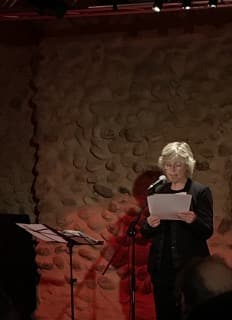
It is on an October afternoon in 1998, in a small apartment in Montreal cluttered with books, that Anne Hébert, passing through between Paris and Quebec, meets Hélène Dorion. The low autumn light falls on a table piled with handwritten notebooks and a collection with dog-eared pages. The two women have known each other for a few years already — Dorion has long read the elder as one reads a source, and Anne follows from afar, with curious tenderness, the work of her junior. She came, that day, to listen to how the young poet prolongs in her own way a certain poetry of silence.
—Hélène, you were born in 1958, just before everything changed in Quebec. Did you grow up feeling the ferment of the Quiet Revolution?
I was born, Anne, at a time when Quebec was reinventing itself almost every morning. I wasn't old enough for the debates, but the air was charged with them — you could feel a voice liberating itself, a language ceasing to be ashamed of itself. You who wrote before that opening know better than I what had to be broken. I inherited a space already loosened, where I could write without asking permission. But this legacy is ambiguous: collective freedom does not console inner solitude. Very young, I sought words for what ordinary language did not say. The country was asserting itself outside; I was digging inside. Perhaps that is my way of responding to that era: making the self a place as vast as a territory.
The country was asserting itself outside; I was digging inside.
—Your first collection, L'intervalle prolongé, in 1983, already spoke of the space between two silences. Why start with silence?
Because silence is not the absence of speech, Anne — it is what makes speech possible. I had written in that first book that between two silences a word holds itself, and that poetry resides in that space we dare not fill. It was almost a program I wasn't aware of. You, who made austerity a strength, understand that I distrust words that are too full, too chatty. The poem, for me, is born from inhabited emptiness, from what trembles just before being said. If I write too quickly, I cover that silence and lose the poem. So I wait. I listen. I let the interval lengthen until a word, finally, deserves to enter it.
Silence is not the absence of speech — it is what makes speech possible.
—I'm told you write little at your desk and a lot while walking. How does the forest enter your work, Hélène?
The forest is my first book, Anne, long before those of the great poets. Before writing a word, I walk. I slip a notebook into my pocket, put on my boots, and slowly set out under the trees. Walking slowly and observing — a leaf, a lake, the light between the trunks — is inseparable, for me, from the act of writing. Words do not come to me at the desk: they are born outside, in the silence inhabited by the world, and I only later gather them. I jot down fragments, impressions, sometimes three words that will become a poem months later. Writing by hand, in the cold, anchors words in the body. The desk comes only afterward, for the patience of form.
Words do not come to me at the desk: they are born outside, in the silence inhabited by the world.
—These Laurentian forests you roam — are they a backdrop, or something more intimate for you?
Never a backdrop, Anne — that would betray them. The boreal forests of Quebec are an inside as much as an outside. When I enter them, I feel I am penetrating a space of meditation where time changes measure. The snow, the winter light, the silence of the conifers: all of this reveals me to myself more surely than a mirror. I believe the landscape inhabits us before we inhabit it; it takes time to understand what it says about us. The forest does not illustrate my states of mind; it precedes them. It dispossesses me of my small self to open me to something vaster. That is why I return to it endlessly: not to describe the trees, but to learn from them a way of being in the world.
The landscape inhabits us before we inhabit it.
—You give a lot of your time to Le Noroît, that publishing house devoted solely to poetry. Why this commitment, at a time when poetry sells so little?
Because poetry needs houses that don't calculate, Anne. Le Noroît is one of those: an entire structure turned toward this language that the market neglects. Devoting myself to it, accompanying other voices, reading manuscripts — for me it's as essential as writing my own books. Poetry is not a solitary career; it is a transmission, a chain between the living and those to come. I also take part in meetings between poets of different languages, and each time I verify the same evidence: beneath borders, we speak a common language. Poetry touches everything that resists ordinary speech, and that knows neither passport nor definitive translation. Serving a poetry house means keeping that door open for others.
Beneath borders, we speak a common language.
—Do you remember, Hélène, the evening we read together and you said you wanted to write 'the country from within'? What did you mean by that?
I remember it very well, Anne — you had listened to me with that attention that both intimidates and reassures. Writing the country from within meant refusing the flag and the slogan to reach a more buried truth. Belonging is not proclaimed; it is felt in a frozen lake, the scent of fir, a November light. The 1995 referendum, so close, confirmed to me that identity is not settled by a ballot: it is made of memory, landscapes, wounds. My Québécitude is not political; it is sensory. I write the territory as one writes a beloved face, without ever fully possessing it. That, I think, is what I was trying to tell you that evening, without yet finding the right words.
Belonging is not proclaimed — it is felt in a frozen lake, a November light.
—You who have lived in Paris for so many years, do you believe that a poetry born of our winters can truly be heard over there, on the other side of the Atlantic?
It is you, Anne, who gives me the courage to believe it. You crossed that ocean before me; you made Quebec read in Paris without renouncing any of our light. I dream, yes, that one day my poetry will be like a bridge thrown across the Atlantic — not to make myself known, but because our forests, our silences, have something to say to those who have never seen them. France has a fine ear for language; and yet it still largely ignores what is written in our land. I know the road is long. But poetry travels slowly, like starlight: it sometimes arrives long after it was emitted. If my books take twenty years to cross, so be it, as long as they cross.
I dream that one day my poetry will be like a bridge thrown across the Atlantic.
—This introspection so present in your verses — does it risk locking you inside yourself, far from the reader?
That is the fear of every poet of the inner world, Anne, and you have surely felt it too. But I have understood one thing: the most intimate is the most shareable. When I descend to the deepest part of my experience — loss, fragility, wonder — I do not find only Hélène Dorion; I find the human. The poetic self is not a narcissistic mirror; it is a place of universal exploration. What is fragile is not what breaks, but what trembles and remains despite everything. By speaking my vulnerability, I reach out to that of others. Introspection, far from locking me in, opens me: it is by going to the very bottom of oneself that one finally meets someone. The reader does not seek my secrets — he seeks his own in my words.
The most intimate is the most shareable.
—To finish, Hélène: after so many years of writing, what is left for you to learn from the poem?
To be more silent, perhaps, Anne. The more I write, the more I measure that the essential lies in what I do not write — in the white around the words, in restraint. I am slowly learning to remove rather than add, to trust silence to carry meaning. You showed me, through your own books, that a stripped-down poem can strike harder than an abundant one. I also still have to learn patience: to let a collection ripen for years, to force nothing. And then there is what the forest continues to teach me — that beauty is ephemeral and must be spoken without holding it back. As long as I walk under the trees with a notebook, I believe I will still have something to learn. The day I know everything, I will stop writing.
The essential lies in what I do not write.
This imaginary interview was generated by artificial intelligence from sources documented in Hélène Dorion's profile. It dramatises what the figure might have said based on what we know about them, but does not constitute attested historical testimony. For primary sources and factual documentation, refer to the full profile.