Imaginary dialogue between Apollon and Hermes
by Charactorium · Hermes · Mythology · 5 min read
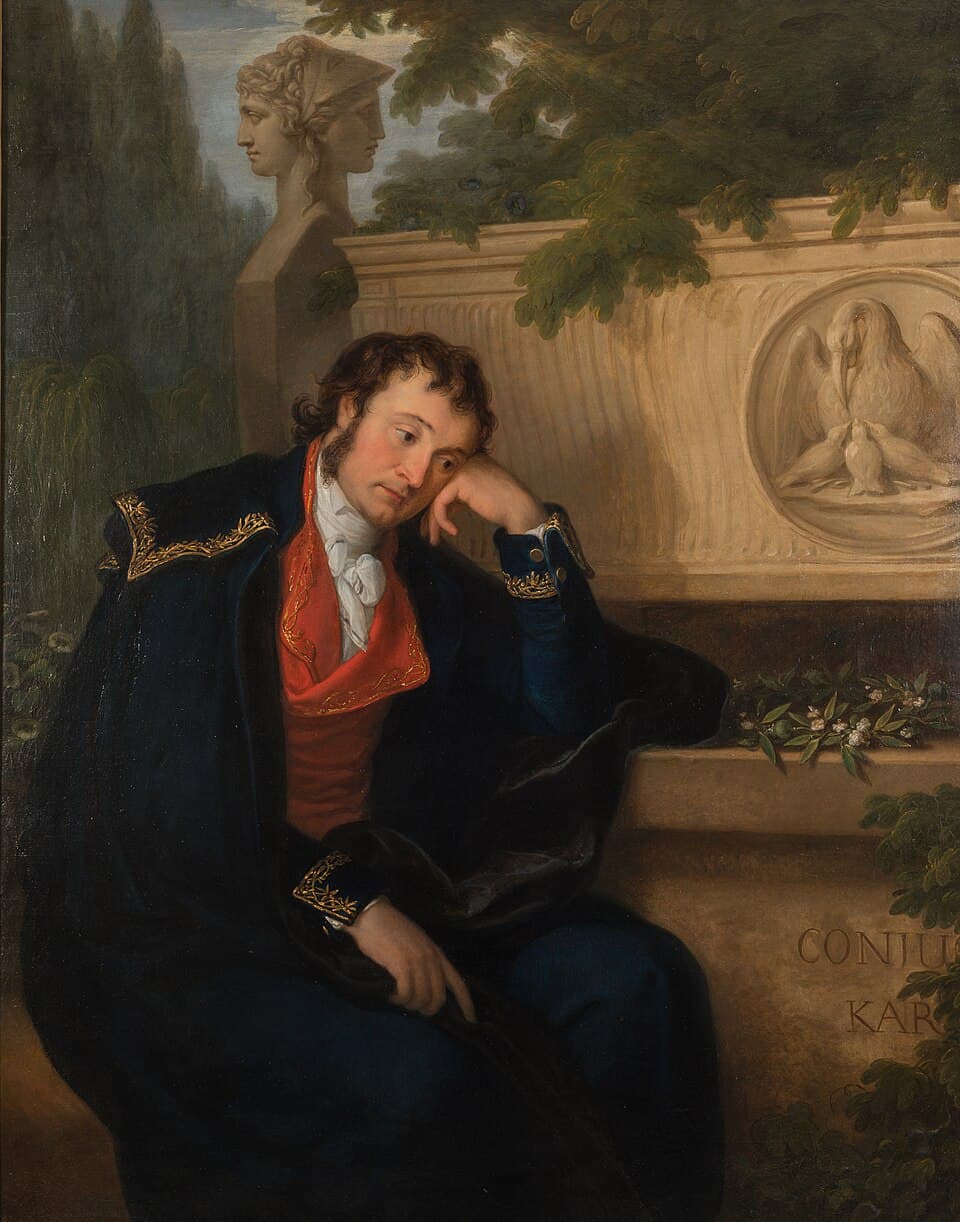
It is on the wooded slopes of Mount Cyllene, at the entrance to the cave where Maia gave birth to her son, that Apollo joins Hermes one evening when the wind smells of resin and warm stone. The archer god still carries on his shoulder the lyre that his junior once offered him, and his fingers brush the strings made of ox gut — of his oxen. They have known each other since Hermes' first day, that mad day when the newborn stole his herd before noon. Apollo comes without anger this time: he wants to understand the one who passes between worlds like no other.
—Little brother, let's talk about that first day. You were not even an evening old and already my herd had disappeared. How does a newborn conceive such a theft?
So you still remember, Apollo — how could you forget? I was born in the morning in that cave, and by noon I was already bored. A god does not stay long in his swaddling clothes. I smelled your cows in the valley, and the idea came to me like a breath: take them, not out of need, but to see if I could. Understand me, brother: I came into the world with cunning sewn into my blood, just as you came with sure aim and just song. It was not a theft of hunger. It was my first word to the world, my way of saying that nothing would be closed to me, not even what belonged to the eldest son of Zeus.
It was not a theft of hunger: it was my first word to the world.
—I followed the tracks, however, and they led me backwards. Confess to me at last, brother: how did you deceive my eye, I who see far?
Ah, that is what gnawed at you most, is it not? I made the beasts walk backwards, hooves turned toward the pasture they were leaving, so that your tracks always led you back where they came from. And I tied bundles of branches to my feet to leave no child's footprint. You looked for a thief going forward when he was fleeing backwards. Do not hold it against me: you read the sky and omens better than anyone, but the trail on the ground — that is my domain, that of roads and thresholds. Each his own art. Yours sings, mine diverts.
You looked for a thief going forward when he was fleeing backwards.
—And yet I did not strike you. You handed me that tortoise shell strung with cords, that lyre. Why offer your masterpiece to the one you had just wronged?
Because I knew, Apollo, that no fine would pay you off. You would drag me before our father and I would lose my first battle. So I took a tortoise found at the cave entrance, stretched strings over its shell, and drew from it a sound that stopped you cold. I saw your anger turn into desire. You are the god of music, brother, and I had just invented the instrument you lacked. To offer it to you was to turn a theft into an alliance — to enrich you with what I had taken from you. From that day, the lyre is yours and the herd is returned. We exchanged what neither of us could keep alone.
To offer it to you was to turn a theft into an alliance.
—Our father has showered you with attributes that I do not possess. That caduceus with two serpents you carry: what does it truly mean in your hand?
This staff is not a weapon, brother, it is a sign. The two serpents that entwine there speak of accord born from discord — two hostile forces that stop biting and knot together. When I hold it between two camps, between two worlds, they know I come as a messenger of Zeus and that my word is not to be disputed. It puts watchers to sleep, wakes sleepers, opens closed doors. You who shoot the arrow, you cut; I, with this wood, connect. Where your bow ends a conflict, my caduceus unties it. It is the emblem of passage and truce, and none bears it but me.
Where your bow ends a conflict, my caduceus unties it.
—I see you always in motion, those winged sandals on your feet, that round hat on your head. Where do you get those talaria that let you cleave the air?
From our father himself, the day he made me his herald. The talaria are golden sandals with wings extending them: they carry me over seas and peaks faster than your arrow flies. The petasos, that broad-brimmed hat you sometimes mock, protects me from the sun on long roads and marks me as the traveler I am. With them, no threshold holds me back: I stride across Olympus, the land of mortals, and the shores below in a single bound. You shine motionless at the center of the world, brother; I am made never to stop. My rest is running.
You shine motionless at the center of the world; my rest is running.
—There is one road that even I do not take. They say you lead the shadows of the dead to the Styx. How do you bear that path?
It is the charge that no other Olympian wanted, and I bear it without trembling. When a mortal breathes his last, I go down, take his shadow by the hand, and lead it to the black waters of the Styx, where the ferryman waits. For this I am called psychopompos, the guide of souls. It is not a path of mourning for me, brother: it is the last service I render to the living and the dead alike. Men know this — they place offerings in my name at funerals, so that the crossing may be gentle. You who heal and strike, you touch bodies; I see to it that souls do not stray in the dark.
It is the last service I render to the living and the dead alike.
—None of us crosses the three realms thus. The sky, the earth, the Underworld — what authorizes you alone to pass everywhere?
My office, and my nature. I am the messenger: a message that cannot reach its recipient is worthless. So there had to be a god whom no border stopped — neither the gates of Olympus, nor the crust of the earth, nor the guarded thresholds of Hades. Others rule over a domain and dwell there; I have no kingdom — I have the intervals, the crossroads, the thresholds, everything that separates and that I connect. That is why I am found at doors, at field boundaries, where one world ends and another begins. I dwell nowhere because I belong to passage itself.
I have no kingdom: I have the intervals, the thresholds, passage itself.
—I have heard that you went down to a mortal, Odysseus, to save him from the spells of a sorceress. Why concern yourself thus with a single wandering man?
Because he was on my road, brother, and travelers are mine. Circe had already turned his companions into pigs, and he was walking straight into the same trap. I came to meet him in the guise of a young man and placed in his hand a herb that the gods call moly — black root, milk-white flower, which no mortal could uproot alone. It rendered the sorceress's drugs vain. I did not do it out of whim: to protect the one who journeys, the lost, the strayed — that is my duty as much as my pleasure. A man who travels puts his life in my hands, and I am not a god who abandons those on the road.
A man who travels puts his life in my hands.
—Mortals set up stones in your likeness, those pillars they call herms, at crossroads and before their doors. What do they seek to protect thus?
Themselves, and their thresholds. Where two roads cross, a man hesitates and danger lurks: that is my place par excellence. They plant these stone pillars with my face so that my presence guards the traveler from bad encounters and marks the boundary of fields, the edge of roads, the entrance of houses. To touch one of these pillars is to greet me and ask for a good journey. You see, brother: your temples are vast and your oracles solemn, but I am found at every crossroads, a simple standing stone that the traveler's hand brushes upon departure. I do not rule from a high sanctuary — I watch at the roadside, where men are truly afraid.
I am found at every crossroads, where men are truly afraid.
—Do you remember our oath, after the lyre? Tell me, brother, what you keep from that first day when you stole from me and then disarmed me.
I keep this, Apollo: that cunning and measure can become brothers, like us. That morning, I was pure audacity, the child who takes what is not his; you were offended light, ready to strike. And from our quarrel was born an alliance — you the lyre and song, I the staff and road. Our father saw us and understood that neither should prevail over the other. Since then, I carry my caduceus and you carry your lyre, and the world holds because we came to terms. I do not regret the theft: without it, we would never have become allies. It is my finest ruse — to have won you as a brother by beginning with stealing from you.
It is my finest ruse: to have won you as a brother by stealing from you.
This imaginary interview was generated by artificial intelligence from sources documented in Hermes's profile. It dramatises what the figure might have said based on what we know about them, but does not constitute attested historical testimony. For primary sources and factual documentation, refer to the full profile.