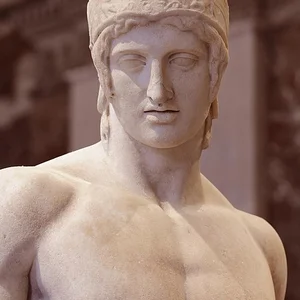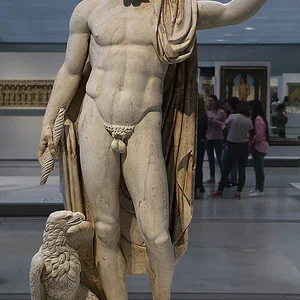

Zeus is the king of the Olympian gods in ancient Greek mythology. God of the sky, lightning, and thunder, he embodies divine authority and celestial justice. A central figure in Greek religion, he was worshipped throughout the ancient Greek world.
Zeus
Zeus
8 min read
Frequently asked questions
Key Facts
- King of the twelve Olympian gods according to Greek mythology
- Depicted as god of the sky, lightning, and thunder, wielding a thunderbolt
- Worshipped throughout the ancient Greek world, with a major cult center at Olympia (sanctuary and Olympic Games)
- Father of many gods and heroes according to mythology (Athena, Apollo, Artemis, Heracles)
- Major figure in the works of Homer (Iliad, Odyssey) and Hesiod (Theogony), dating to the 8th–7th century BCE
Works & Achievements
A cosmic conflict in which Zeus and his Olympian siblings overthrew the Titans to establish their rule. This mythic battle symbolizes the triumph of divine order over primordial chaos.
Zeus established his kingdom on Mount Olympus, where the twelve major gods reside. This act laid the foundation for the divine hierarchy and the organization of the Greek pantheon.
Zeus is credited with founding the Olympic Games in honor of his victory over Cronus. These games became the foremost religious and athletic celebration of the ancient Greek world.
Zeus condemned the Titan Prometheus to eternal torment for stealing fire from the gods and giving it to humanity. This act illustrates divine power and the consequences of defying the gods.
Zeus unleashed a catastrophic flood to punish humanity for its impiety, sparing only Deucalion and his family. This myth establishes divine responsibility over human fate.
Zeus arbitrated disputes among the gods and intervened in human affairs to maintain cosmic and divine order. He embodies celestial justice and the balance of the world.
Anecdotes
Zeus is depicted in Homer's Iliad (8th century BC) as the undisputed king of the Olympian gods. In this foundational text, he arbitrates conflicts between deities and intervenes in the Trojan War, demonstrating his absolute authority even over the other gods. Zeus's supremacy in Greek mythology is confirmed by all ancient sources.
The cult of Zeus at Olympia in ancient Greece was one of the most important in the Greek world, with a major sanctuary built in the 5th century BC. The Olympic Games, established in the 8th century BC, were celebrated in his honor every four years. A colossal gold and ivory statue of the god, sculpted by Phidias in the 5th century BC, stood inside the temple and was counted among the Seven Wonders of the Ancient World.
In Hesiod's Theogony (7th century BC), we learn how Zeus overthrew his father Cronus to become king of the gods. This myth of divine succession lies at the heart of Greek mythology and shows how the gods came to power according to ancient beliefs. The story was passed down orally for centuries before being committed to writing.
Zeus was honored throughout ancient Greece with animal sacrifices and prayers, as attested by inscriptions found on archaeological altars. The Greeks prayed to him for protection, justice, and good harvests. His cult varied by region, but his status as king of the gods remained universal across the Greek world.
An oath in Zeus's name was the most solemn pledge in ancient Greece, as it was believed that the god would punish those who broke it. This practice is documented in numerous historical sources, from commercial contracts to treaties between city-states. It demonstrates the central importance of Zeus in the daily and political life of the ancient Greeks.
Primary Sources
Zeus, having grown to adulthood, forced Cronus to disgorge and vomit up first the stone he had swallowed in Zeus's place, then his brothers and sisters. With the help of his uncles the Cyclopes, whom he had freed from Tartarus, Zeus fought the Titans in a cosmic war known as the Titanomachy.
Zeus, father of gods and men, looked down from Mount Olympus and watched the battle unfold below Troy. He rules the immortals through his wisdom and power, wielding his thunderbolt to assert his authority over sky and earth alike.
Zeus, who sees all and knows all, punishes unjust men and protects righteousness. He sends plagues upon those who violate divine law, reminding mortals of the necessity of respecting the order established by the gods.
Zeus, master of the sky and the thunderbolt, transforms his appearance to seduce mortal women: into a white swan for Leda, a shower of gold for Danaë, an eagle to carry off Ganymede — all in pursuit of his earthly desires.
Key Places
Sacred mountain in northern Greece, the main residence of Zeus and seat of the divine palace where the twelve Olympian gods dwell. A major religious and mythological center of ancient Greece.
The island where Zeus was hidden as a child in a cave to escape his father Cronus. The mythological birthplace of the king of the gods, particularly venerated in Cretan cults.
Panhellenic sanctuary in Elis dedicated to Zeus, home to the Temple of Zeus and the famous chryselephantine statue of Zeus at Olympia. Site of the ancient Olympic Games held in his honor.
Ancient oracular sanctuary in Epirus dedicated to Zeus, one of the oldest places of worship of the god. Zeus revealed his will there through the rustling of the leaves of the sacred oak tree.
Capital of ancient Greece where Zeus was venerated as protector of the city. Several temples and altars were dedicated to him, most notably the Olympieion (Temple of Olympian Zeus).
Typical Objects

Zeus's quintessential divine weapon, forged by the Cyclopes. A symbol of his absolute power and his role as god of the sky and storms in Greek mythology.

Attribute of Zeus's power and sovereignty as king of the Olympian gods. Represents his supreme authority over all gods and mortals.

Sacred animal and companion of Zeus, symbol of his might and majesty. The eagle is one of the most recognizable emblems associated with the king of the gods in Greek iconography.

The divine seat from which Zeus rules over all gods and the universe. The center of divine power in Greek mythology, located at the summit of Mount Olympus.

A goatskin or snakeskin worn by Zeus as an invulnerable breastplate. Symbol of his divine protection and invincibility in battle.

A typical vessel of ancient Greece used to transport and store wine or water. An everyday object often decorated with mythological scenes featuring Zeus and the other gods.

Ritual structures where ancient Greeks offered animal sacrifices to Zeus in order to win his favor and intervention. A central element of Greek religious worship directed at the king of the gods.

Ancient Greek coins often struck with the image of Zeus or symbols associated with the god. Evidence of his official cult and of Zeus's importance in the economic and religious life of the ancient city-state.
School Curriculum
Vocabulary & Tags
Key Vocabulary
Tags
Mythologie
Daily Life
Morning
Zeus rules from his throne on Mount Olympus, dwelling among the twelve major gods. At dawn, he presides over divine assemblies and receives the prayers and offerings of mortals who worship him. He consults the other deities on matters concerning the cosmos and the earthly realms.
Afternoon
In the afternoon, Zeus watches over mortals from Olympus, intervening in their affairs as he sees fit. He sometimes hurls thunderbolts to punish the impious or reward the righteous, dispensing divine justice. He may also transform himself and descend to earth to carry out his designs.
Evening
In the evening, Zeus presides over the divine feasts of Olympus alongside his wife Hera and his court of deities. These celestial banquets are accompanied by nectar and ambrosia, the food and drink of the gods. He listens to reports from the other divinities about events in the mortal world.
Food
Like all Greek gods, Zeus does not consume ordinary mortal food. He feeds exclusively on nectar and ambrosia, the divine substances that ensure his immortality. He also receives tribute from humans in the form of sacrifices and burnt offerings, whose rising aromas he savored.
Clothing
Zeus is depicted dressed in a majestic, sweeping aristocratic robe. He often bears the aegis (a divine breastplate) and is symbolized by the royal scepter, emblem of supreme power. His hair is thick and commanding, a symbol of his unsurpassed divine might.
Housing
Zeus resides at the summit of Mount Olympus, home of the twelve major gods and center of divine power in Greek mythology. His celestial palace is a golden, timeless fortress, inaccessible to mortals. It is the seat of the divine court from which he governs the gods and oversees the world of men.
Historical Timeline
Period Vocabulary
Visual Style
Un style graphique inspiré de l'art grec classique et de la sculpture hellénistique, combinant la majesté des vases antiques avec une esthétique intemporelle. L'ambiance privilégie les contrastes lumineux dramatiques, les dorures majestueuses et les teintes célestes pour évoquer la puissance divine et l'autorité olympienne.
Sound Ambience
Une ambiance majestueuse mêlant les sons d'un orage divin avec les échos de temples grecs antiques : tonnerres imposants, chants rituels, instruments de musique grecque et cris d'aigles, créant une atmosphère grandiose et transcendante digne du roi de l'Olympe.
Liens externes & ressources
Références
Œuvres
Titanomachia (Guerre contre les Titans)
mythologie intemporelle, textes attestés à partir du VIIIe siècle av. J.-C.
Fondation de l'Olympe
mythologie intemporelle
Institution des Jeux Olympiques
mythologie intemporelle (tradition historique : VIIIe siècle av. J.-C.)
Châtiment de Prométhée
mythologie intemporelle
Déluge universel
mythologie intemporelle
Jugement des conflits divins et humains
mythologie intemporelle