Imaginary interview with Hermes
by Charactorium · Hermes · Mythology · 6 min read
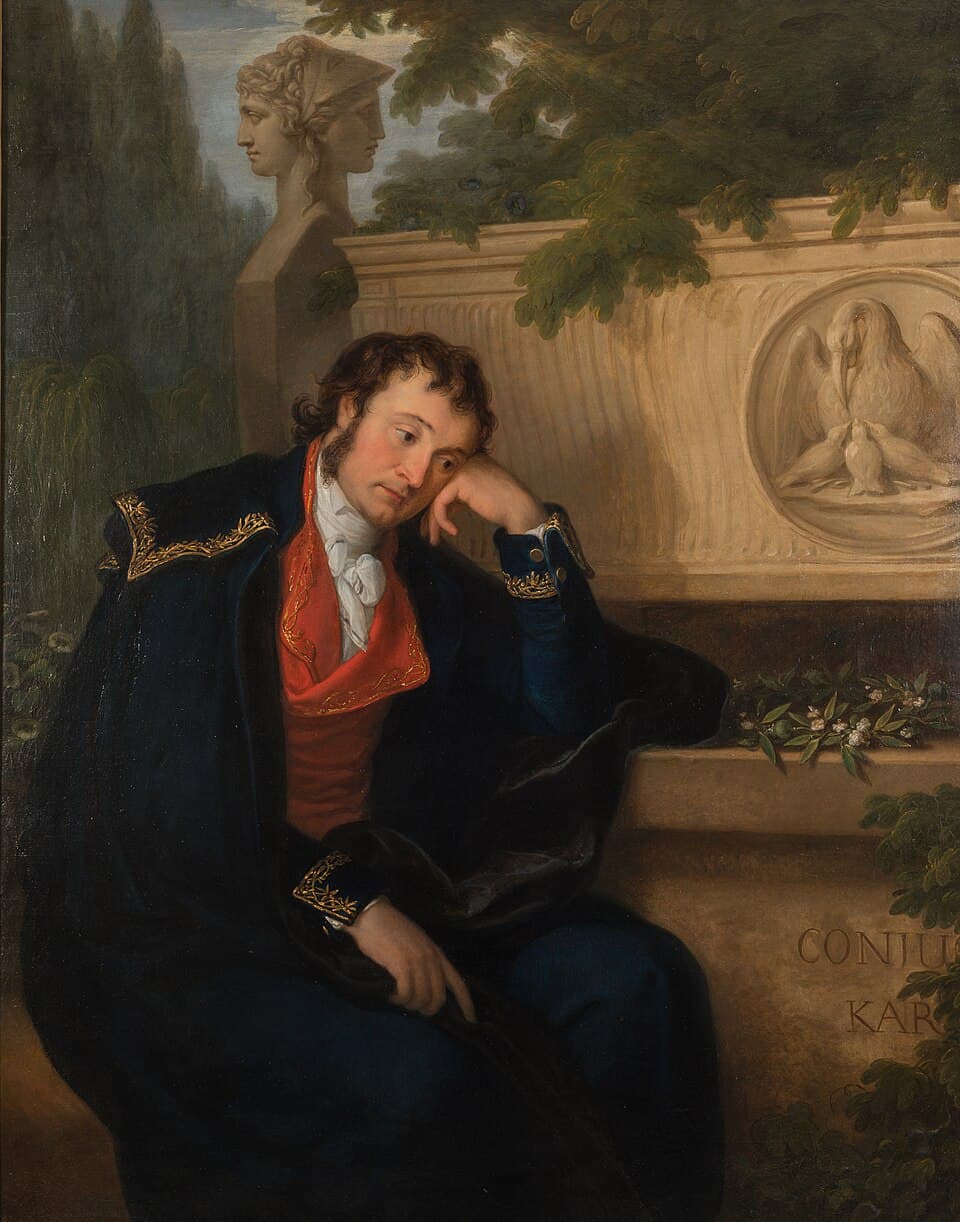
We waited for him at a crossroads in Arcadia, where a stone pillar bears his face. He arrived without a sound, sandals barely touching the dust of the road, a smile like a boy who has just pulled a prank. Hermes, messenger of the gods and guide of souls, agreed to stop for a conversation — he who never stops.
—They say you acted on the very morning of your birth. How did that happen?
I was born in a cave on Mount Cyllene, in Arcadia, to Zeus and my mother Maia, the most discreet of the Pleiades. Morning saw me born; by noon, I had already stretched seven strings across a tortoise shell and drawn sounds no one had ever heard. And when evening came, the cradle bored me. So I went out, found my brother Apollo's herd, and took it away. I can't help it: cunning was my first step. The Hymn they sing about me says it plainly: born in the morning, lyre-player at noon, thief by evening. A god's day is worth a man's lifetime.
Morning saw me born; by noon I played the lyre; by evening, Apollo's herd was mine.
—Your brother Apollo surely did not accept that theft without anger. How did you appease him?
Apollo is radiant but quick to fury, and he had every reason to seek me out. Yet I had taken precautions: I made his cattle walk backwards, so their tracks would lie and point in the wrong direction. When he finally unmasked me — one god cannot fool another for long — I did not plead. I placed between us the lyre born from my tortoise, and I played it. Apollo's anger melted like snow under the first sun; he who presides over the Muses could not resist such an instrument. He let me keep the herd, and I kept his affection. That is how a theft becomes the first peace treaty between two brothers.
—Let's talk about your attributes. What do these objects, which mortals recognize at a glance, mean to you?
My father Zeus gave me what I needed for my office. On my feet, the talaria, those golden-winged sandals that carry me over seas and mountains faster than thought. On my head, the petasos, a round, wide-brimmed hat with two wings beating at its sides. And in my hand, the caduceus: a staff around which two serpents entwine. It is no mere ornament — with a gesture I put mortals to sleep, with another I wake them, and I touch with the same wood the eyelids of the living and the dead. These three objects express my entire function: to pass, to connect, to cross. Where other gods sit enthroned, I move.
Where other gods sit enthroned, I move.
—You are often depicted with a purse in your hand. What does that add to your image?
The purse! You see, I have been entrusted with more than just the messages of the gods. I watch over merchants, over those who trade oil for wheat in the shade of the agora, over honest scales and handshake deals. Commerce, you see, is another way of connecting people: they exchange goods as I exchange words between Olympus and the earth. So I hold the purse as I hold the caduceus — one for wealth that circulates, the other for speech that passes. And if I am also said to have thieves among my protégés, do not be surprised: who knows both sides of an exchange better than I?
—You are also the one who accompanies the dead. How do you experience this very particular role?
I am the only Olympian who can descend where the others do not go. The sky, the earth, and even lower: to the banks of the Styx, that dark river no living soul crosses without trembling. The Greeks then call me Psychopompos, the conductor of souls. When a breath leaves a body, I take it by the hand — for a lost soul is a pitiful sight — and I lead it to the crossing. Offerings are made in my name at funerals, and rightly so: someone must make the final journey with the departed. I touch the dead with the same caduceus that puts the living to sleep. Between the two worlds, I am the only door that opens both ways.
A lost soul is a pitiful sight; I take it by the hand until the passage.
—Does this role of ferryman ever weigh on you, you who are said to be so light?
Light, yes, but not carefree. Consider what it requires: guiding without fail souls that do not yet understand they have left the light. Some cling, others refuse to see the Styx; it takes patience, and a certain gentleness that mortals do not suspect in the cunning one I am. That is why I am honored at crossroads as much as at tombs: every passage is a little death and a little birth. I am the god of thresholds. The merchant setting out on a journey, the dead descending to the Underworld, the speaker searching for words — all cross a boundary, and all find me there, standing at the edge. My lightness is not indifference: it is the only way not to lose oneself while crossing so many worlds.
—You intervened with Odysseus against the sorceress Circe. Do you remember that encounter?
How could I forget? His companions had just been turned into pigs by Circe's potions, and he himself was walking straight toward the same fate, head down, like men who think they can face anything. I stood in his path, in the guise of a young man, and placed in his hand a herb the gods call moly: white flower, black root, which no mortal hand can uproot alone. With it, the sorceress's spells slid off him harmlessly. I protect travelers, you see, and Odysseus was of that enduring race of men I love to help. Without that herb given at the right moment, the wiliest of Greeks would still be grunting in a pigsty. Sometimes a god only needs to arrive on time.
Without that herb given at the right moment, the wiliest of Greeks would still be grunting in a pigsty.
—Why get involved in the fate of a mere mortal like Odysseus?
Because roads are my domain, and no one is more exposed than a man far from home. The traveler sleeping under the stars, the merchant venturing on unknown paths, the shipwrecked cast upon a foreign shore — all are under my protection. Odysseus was all of these at once: a wanderer, a man of cunning who resembled me a little. I love to help those who help themselves, those whose minds work. He did not whine; he looked for a way out; I only had to show him one. Mortals think that we gods play with them like dice. Some among us do. I prefer to reach out at the crossroads and watch the man choose his path.
—All over Greece, stone pillars bearing your image are erected. What purpose do they serve?
These are the hermai, my boundary stones — stone pillars topped with my face, placed at crossroads, in front of houses, along roads. In Athens, there is one at almost every door. They do two things at once: they guide the traveler who no longer knows which direction to take, and they ward off evil encounters, for my stone presence protects the threshold as my living presence protects the path. The traveler greets them, sometimes leaves a pebble at their foot when passing. It is a humble devotion, without temple or great pomp, suited to me: I am not a god of sanctuaries but a god of the roadside, watching where paths cross and men hesitate.
I am not a god of sanctuaries but a god of the roadside.
—Yet these pillars were at the heart of a great scandal in Athens. What do you remember of it?
One night, in Athens, hands protected by darkness mutilated my hermai — faces broken, stones desecrated, all across the city. The city awoke frozen with terror, for to strike my pillars was to strike the very protection of thresholds, just as the fleet was about to set out on a great expedition. They sought culprits, accused, and the suspicion even fell upon the general Alcibiades, who was recalled to stand trial. See the irony: I, god of thieves and tricks played in the shadows, found myself at the center of a shadowy affair that no one ever fully cleared up. That day, men understood that one does not harm the guardians of passages with impunity. Even made of stone, I watch.
This imaginary interview was generated by artificial intelligence from sources documented in Hermes's profile. It dramatises what the figure might have said based on what we know about them, but does not constitute attested historical testimony. For primary sources and factual documentation, refer to the full profile.