Imaginary interview with Hugh Capet
by Charactorium · Hugh Capet (940 — 996) · Politics · 6 min read
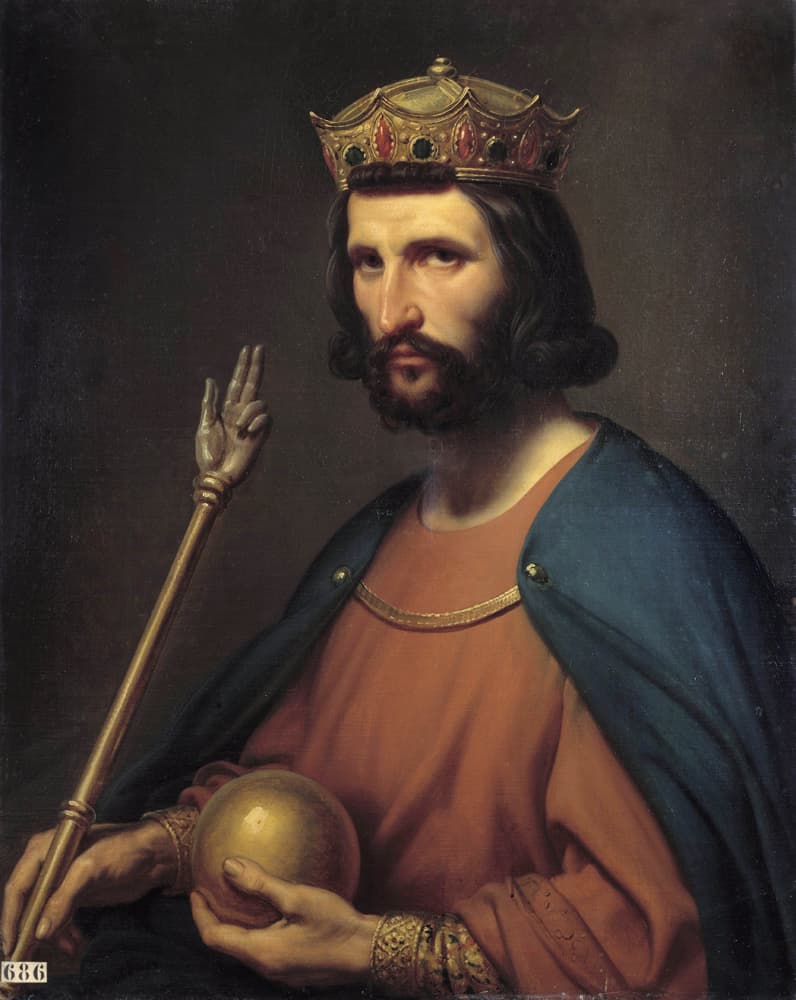
Winter 988. In the great hall of a fortified palace in Senlis, the central hearth crackles while outside the forests of Île-de-France sleep under the frost. A broad-shouldered man, dressed in a scarlet cloak clasped at the shoulder, sets down his wine goblet: Hugh, by the grace of God king of the Franks for barely a year, agrees to answer a few questions about the new weight upon his brow.
—How did this crown come to you, who were not of Carolingian blood?
Everything was decided in a few months, like a spring storm. Louis V, the last of the Carolingians, died in 987 without leaving a child, young and without an heir of his body. The nobles of the kingdom and the bishops then assembled here, in Senlis, and it was Adalbéron, Archbishop of Reims, who championed my cause. He said it bluntly: better a man capable of wielding the sword and bringing peace than a Carolingian prince still a child. You should know that among the Franks the crown remains elective — the king is chosen by the consent of the lords and prelates, not given by birth alone. I was already Duke of the Franks, the most powerful after the king; it took only a word from the bishops for what was power to become royalty.
Better a man capable of wielding the sword than a prince still a child.
—What does a man feel on the day the holy oil touches his brow?
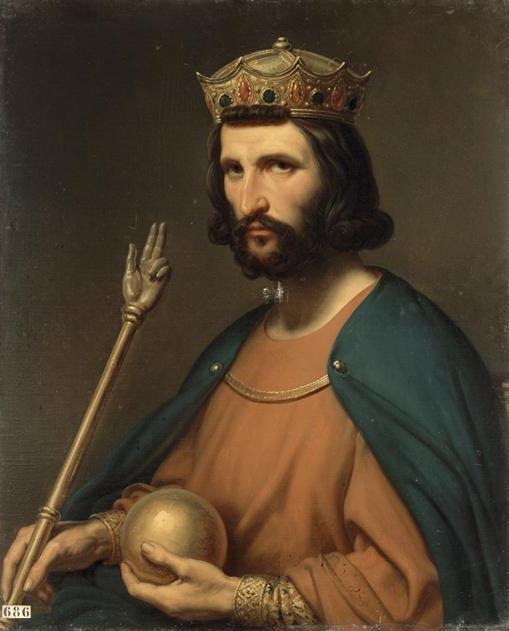
I was anointed at Noyon, in July, by the hands of Adalbéron. I confess to you: it is not the crown that changes a man, it is the anointing. When the chrism touched my brow, I understood that I no longer fully belonged to the world of ordinary lords — the holy oil separates the king from all other men and places him in the hands of God. I was girded with the sword, a sign that I must protect Christendom; I was given the scepter and the hand of justice, so that I might judge with equity. These insignia came directly from the treasury of the kings before me. That day I felt that I bore less an honor than a debt: that of keeping peace in a kingdom that no longer quite knew what peace was.
It is not the crown that changes a man, it is the anointing.
—Why did you have your son Robert crowned so soon after your own coronation?
Because an elective crown is a fragile crown, and I did not want the nobles to repeat at my death the bargaining they had done at Senlis. As early as 987, the very year of my coronation, I had my son Robert anointed and associated with the throne. During my own lifetime, you understand — so that no lord would have the leisure to look elsewhere for another king when I close my eyes. Many found the idea bold; I found it prudent. If God wills it, my descendants will continue this custom of crowning the eldest during the father's lifetime, and what is still only a practice may become a law of blood. I build for men I will never see. That is what it means to found a lineage: to plant an oak whose shade you will not enjoy.
I build for men I will never see.
—You speak of lineage — did you realize you were founding much more than a reign?
A man never knows which seed will take root. I only know this: a king without a crowned son is but a passing storm, and a king whose son is already anointed is the first link in a chain. I wanted Robert to be that link. My domain is modest — Paris, Senlis, Orléans, Étampes, a few good lands clustered around me — but it is solid, and a house is built on sure foundations before it rises. If I could imagine that I would be read in a century or two, I would dare hope that my heirs still reign and that they will say it all began with that prudent coronation. But I leave that to God. My duty is not to prophesy: it is to pass on, intact, what was entrusted to me at Noyon.
A king without a crowned son is but a passing storm.
—They call you king, but are your vassals not almost as powerful as you?
You touch my wound, and I will not hide it. The Duke of Normandy, the Count of Anjou — they hold their lands as I hold mine, and their sword is almost equal to mine. I am the suzerain, the lord at the top, the one on whom all vassals depend in law; but law and force do not always dwell under the same roof. Each of these great lords holds his fief by oath of fealty, and the oath, you see, is better kept when the king is near and the sword ready. Beyond my domain, my authority is often only a word set down on parchment. A king of the Franks, in this century, is not a master: he is the first among lords who accept, on certain days, to remember that he is their king.
Law and force do not always dwell under the same roof.
—How do you impose order when your authority does not extend beyond your own lands?
You ride. In 993, I led my men into Burgundy to remind recalcitrant vassals that an oath is not an empty word. The hauberk of mail weighs heavy on a king's shoulders, but a suzerain who stays seated in his great hall sees his authority melt like snow in the sun. War, the ride, the plaid where I render justice among my nobles — these are my tools. I do not govern by decree from a distant throne; I govern by showing myself, sword at my side, where I am too quickly forgotten. My domain is small but firm, and it is from this firmness, not from great dreams of empire, that my successors may perhaps draw a kingdom. A king makes himself respected one land at a time.
—You rely heavily on the Church — what do you expect in return?
Everything, or nearly. It was the bishops who made me king at Senlis, it was Adalbéron who anointed me at Noyon; without the Church, I would be only a duke who had seized a title. So I serve her as she serves me: I confirm the privileges of abbeys, I protect Saint-Denis and Fleury, I wish to be the guardian of royal tradition and the Peace of God. For there is this new movement, the Peace of God, born at the council of Charroux in 989: it forbids, under pain of excommunication, raising one's hand against clergy, peasants, merchants. I supported it with all my weight. A kingdom where the weak are slaughtered is not a Christian kingdom — and a king who allows it is not worthy of the oil poured upon him.
Without the Church, I would be only a duke who had seized a title.
—Yet they say you are in open quarrel with certain prelates, such as at Reims. How do you explain that?
Serving the Church does not mean surrendering my kingdom to her. The archbishopric of Reims is too precious — it is the seat that crowns kings — for me to let just anyone sit there. When Arnoul proved disloyal, I had him deposed at the council of Saint-Basle, in 991, and it was Gerbert of Aurillac, the most learned clerk of our time and one of my counselors, who took his place. This earned me quarrels all the way to Rome, I do not deny it. But a king who allows the bishop of his own coronation to conspire against him saws off the branch on which God has placed him. Gerbert knows my affairs like no other; his letters show clearly that I want an energetic and faithful man where others would want a puppet. The peace of the Church sometimes requires the king's firmness.
—This nickname 'Capet' that some whisper — where does it come from?
I stop you: in my lifetime, no one calls me that to my face. That name will be given mainly to my house after me. They say it comes from the Latin capa, the cloak, the mantle — and therein lies the whole story of my ancestors. The Robertians, from whom I descend, were lay abbots of Saint-Martin of Tours and guardians of the most venerated relic in Gaul: the cloak of Saint Martin. To hold this relic, in the most popular sanctuary in the kingdom, was to carry upon oneself some of the saint's prestige. That is perhaps why this word cape would be attached to my name. A nickname is only a garment that men tailor for you; but I like that mine, if it must be one, ties me to Saint Martin rather than to my battles.
A nickname is only a garment that men tailor for you.
—What does this heritage of the Robertians, this family that rose so high, mean to you?
A long patience. My ancestor Odo was elected king of the Franks in 888 — the first non-Carolingian to wear that crown. After him, my family remained dukes of the Franks, powerful, sometimes more than the king, but without the crown. My father, Hugh the Great, bequeathed to me at his death, in 956, the title of Duke of the Franks and the first place in the kingdom after the sovereign. We were the Robertians, named after Robert the Strong: the great house that had faced the Carolingians for three generations. What I received at Senlis, I did not conquer alone — I plucked it at the end of a century of waiting by my lineage. A man founds nothing: he completes what his fathers began, and entrusts it to his sons.
A man founds nothing: he completes what his fathers began.

This imaginary interview was generated by artificial intelligence from sources documented in Hugh Capet's profile. It dramatises what the figure might have said based on what we know about them, but does not constitute attested historical testimony. For primary sources and factual documentation, refer to the full profile.