Imaginary dialogue between Ghazan Khan and Ibn Taymiyya
by Charactorium · Ibn Taymiyya (1263 — 1328) · Spirituality · Philosophy · 6 min read
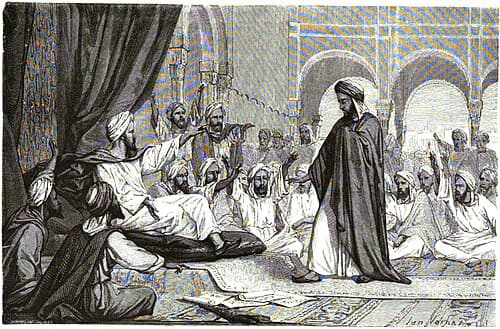
Winter 1300. Beneath the felt tents of the Mongol camp pitched on the outskirts of Damascus, the oil lamp casts dancing shadows on the carpets. Ghazan Khan, the ruler of Iran recently converted to Islam, has summoned before him this Hanbali shaykh who, alone, crossed the lines to plead for mercy for his city. The two men size each other up: one holds the sword and the steppe horsemen, the other has only his voice and his memory of the texts. From this unlikely encounter between power and scholar is born the interview that follows.
—Shaykh, you came to my tent when every other voice fell silent before my horsemen. What did you expect from a khan of the steppes?
I expected from you, O Ghazan, what I expect from any man who now claims Islam: justice toward those whom God has entrusted to you. Damascus is not a city of infidels to punish, but a city of believers, of women and children. I did not come to beg: I came to remind you that the blood of Muslims is sacred, and that whoever sheds it unlawfully will have to answer for it before One greater than you. You bear a sword, but I bear a word that does not fear the sword. That is why I crossed your lines while the notables hid: fear of God erases fear of men.
You bear a sword, but I bear a word that does not fear the sword.
—I am told that at Marj al-Suffar you exhorted the fighters to jihad against us. How can you preach war after pleading for peace?
There is no contradiction, sovereign. Jihad is not a thirst for blood; it is the defense of the community when it is unjustly attacked. When I came to you, I sought to spare Damascus through words; when words are no longer enough and armies descend upon the believers, it is a duty to defend the weak, the mosques, and the homes. The scholar who remains seated in his madrasa while his people are slaughtered betrays his knowledge. I called men to combat as I called the powerful to mercy: by the same law. Peace when it is possible, firmness when it is necessary — that is the way of the pious ancestors.
The scholar who remains seated while his people are slaughtered betrays his knowledge.
—Before me, you cited dozens of traditions of your Prophet without ever opening a book. Where does such a memory come from, shaykh?
It is not a merit I boast of, Ghazan, but a grace that God grants to those who devote themselves to His texts from childhood. I have lived among the hadiths as others live among their flocks: by frequenting them, they inhabit the heart. I was trained to advance nothing without proof, to trace every saying back to its source, to know those who transmitted it. When I answer you, it is not my opinions I pour out, but what the early generations faithfully carried. A man who speaks of religion without citing his supports is like a horseman without a mount: he falls at the first assault. My memory is merely a servant of received truth.
I have lived among the traditions as others live among their flocks.
—They say that as a child, you returned a book to a bookseller after reciting it from memory following a single reading. Is that a legend people spread?
People like to embellish, sovereign, and I do not pretend to judge what is reported of my childhood. What I know is that a book I was denied, I read with the eagerness of one who thirsts in the desert — and what enters a thirsty heart in that way is never erased. Knowledge is not an ornament one puts on; it is food one swallows that becomes flesh. You who command armies, you know that a leader remembers every face of his loyal men: thus I remember every word of my teachers. The Quran and the traditions of the Prophet, I carry not on paper but in my chest, where no jailer can ever seize them.
Knowledge is not an ornament one puts on: it is food that becomes flesh.
—You constantly invoke revelation. But a king must weigh, calculate, reason. Does human reason have no place in your religion, shaykh?
Quite the contrary, Ghazan: it is precisely because I respect sound reason that I refuse to set it against revealed text. I have long pondered this question and devote an entire work to it, Dar' Ta'arud al-'Aql wa-l-Naql. My conviction is firm: a certain rational proof can never contradict an authentic revelation. If a contradiction appears, it is because one of the two is not truly established — either reason has faltered, or the text has been misunderstood. Whoever claims to choose reason over revelation betrays both. The true scholar holds them together, like the two hands of the same man. God, who created the intellect, did not make it an enemy of His word.
A certain rational proof can never contradict an authentic revelation.
—Your rivals, I am told, are masters of kalam, those theologians skilled in discourse. Why do you attack men who, like you, defend the faith?
Because their remedy is worse than the disease, sovereign. These people of kalam sought to defend the faith with weapons borrowed from the Greek philosophers, and they ended up twisting the meaning of the texts to bend them to their reasoning. They deny the attributes that God has given Himself, on the pretext of purifying Him. As for me, I stick to what the Book affirms and what the Messenger transmitted: without distortion, without negation, without asking how. This is not simple-mindedness; it is fidelity. The early generations did not need this dialectic to believe rightly. When you add to religion what it never contained, you do not strengthen it: you weaken it.
They sought to defend the faith with the weapons of the philosophers, and they twisted the texts.
—In my lands, people visit the tombs of saints, pray there, make vows. You condemn these customs. Isn't that depriving the people of their consolation?
True consolation, Ghazan, is not in the stone of a tomb but in the Lord of tombs and the living. When a man prostrates before a grave, implores it, asks it for what God alone can give, he slides toward what Islam came to abolish. This is called bid'a, a blameworthy innovation, because the Companions of the Prophet never practiced it. Honoring pious men, yes; invoking them in place of God, never. I know these fatwas earn me the hatred of jurists and the anger of the powerful, but I prefer truth alone to the approval of the masses. Restoring to God His oneness, tawhid, is the greatest service one can render a people — not depriving them, but liberating them.
True consolation is not in the stone of a tomb but in the Lord of tombs.
—You always speak of the salaf, the ancients. But the world has changed, shaykh. Why try to bring the living back to the customs of the long-dead?
The salaf are not distant dead, sovereign: they are the pure spring from which everything else has flowed. The further one moves from the source, the more the water becomes turbid and laden with silt. The early generations received religion from the very hands of the Prophet; they understood and lived it before quarrels and innovations clouded it. Returning to them is not moving backward; it is recovering clarity. You who have just embraced Islam, do you not want to know it as it was given, not as centuries have encumbered it? I do not fight the present: I fight what has been added as foreign to the faith. Bringing men back to the origins is giving them back their compass.
The further one moves from the source, the more the water becomes turbid and laden with silt.
—Your frankness, shaykh, will cost you your freedom one day. One day a sultan will throw you in prison. Are you not afraid of walls and chains?
What can my enemies do to me, Ghazan? My paradise is in my heart; it follows me everywhere and never leaves me. If I am imprisoned, my cell will be a spiritual retreat where I will finally be alone with my Lord. If I am exiled, my exile will be a journey to Him. And if I am killed, I will be a martyr. The true prisoner is not the one thrown behind walls: it is the one whose heart is held back from his Lord, the captive whom his own passions have chained. A man free within, no jailer can hold. That is why neither your horsemen nor the dungeons of any sultan will tear from me what I carry within.
What can my enemies do to me? My paradise is in my heart.
—You are described as living on bread and dates, writing at night by lamplight. Does a man of your learning not deserve more comfort?
The comfort you speak of, sovereign, is a burden I have shed. Bread, dates, a little water: that suffices for a body that is merely a mount for the soul. Overfeeding the mount weighs it down. My true riches are my calames, my ink, and the manuscripts I copy. When night falls and the city falls silent, I sit by my lamp and write until fatigue overcomes me on my pages. Those hours are worth all the palaces. You who possess treasures, know that a man who needs nothing is more powerful than a king who fears losing everything. My chosen poverty is my true sovereignty.
A man who needs nothing is more powerful than a king who fears losing everything.
This imaginary interview was generated by artificial intelligence from sources documented in Ibn Taymiyya's profile. It dramatises what the figure might have said based on what we know about them, but does not constitute attested historical testimony. For primary sources and factual documentation, refer to the full profile.