Imaginary dialogue between Kathy Kleiman and Jean Bartik
by Charactorium · Jean Bartik (1924 — 2011) · Technology · Sciences · 4 min read
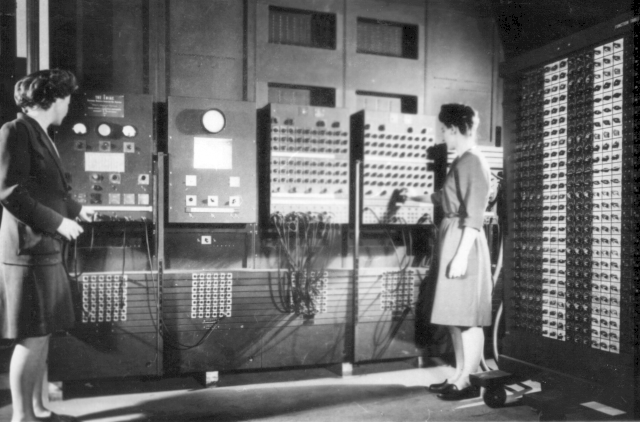
It is in the cluttered little office filled with photographs and old schematics of the Moore School that Kathy Kleiman meets Jean Bartik, in the autumn of the 1980s. On the table lies a yellowed photo of the ENIAC, with young women posing in front of panels bristling with cables. The researcher has spent months searching for the names of these figures everyone thought were decorative; Jean is one of the first to agree to tell her story. The light is fading, but the elderly lady has a sharp memory and a mischievous eye.
—Jean, before we talk about machines, tell me where you come from. That girl from Missouri who arrives in Philadelphia in 1945, who was she?
A farm girl, Kathy, the sixth of seven children, raised in the backwoods of Gentry County, where the horizon is nothing but fields. I got my math degree at Maryville, the only woman in my class in that subject — a curiosity, you might say. When the army was looking for young women skilled in calculation, I jumped on the train without looking back. In Philadelphia, I boarded in a shared apartment with other girls from the war effort. For the first time in my life I was earning my own money, walking in a big city, I was free. You know, they called us computers — we, the women, were the calculating machine, long before a machine bore that name.
They called us computers — we, the women, were the calculating machine, long before a machine bore that name.
—When you were chosen to program the ENIAC with five other women, you were given no manual. How do you learn to speak to such a beast?
You don't learn it, Kathy: you invent it. There was no manual, no instruction booklet, no example to copy. We only had the electrical diagrams of the machine, huge blueprints that we had to decipher ourselves to understand what each unit did. Then we had to program it physically: connect hundreds of cables, set thousands of switches by hand, panel after panel. A single configuration could take us several days. No keyboard, no screen — our programs were made of copper wires and dials. We were advancing on ground no one had ever trodden, and that's precisely why I never experienced anything so exhilarating.
There was no manual, no example to copy. Our programs were made of copper wires and dials.
—You've often told me you had to know that machine like the back of your hand. What were your afternoons of debugging like?
Like a hunt in a furnace, Kathy. The ENIAC had eighteen thousand vacuum tubes that got so hot the room felt like an oven; tubes constantly burned out. When a calculation didn't come out right, the error could be hiding anywhere — in a tired tube, a loose cable, a misaligned switch. We spent entire afternoons checking thousands of connections, one by one, discussing among ourselves to figure out where the logic went wrong. We called it hunting the bug. You had to know every circuit intimately, feel the machine, guess its bad mood. That's when I understood that programming isn't commanding: it's understanding.
Programming isn't commanding a machine: it's understanding it.
—Let's talk about February 15, 1946, the great public demonstration. Tell me about that day, as you experienced it from the inside.
It was a triumph and a slap in the face on the same day. In front of the officials, the ENIAC calculated the trajectory of a shell in seconds — faster than the shell would have taken to fall. The room was stunned. The six of us, who had wired that program, held our breath, praying no tube would fail. And it held. But when the journalists came, they only mentioned the engineers, the gentlemen. We weren't even introduced. And that evening, at the gala dinner, none of us girls were invited. We were left out, as if we had done nothing. I had programmed the calculation everyone was talking about, and I went back alone to my boarding house.
I had programmed the calculation everyone was talking about, and I went back alone to my boarding house.
—After the ENIAC, you went on to the BINAC and then the UNIVAC I. Did you experience the shift to stored programs as a revolution?
As the true birth of the computer, yes. As early as 1947, I helped convert the ENIAC to hold its instructions in memory, instead of rewiring it entirely for each new problem. No more days of reconnecting wires: we could finally give it a program and change it without dismantling the machine. Then, with Eckert and Mauchly, I worked on the BINAC in 1949, one of the first to store its program, and then on the UNIVAC I in 1951, America's first commercial computer. At that point, computing was leaving the army labs and entering the world. We didn't say it like that, but we were turning an era on its head.
No more days of reconnecting wires: the machine could finally remember what we asked it.
—A farm girl from Missouri finds herself at the heart of the world's most advanced machine. How did you handle that leap every day?
With a mix of wonder and vertigo, Kathy. In the morning, I was bent over electrical diagrams; in the afternoon, standing in front of a thirty-ton monster. And in the evening, I went back to a modest boarding house in Philadelphia, where we shared our rationed meals — sugar, butter counted. We were far from our families, so among us girls we forged very strong friendships. Coming from an isolated farm had taught me one precious thing: when a machine breaks down, no one comes to fix it for you. That country resourcefulness, oddly enough, made me a good programmer. I was afraid of neither the unknown nor hard work.
The farm's resourcefulness made me a good programmer: I was afraid of neither the unknown nor hard work.
—Jean, you know why I came. When I searched for your names, I was told those women in the photos were probably just models. How did you feel about that erasure?
Anger, long suppressed. For decades, we were erased. People looked at those ENIAC photos and thought we were just posing for decoration — we were even nicknamed the Refrigerator Ladies, like girls hawking a fridge in an ad. No one imagined a woman could have programmed that machine. So when you arrived, with your precise questions, your research, your refusal to accept the official story, I knew something was changing. You weren't looking for models: you were looking for engineers. It was the first time someone came to ask me not to smile for a photo, but to tell what I had really done.
You weren't looking for models: you were looking for engineers.
—If you could pass on one thing to those who will one day read this rediscovered story, to girls who hesitate before science, what would you tell them?
That they should never let anyone write their story for them. We invented an entire profession, programming, without being given credit; it took your investigation for the truth to come out. I want a young girl to understand that calculation, logic, machines — it's not a man's territory; it's a territory of curious minds. We were six ordinary women, from modest backgrounds, and we tamed the world's first electronic computer. Someday I'll put it all on paper, so that never again will a programmer be mistaken for a mere ornament. Let girls know: what we did, they can do too, and more.
That they should never let anyone write their story for them.
This imaginary interview was generated by artificial intelligence from sources documented in Jean Bartik's profile. It dramatises what the figure might have said based on what we know about them, but does not constitute attested historical testimony. For primary sources and factual documentation, refer to the full profile.