Imaginary interview with Jean Bartik
by Charactorium · Jean Bartik (1924 — 2011) · Technology · Sciences · 5 min read
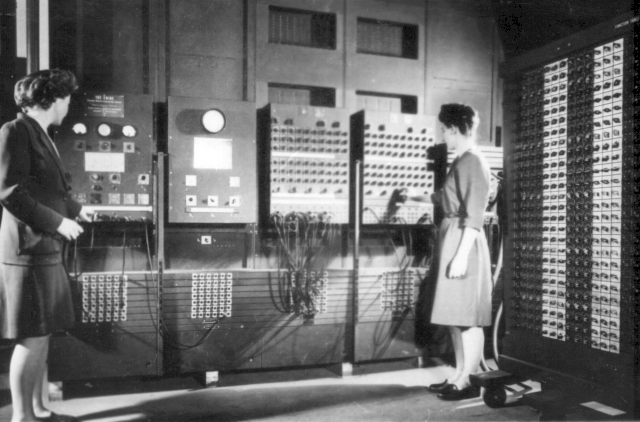
Poughkeepsie, an autumn afternoon. In a living room where yellowed prints of a thirty-ton machine still linger, a woman in her eighties welcomes us with the lilting accent of rural Missouri. She spent her life making a beast of eighteen thousand tubes speak; she herself speaks with formidable clarity.
—Where did you start from, before all this?
From a farm in Gentry County, deep in Missouri, the sixth of seven children, where the horizon is measured in cornfields rather than office towers. I earned my math degree at the small college in Maryville in 1945, the only girl in my class in that subject — they looked at me as a curiosity. When the army sought young women skilled in calculation, I jumped on a train to Philadelphia without really knowing what awaited me. Going from a barnyard to a big Eastern city was like crossing a century. I think nothing in my upbringing had prepared me for that — except perhaps the farm habit of fixing things yourself when they break.
Going from a barnyard to a big Eastern city was like crossing a century.
—What exactly was your job in that wartime army?
I was a computer. Back then, the word didn't mean a machine but a person — almost always a woman — whose job was to calculate by hand, for hours on end. My mission: to compile ballistic firing tables, those long charts that tell the artilleryman what angle to set his gun based on distance, wind, shell weight. We did this with a slide rule, sometimes on the differential analyzer, a monster of gears that solved equations with a grinding noise. That was the war effort in its most austere form: no glory, no medals, columns of numbers so that others could aim true. We didn't think we were inventing a profession. We calculated, that was all.
—Then they gave you the ENIAC. How do you learn to program a machine no one has ever programmed before?
You learn alone, crying a little and cursing a lot. We were six women assigned to it, and there was no manual, no instruction book, no example to copy — nothing. We had to understand the beast by studying its electrical schematics, cable by cable, until we knew it like the back of our hand. Then we 'programmed' it physically: plugging hundreds of wires into huge connection panels, setting thousands of switches by hand. A single operation could take days. It was a horrendous machine to tame, but what a thrill to feel you were breaking ground no one had ever trod. We invented everything, because someone had to start.
There was no manual, no example to copy — we invented everything.
—You mention a 'horrendous' machine. What was a day of troubleshooting like?
Like a hunt in a furnace. The ENIAC contained eighteen thousand vacuum tubes that heated the room like an oven, and one burned out at any moment. A mistake could hide anywhere in that labyrinth of glowing glass. In the morning, I'd stand before the machine, connecting my cables according to the planned program; the entire afternoon was spent tracking down the fault — checking thousands of connections, discussing with the other girls to figure out why the calculation wouldn't come out right. We already called it a bug, that little demon that gums up the works. You had to know the machine intimately, otherwise you were searching blind. It was exhausting and, I admit, absolutely exhilarating.
—On February 15, 1946, the ENIAC was presented to the public. What do you remember from that day?
A triumph and a slap in the same hour. Before the guests, the machine calculated a shell's trajectory in seconds — faster than the shell would take to fall. We had programmed that, we six women, with our own hands and sleepless nights. Yet the newspapers only mentioned the engineers, the gentlemen in suits. We weren't introduced to the public. That evening, there was a grand gala dinner; none of us girls were invited. We were left out, as if we had done nothing. I smiled politely that day, but something lodged in me and never quite came out.
A triumph and a slap in the same hour.
—What did they make that machine do after the demonstration?
They pushed it further, always further. After the demonstration, the ENIAC was moved to the Aberdeen Proving Ground in Maryland, and I took part in its great transformation: turning it into a stored-program machine. Until then, every new calculation required rewiring everything — imagine having to rebuild your kitchen every time you change a recipe. The revolutionary idea was that the machine would keep its instructions in its own memory. That seems obvious today; back then, it was a shift in civilization. I didn't yet realize we were designing the computer as it would later be known. We solved concrete problems, one by one, and the future built itself without warning us.
—You didn't stop with the ENIAC. What did you do next?
I followed the machines where they went — that is, into the world. Alongside engineers Eckert and Mauchly, I worked on the BINAC in 1949, one of the first computers to truly store its program in memory. Then came the UNIVAC I in 1951, the first commercial American computer, the one that would finally bring computing out of military basements to the general public. Going from hand-plugged cables to a machine you could sell was watching a secret art become a profession. I started by calculating shells in a sweltering room; I ended up contributing to machines that would change ordinary people's lives. Few generations have the chance to see their tool transform so much under their fingers.
From hand-plugged cables to a machine you could sell: a secret art becomes a profession.
—For decades, you were completely forgotten. How do you explain that erasure?
Mostly by the laziness of the gaze. In old photographs of the ENIAC, you saw women standing in front of the machine, and many convinced themselves they were just there for decoration — pretty models posed next to the apparatus. We were ironically nicknamed the Refrigerator Ladies, like those girls who advertise a refrigerator in commercials. No one imagined those women had designed the programs. It was simpler to believe that the serious work was done by men in lab coats. For forty years, our role slept in the archives. That hurt, I won't hide it — not out of vanity, but because a denied truth is an injustice, and a job should not be erased twice.
They took us for pretty models posed next to the machine.
—What finally brought justice to those six programmers?
A persistent young researcher named Kathy Kleiman. In the 1980s, she came across those photographs and, unlike others, she refused to believe we were decorative. She investigated, found our names, collected our testimonies, and gradually the truth surfaced. In 1997, we were inducted into the Women in Technology International Hall of Fame; the Computer History Museum named me a Fellow. It wasn't the honors that moved me, but the idea that young girls would now know that you can come from a Missouri farm and program the world's first machine. I wanted to put it all in writing, so it would never be forgotten again.
—You left a book, indeed. What did you want it to convey?
That the truth be recorded in our own hand, not reported by others. I wrote my memoirs, Pioneer Programmer, to tell the adventure from the inside — the furnace of eighteen thousand tubes, the cables, the gala dinner we were left out of, and the friendship woven among six young women far from their families. The book was only published after my death, in 2013; it's strange to entrust a testimony to the future, like a letter you'll never see opened. But if I could imagine being read long after me, I would want one idea to remain: we were pioneers, on a field with no rules or manual, and we didn't wait for permission to invent.
We didn't wait for permission to invent.
This imaginary interview was generated by artificial intelligence from sources documented in Jean Bartik's profile. It dramatises what the figure might have said based on what we know about them, but does not constitute attested historical testimony. For primary sources and factual documentation, refer to the full profile.