Kids interview Jean Bartik
by Charactorium · Jean Bartik (1924 — 2011) · Technology · Sciences · 5 min read
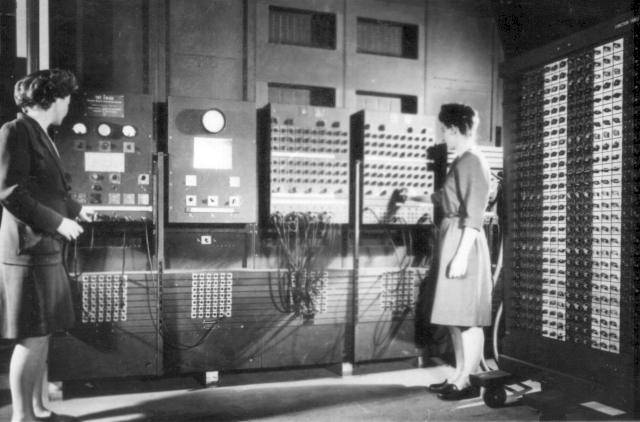
Two 12-year-old students visit an exhibition on the early days of computing. In front of a huge photo of the ENIAC, a little old lady with a mischievous smile waits for them. It's Jean Bartik, and she has all the time in the world to tell her story.
—Where did you grow up, when you were little like us?
Oh, very far from all these machines! I was born in 1924 on a farm in Gentry County, deep in Missouri. Imagine fields as far as the eye can see, no factories, no hum of electric motors. I was the sixth of seven children. No one in my village had ever heard of a computer — the word didn't even exist yet! I loved numbers, yes I did. So I studied mathematics, the only girl in my class at Maryville. When I graduated in 1945, I told myself: I don't want to stay here all my life. The world was waiting for me elsewhere.
I loved numbers from the farm, long before I knew what a computer was.
—Is it true they called people 'computers'? That means machine, right?
Ah, you've hit on something funny! In my day, a computer wasn't a machine. It was a person — most often a young woman — whose job was to calculate by hand. All day long, with a slide rule, that little sliding instrument, we did endless additions and multiplications. During the war, the army recruited us to calculate firing tables: tables of numbers that told artillerymen how to aim their guns. I arrived in Philadelphia in 1945 for that. I was a human computer, can you imagine? The word stuck, but it eventually came to mean the machines that replaced us.
Before machines, the computer was us: women with a pencil.
—What was that huge machine like? Did you press a button to make it work?
A button? If only! The ENIAC was a 30-ton beast, filled with 18,000 vacuum tubes — little glass bulbs that got so hot the room was a real furnace. To give it a calculation, there was no keyboard or screen. We programmed it with our hands: plugging in hundreds of cables, turning thousands of switches on huge panels. A single operation could take several days! It was physical programming, you see. You had to know that machine like the back of your hand. I once said: the ENIAC was a beastly thing to program.
You didn't type on keys: you wired it by hand, wire by wire.
—But how did you know what to do? Was there a book to explain?
No, my child, and that's the craziest part! We were six women chosen to program the ENIAC, and there was no manual, no instructions. No one in the world had ever done it before us. So we studied the machine's electrical schematics, those complicated plans, to understand how the current flowed. Then we invented everything ourselves. Imagine being given a musical instrument never seen before, without a score, and being told: 'make a melody come out of it.' That was our job. We were pioneers, and pioneers walk on ground no one has ever trodden.
There were no rules, no manual, no example: we had to invent everything.
—The day the machine worked in front of everyone, were you proud?
Proud, yes, wildly! It was February 15, 1946. Before an audience of scientists and journalists, the ENIAC calculated the trajectory of a shell in seconds — faster than the shell would take to fall back from the sky. It was a triumph. We had worked for weeks for that, my colleagues and I. But you know what? The newspapers the next day only mentioned the engineers, the men. We, the six programmers, weren't even introduced to the public. We were left aside, as if our hands had plugged in nothing. It was bittersweet.
The machine calculated faster than the shell fell — but we were not named.
—Were you sad not to be invited to the evening party?
Sad, and above all hurt. That evening, there was a grand gala dinner to celebrate the ENIAC. All the important gentlemen were invited. None of us, the girls, were invited. We were left out, as if we had done nothing. We went back to our shared lodgings in Philadelphia, a little bitter, telling ourselves that we knew what we had accomplished. You'll learn something in life, my child: sometimes you do great work and no one thanks you at the moment. You have to keep the pride inside you and move on.
Keep your pride inside you, even when they forget to thank you.
—After that, did you continue with even more powerful machines?
Yes, and that's where it gets exciting! On the ENIAC, you had to rewire everything for each new calculation — a tedious job. In 1947, I helped transform it so it could keep instructions in its memory. That's called the stored program: the machine remembers what to do, instead of being rewired each time. A revolutionary idea! Then I worked on the BINAC in 1949, and then on the UNIVAC I in 1951, the very first commercially sold computer in America, with engineers Eckert and Mauchly. Little by little, we were inventing the computer as you know it.
The big breakthrough: a machine that remembers, instead of being rewired each time.
—Was it hard to find errors when the machine didn't work right?
A real nightmare, yes! When a calculation didn't come out right, you had to search for the fault among the 18,000 vacuum tubes. Imagine having to check thousands of little bulbs and hundreds of wires, one by one, to find the culprit. And those tubes got so hot they burned out constantly! We called these errors bugs. Tracking a bug could take an entire afternoon. We'd discuss among programmers, turning the problem over and over. You needed the patience of a saint and to know the machine by heart. It's like looking for a needle in a burning haystack.
Looking for a bug in 18,000 tubes is a needle in a burning haystack.
—Why were you forgotten for so long? That's not fair!
No, it wasn't fair, you're right. For decades, no one remembered us. The saddest part: looking at old photos of the ENIAC, people saw women standing in front of the machine and thought we were just models, there for decoration! We were nicknamed the Refrigerator Ladies, like girls posing in front of a fridge in an ad. But we had programmed it! It took until the 1980s and the investigation of a young researcher, Kathy Kleiman, for our true role to be rediscovered. She refused to believe we were just decorations.
They took us for decorative models, when we had programmed the machine.
—In the end, did people finally understand what you had done?
Yes, my child, in my lifetime I saw the light return. In 1997, my colleagues and I were honored for our pioneering role. In 2008, a major computer museum named me a Fellow, a title of honor. And after my death, in 2013, my memoirs were published, Pioneer Programmer, where I tell the whole adventure from the inside. It warmed my heart. Remember this: what you accomplish with seriousness always eventually becomes known, even if it takes time. Don't wait for applause to do things well. Do them first for the beauty of the effort.
What you do with seriousness always eventually becomes known, even if it takes time.
This imaginary interview was generated by artificial intelligence from sources documented in Jean Bartik's profile. It dramatises what the figure might have said based on what we know about them, but does not constitute attested historical testimony. For primary sources and factual documentation, refer to the full profile.