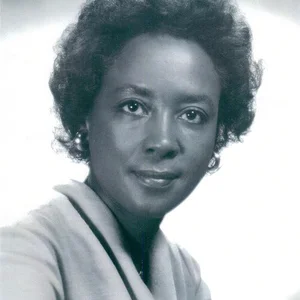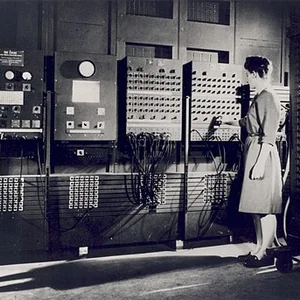

Jean Bartik (1924-2011) was an American mathematician and computer scientist, one of the first six programmers of the ENIAC, the first fully programmable electronic computer. She helped transform automatic computation into a new discipline: programming.
Jean Bartik(1924 — 2011)
Jean Bartik
États-Unis
7 min read
Frequently asked questions
Key Facts
- Born on December 27, 1924, in Missouri (United States) and graduated in mathematics in 1945.
- Recruited in 1945 as a human “computer” for the U.S. Army, then chosen among the six programmers of the ENIAC.
- In 1946, she took part in programming the ENIAC, the first large electronic computer, unveiled publicly that same year.
- She then worked on the BINAC (1949) and UNIVAC I (1951) computers, the first commercial computers.
- Long forgotten, she was rehabilitated starting in the 1990s and died in 2011.
Works & Achievements
Together with her colleagues, Jean programs the ENIAC to compute a ballistic trajectory, a feat presented triumphantly on February 15, 1946. It is one of the very first programs ever run on an electronic computer.
Jean takes part in transforming the ENIAC so that it keeps its instructions in memory instead of being rewired each time — a key step toward the modern computer.
Working alongside engineers Eckert and Mauchly, she contributes to the BINAC, one of the first computers to store its program in memory.
Jean works on the UNIVAC I, the first commercial computer in the United States, which would bring computing to the general public.
An autobiography published after her death, telling from the inside the story of the ENIAC and doing justice to the role of the six women programmers.
Anecdotes
During the Second World War, the U.S. Army recruited young women gifted in mathematics to calculate by hand—using slide rules and mechanical machines—the trajectories of artillery shells. Their job had a surprising name: they were called “computers,” meaning human “calculators.” That is how Jean Bartik, freshly graduated from Missouri, arrived in Philadelphia in 1945.
Jean and five other women were chosen to program the ENIAC, but without a manual or instructions: none existed! They had to understand the machine by studying its electrical diagrams, then “program” it physically by plugging in hundreds of cables and flipping thousands of switches by hand. A single operation could take several days.
On February 15, 1946, during the public unveiling of the ENIAC, the machine calculated a shell's trajectory in a few seconds—faster than the shell would take to land. It was a triumph, but the newspapers credited only the male engineers. The six programmers were not even introduced to the public, nor invited to the gala dinner held that very evening.
For decades, these pioneers were completely forgotten. Looking at the old ENIAC photographs, many people assumed that the women posing in front of the machine were merely decorative models; they were mockingly nicknamed the “Refrigerator Ladies.” Their real role was not rediscovered until the 1980s, thanks to an investigation by the researcher Kathy Kleiman.
Debugging the ENIAC was a feat: the smallest error could be hiding among its 18,000 vacuum tubes, which grew so hot that the room felt like a furnace and tubes were constantly burning out. Jean used to say you had to know the machine “like the back of your hand” to track down the fault.
Primary Sources
We were pioneers, and like all pioneers, we were moving across ground that no one had ever set foot on: there were no rules, no manual, no example to follow. We had to invent everything.
The ENIAC was a dreadful beast to program. To make it carry out a calculation, you literally had to wire it by hand, wire by wire, switch by switch.
None of us girls were invited to the dinner that evening. We had been left outside, as if we had done nothing at all.
Key Places
Isolated farming region in northwestern Missouri where Jean was born and grew up on a farm, the sixth of seven children. Far from any technology hub.
Small Missouri university where Jean earned her mathematics degree in 1945, the only one in her graduating class in that field.
Department of the University of Pennsylvania where the ENIAC was built and where Jean worked as a programmer beginning in 1945. The birthplace of American electronic computing.
Military base where the army tested weapons and where the ENIAC was finally relocated in 1947. Jean traveled there to continue her work on the machine.
Town in the Hudson Valley where Jean Bartik died in 2011, after a long career in computing and technical publishing.
Typical Objects
The first fully programmable electronic computer, a giant 30-ton machine that filled an entire room, made of 18,000 vacuum tubes. Jean Bartik was one of its first six programmers.
📷 Domaine public · Wikimedia Commons ↗
Cards perforated with holes representing data or instructions, fed into the machine to transmit information to it. They were used to input data into the ENIAC and output its results.

To “program” the ENIAC, you had to plug in hundreds of cables by hand and set thousands of switches across enormous panels. It was physical programming, with no keyboard or screen.

A sliding calculation instrument allowing quick multiplications and divisions, the everyday tool of human “computers” before computers arrived. Jean used it to check her calculations.

Long tables of numbers telling gunners how to set their cannons according to distance, wind, and the weight of the shell. Computing these tables by hand was the primary mission of the wartime “computers.”

A huge mechanical calculator made of wheels and gears, used before the ENIAC to solve equations. It represented the old, slow, analog way of computing trajectories.
School Curriculum
Vocabulary & Tags
Key Vocabulary
Tags
Daily Life
Morning
At the height of the war, Jean starts her day early at the Moore School, bent over electrical diagrams and calculation sheets. Much of the morning is spent standing in front of the ENIAC, plugging in cables and setting switches according to the planned program.
Afternoon
The afternoon is devoted to debugging: tracking down an error in the machine can mean checking thousands of connections and vacuum tubes. Jean talks things over with her fellow women programmers to figure out why a calculation isn't coming out right.
Evening
In the evening, the young women head back to their shared lodgings in Philadelphia. Far from their families, they form strong friendships and enjoy life in a big city, so different from the Missouri countryside.
Food
Like many Americans during the war, Jean copes with the rationing of certain goods (sugar, meat, butter). Meals are often taken in the university cafeteria or in cheap little neighborhood restaurants.
Clothing
In the 1940s, Jean wears the elegant yet understated outfits of the era: dresses fitted at the waist, knee-length skirts, low-heeled shoes. For working close to the hot machine, practical clothing was welcome.
Housing
A young woman from Missouri, Jean lives in a shared apartment or a boarding house in Philadelphia, like many women working for the war effort. The comfort is modest, but the financial independence is brand new for a woman of her generation.
Historical Timeline
Period Vocabulary
Liens externes & ressources
Références
Œuvres
Programmation de l'ENIAC pour la démonstration publique
1945-1946
Conversion de l'ENIAC en machine à programme enregistré
1947-1948
Développement du BINAC
1949
Développement de l'UNIVAC I
1951
Pioneer Programmer (mémoires)
2013