Imaginary interview with Jean-Paul Sartre
by Charactorium · Jean-Paul Sartre (1905 — 1980) · Literature · Philosophy · 5 min read
A spring afternoon in 1975, on the first floor of the Café de Flore, where the marble tables still hold the smell of cold tobacco. The man sits down, pipe already lit, his strabismus fixed on an invisible point behind the window. He speaks quickly, as if dictating aloud.
—How would you describe the pact you made with Simone de Beauvoir?
We sealed it in 1929, the year of the agrégation — I came first, she second, and everyone today knows she is the more rigorous of the two. We promised each other what I call a necessary love, irreducible, and the freedom to have, alongside it, contingent loves. That made the self-righteous howl, who saw it as mere libertinage disguised as philosophy. But the issue wasn't pleasure; it was transparency: never lie to each other, never hold each other by ownership. You don't own a free being; you accompany them. One day we will rest side by side at Montparnasse; that, I believe, is the only institution I have not refused.
You don't own a free being; you accompany them.
—Do you remember the state of mind in which you wrote The Flies, in the midst of the Occupation?
I had returned from captivity — they took me at Padoux in 1940, and it was there, behind the barbed wire, that I read Heidegger for real, line by line, like digging a tunnel. In 1943, I took up the myth of Orestes: a man who kills, who assumes his act, and who refuses the remorse of the gods. The German censors saw only an old Greek story; the Parisians, however, heard something else, that word freedom passing under the cloak. I didn't fight in the Resistance with weapons, I won't decorate myself retroactively. But I understood this: even a prisoner, even occupied, one is never exempt from choosing.
Even a prisoner, even occupied, one is never exempt from choosing.
—What exactly do you mean by the phrase "existence precedes essence"?
Reverse the usual order. People think there is first a human nature, a plan, and each person only has to fulfill it like a paper-knife fulfills the idea of the paper-knife in the craftsman's mind. Wrong. "Man first exists, encounters himself, surges into the world, and defines himself afterwards." There is no model, no excuse, no Superego that decides for you. That is why I say that "man is condemned to be free" — condemned, because he did not create himself, yet responsible for everything he does. He who hides behind his temperament, his job, his class, is in what I call bad faith.
There is no model, no excuse, no Superego that decides for you.
—Doesn't this freedom you describe become unbearable to bear?
It comes with a vertigo, yes, and that vertigo has a name: existential anguish. But be careful, it is not a disease of the soul to be cured by rest or prayer. It is, on the contrary, the sign that you have seen correctly. When I wrote Nausea in 1938, my Roquentin feels before a tree root that raw contingency: things are there, without reason, without justification, superfluous. It turns the stomach. And then one understands that this excess is also the place of our freedom, since nothing is written. Anguish is not the opposite of courage — it is its lucid beginning.
Anguish is not the opposite of courage — it is its lucid beginning.
—People always imagine you settled at the Café de Flore. What was your workday like?
My office had no walls: it was that banquette at the Flore, or sometimes the Deux Magots across the street. I got up late, strong coffee from the moment I woke, then hours filling school notebooks by hand — thousands of pages a year, I'm not exaggerating. The pipe never left my lips, and in the evening, to keep up the pace, I swallowed Corydrane, those amphetamines I crunched like candy. I know today what that cost me in health. But you don't think about radical freedom part-time. I wrote like I breathed: to avoid suffocating under reality.
My office had no walls: it was that banquette at the Flore.
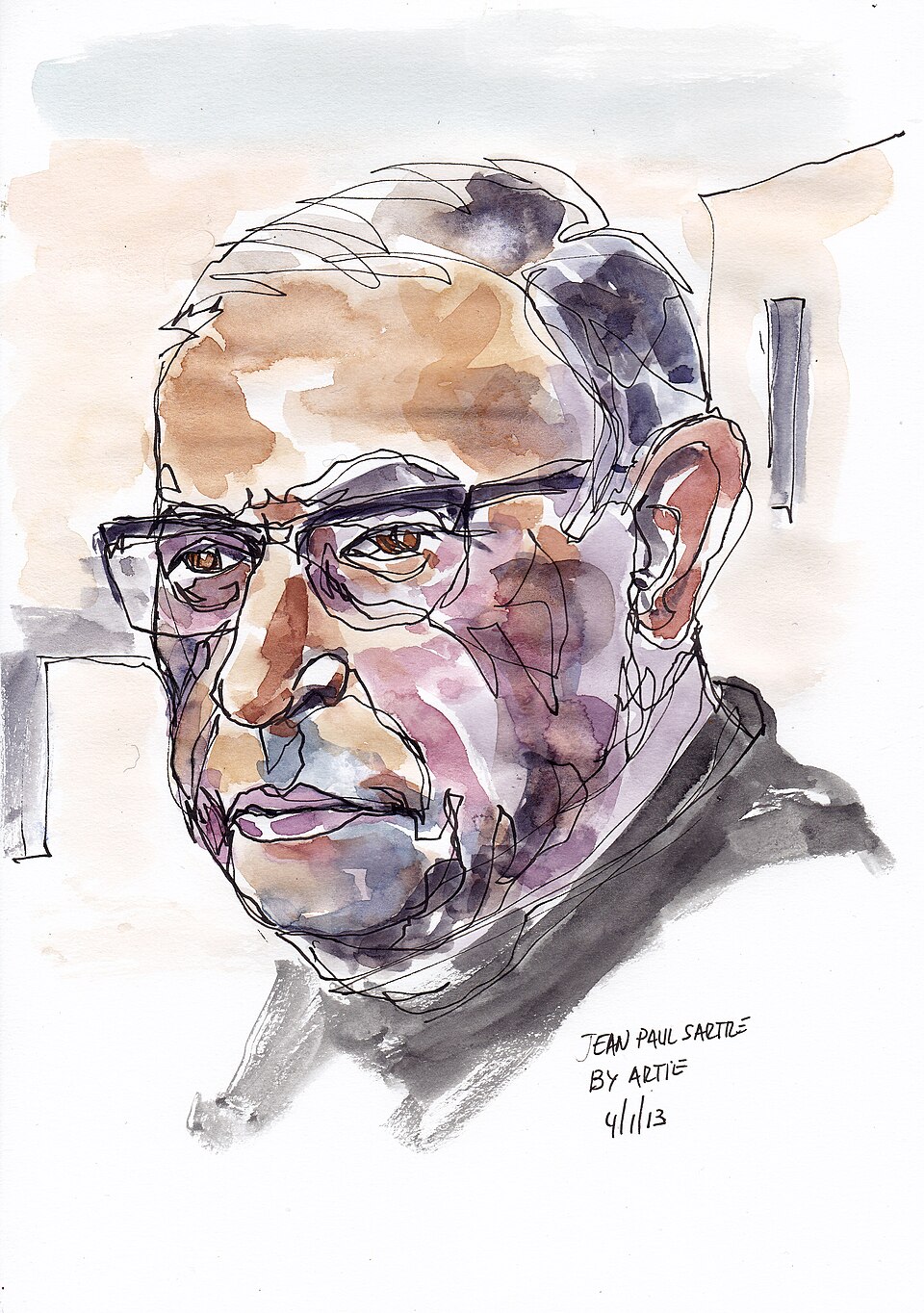
—At over sixty, what drove you into the streets in May '68?
The very idea of the committed intellectual, which I defended all my life, forbade me to stay at my desk while the youth occupied the Sorbonne. I went up there, I spoke before those thousands of students, and believe me, it wasn't to lecture them — I had more to learn from them. Later I sold La Cause du Peuple on the sidewalk, that banned newspaper, knowing they wouldn't dare arrest Sartre. It was a trick, I admit: using my fame as a shield for the younger ones. A writer who remains silent when he could speak is, in my eyes, responsible for what he allows to happen.
I sold the banned newspaper knowing they wouldn't dare arrest Sartre.
—You say writers are responsible. How far does that responsibility go?
Very far, farther than one politely admits. I wrote in What Is Literature? that "every word has repercussions, every silence too." I went so far as to hold Flaubert and Goncourt accountable for the repression that followed the Commune, because they didn't write a line to prevent it. I was called unfair, excessive. Perhaps. But the writer is situated in his time; he does not write from an ivory tower suspended above History. The blank page is already a political act: you choose what you say, and you equally choose what you leave in the shadows. That is commitment.
The blank page is already a political act.
—Why did you refuse the Nobel Prize in 1964?
Because "the writer must refuse to let himself be turned into an institution, even if it takes place under the most honorable forms." The Swedish Academy was offering me a crown; but a crown fixes you, embalms you alive. The morning the news broke, I was drafting The Words, that ironic autobiography of the child I had been, and there was a cruel coincidence: they wanted to crown me as a writer at the very moment I was telling how I had fabricated that vocation from scratch. Accepting would have been to turn myself into a statue. But a being for-itself never lets itself be frozen; it is never anything but what it is not yet.
A crown fixes you, embalms you alive.
—This horror of being frozen is also found in your theater, isn't it?
Entirely. In No Exit, in 1944, three dead people locked in a drawing-room discover there will be no torturers, no rack: it is the gaze of the other two that tortures them. Hence the phrase people keep quoting, "Hell is other people" — which is misunderstood, moreover, as misanthropy. I meant this: when the other's gaze freezes me into a thing, a bastard, a definitive coward, and I submit to it, then it is hell. The living for-itself can always move; the dead person, however, is delivered to the judgment of the survivors. That is why I was so determined not to become, during my lifetime, a commemorative statue.
When the other's gaze freezes me into a thing, and I submit to it, it is hell.
—With hindsight, what do you take away from the childhood you describe in The Words?
That I am a pure product of chance and indulgence. My father, a naval officer, died when I was one; I barely knew him, and I think that absence freed me from a burden. "I have no Superego," I wrote — I had a very gentle grandfather who lacked the authority to plant one in me, and I was left to do as I pleased. Small, myopic, afflicted with a strabismus that later earned me the nickname the One-Eyed, I took refuge in the books of his library. It was there, in that sublime lie, that I invented myself as a writer. Perhaps all of Being and Nothingness came out of that child who was playing at existing.
I invented myself as a writer in a sublime lie.
This imaginary interview was generated by artificial intelligence from sources documented in Jean-Paul Sartre's profile. It dramatises what the figure might have said based on what we know about them, but does not constitute attested historical testimony. For primary sources and factual documentation, refer to the full profile.