Kids interview Jean-Paul Sartre
by Charactorium · Jean-Paul Sartre (1905 — 1980) · Literature · Philosophy · 5 min read
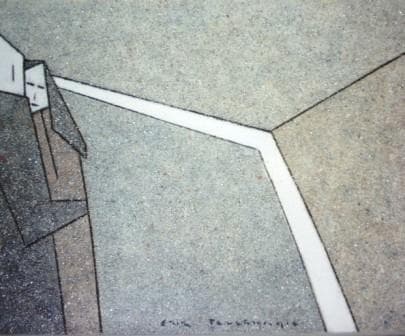
That morning, two middle-school students pushed open the door of an old café in Saint-Germain-des-Prés. In the smoke and clinking of cups, a man with thick glasses and a pipe was waiting for them. It was Jean-Paul Sartre, and he had agreed to answer all their questions.
—What was your day like when you were writing?
You know, my office had no walls: it was the Café de Flore, right here in Saint-Germain. I'd arrive in the morning, always take the same table, and pull out my school notebooks. I wrote everything by hand, page after page, sometimes until evening. Pipe in my mouth, a very strong coffee beside me. Imagine a big room full of smoke, voices, people chatting — and me, in the middle, filling my pages. I'll confess: I drank too much coffee and took pills to keep up the pace. It was a bad habit. But I loved that noise: it kept me awake and alive.
—Why did you always have a pipe in photos?
Ah, my pipe! It never left me, it's true. When I was searching for an idea, I'd relight it, take a puff, and it helped me think. With my thick tortoiseshell glasses — I was very nearsighted, almost blind in one eye — I had a funny face, I know. But you see, I didn't care about my appearance. My clothes were dark, never neat. I thought a man is not worth his tie, but what he does. The pipe, the coffee, the notebooks: those were my real tools. The rest I left to people in a hurry to show off.
—Were you afraid when the Germans took you prisoner?
In 1940, the Germans captured me in Padoux, a small village. There I was, a prisoner of war, locked up with thousands of men. Afraid? A little, yes. But above all, I had time — immense, empty time. So I read. A very difficult German philosopher, Heidegger, whom I deciphered slowly in the cold. It's strange, but it was in that prison that my thinking about freedom grew. They had taken my body, my home, almost everything. And yet, in my mind, I remained free to think. No one could take that away from me. I was released in 1941, but I kept that idea all my life.
—How did you manage to talk about freedom under the Nazis?
It was risky, you know. In 1943, in the middle of the Occupation, I wrote a play, The Flies. I told an old Greek story, that of Orestes, who rebels against a tyrant. But behind that disguise, I was talking about us, the French crushed by the occupier. The Parisian audience understood the hidden message: refuse to obey, stay free. And the funniest part? The German censors saw nothing! They let the play run. Imagine: shouting resistance out loud, in a theater, under the enemy's nose, hiding behind a myth two thousand years old.
Theater can be a silent weapon.
—Who is the most important person in your life?
Without hesitation: Simone de Beauvoir. We met in 1929, young philosophy students, on the day of our big exam. She was brilliant, perhaps more than me. Very quickly, we made a pact, a somewhat crazy promise: tell each other everything, never lie, stay free both of us. We never married, and yet we walked side by side for fifty years. She read everything I wrote and told me when it was bad. She was my thinking partner, my greatest friend. Today, we rest together at the Montparnasse Cemetery. Even death did not separate us.
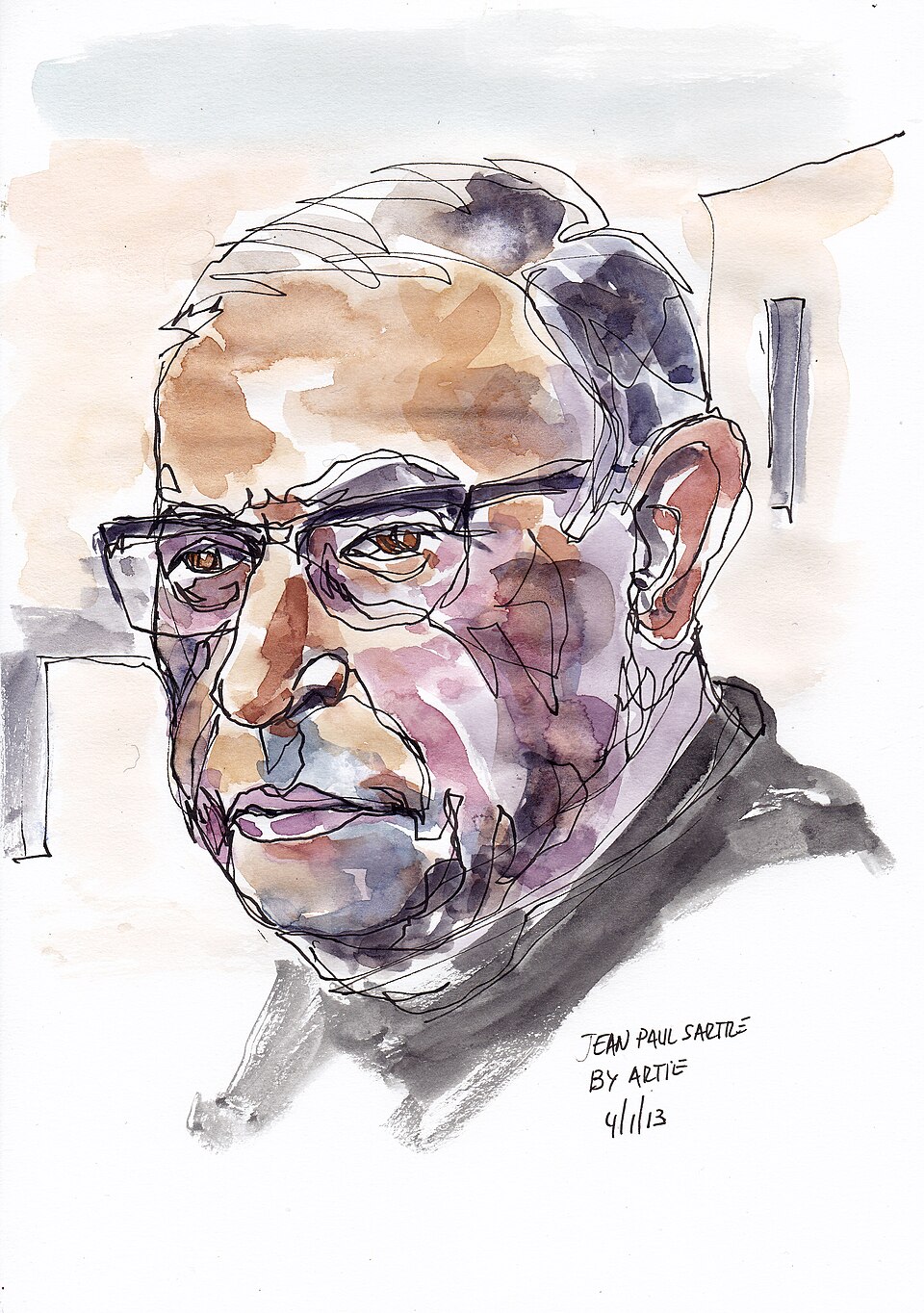
—What did you do for fun in the evening?
Oh, I loved parties! After a day of writing, I'd meet friends in the cellars of Saint-Germain-des-Prés. There we listened to jazz, that lively music from America. Simone was often there, and we'd talk for hours, about everything and nothing, books and the world. There were also theater premieres, dinners that ended very late. I worked a lot, it's true, but I wasn't a shut-in hermit. Life, friends, ideas sparking in the smoke of a cellar — that was my real happiness. Thinking, for me, was never being alone.
—Is it true that you saw crabs following you?
Ah, you know that story! Yes, it's true, and it's a bit frightening. In 1935, a doctor friend had me try a substance, mescaline, for an experiment. For months afterward, I thought I saw crabs and octopuses following me everywhere, in the street, behind me. It wasn't real, of course — it was my brain playing tricks on me. But that feeling of anguish, that strange disgust with the world, I put it into my first novel, Nausea. My hero, Roquentin, feels that things are there, too present, without reason. Sometimes, you see, even a fear can become a book.
—What does it mean that man is free?
That's the heart of everything I thought. Listen carefully. A knife, before it exists, someone imagined it for cutting: its purpose comes before it. Man is the opposite: he is born first, and only afterward he decides who he will be. I said: 'existence precedes essence'. That means you are not obliged to be what others expect of you. You build yourself through your choices, every day. It's magnificent, but it's also heavy. I had another formula: 'man is condemned to be free'. Condemned, because you cannot hide behind excuses. What you make of your life depends on you.
You are not obliged to be what others expect of you.
—Why did you say no to the Nobel Prize?
In 1964, I was offered the Nobel Prize in Literature, the greatest honor for a writer. And I said no. The first to voluntarily refuse it! People thought I was crazy. But here's my reason: I was afraid of becoming a statue, what they call an 'institution'. I wrote to the Academy that 'the writer must refuse to let himself be transformed into an institution'. You understand? If I accepted that medal, I would be respected as a monument, and I could no longer criticize freely, nor disturb. But I wanted to remain a living man. That same year, I published The Words, the story of my childhood.
I wanted to remain a free man, not a trophy in a display case.
—What would you like people to remember about you?
What a beautiful question. I don't want people to remember me as a great man in a dusty book. No. I'd like you to remember one idea: you are free, therefore you are responsible. No one decides your life for you — not your parents, not your era, not the chance of your birth. It's frightening, I know. But it's also the best news in the world. When I died, in 1980, more than fifty thousand people marched behind me through the streets of Paris. It wasn't for my medal — I had refused it. It was, I think, for that idea of freedom. Keep it carefully, and make something of it.
This imaginary interview was generated by artificial intelligence from sources documented in Jean-Paul Sartre's profile. It dramatises what the figure might have said based on what we know about them, but does not constitute attested historical testimony. For primary sources and factual documentation, refer to the full profile.