Imaginary dialogue between Oskar Morgenstern and John von Neumann
by Charactorium · John von Neumann (1903 — 1957) · Sciences · 6 min read
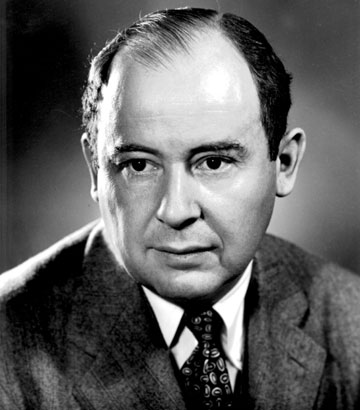
It is in the grand living room of the house on Westcott Road, in Princeton, that Oskar Morgenstern meets his old friend John von Neumann on an autumn evening in 1946. The radio plays softly, glasses still clink near the fireplace after the last guests have left, and sheets covered with matrices lie on the coffee table. The two men have just completed Theory of Games and Economic Behavior together; Oskar comes tonight not to talk economics, but to probe the man behind the calculator — the one he has seen laugh out loud and bend the world into equations.
—Johnny, before Princeton, before our games, there was Budapest. They say you recited the phone book from memory — tell me, where does that prodigious mind come from?
You know, Oskar, at six I joked with my father in ancient Greek, and the Budapest phone book was just a parlor game my uncles asked for on Sundays. A page read once was imprinted, intact, like a photographic plate — the entirety of Dickens' A Tale of Two Cities, I could reproduce it years later. It's not a merit, understand me: it's a tool, like your eyes or hands. Budapest gave me that, and teachers who never shied from a gifted child. But a memory that retains everything is nothing without a sorting mechanism. You who have seen me work know that true talent is not retention — it is knowing, in that jumble, where to place the finger.
A page read once was imprinted, intact, like a photographic plate.
—We have just signed our book on games together. When did the idea come to you that human rivalry could be reduced to mathematics?
Long before you, my friend — but you gave me economics as a field. As early as 1928 I had proved the minimax theorem: in a zero-sum game, there always exists a strategy that minimizes your maximum loss, whatever the opponent does. It was abstract, almost a diversion. Then you arrived with your markets, your rational actors, and suddenly these games spoke of real life. What fascinates me is that rational decision-making against an enemy can be written in equations as cleanly as a shell's trajectory. We did not invent human cunning; we gave it a grammar. And that grammar, I fear, will soon serve tables far less innocent than those of poker.
We did not invent human cunning; we gave it a grammar.
—You say 'less innocent tables.' In Washington, they listen to you on the bomb. Do your decision mathematics truly guide the generals?
They should, Oskar, because generals decide blindly where calculation sees clearly. Consider this: two powers hold the weapon, each fears the other's first strike. It is a game, the gravest of all, and minimax dictates a cold logic — that of deterrence, where the threat of devastating retaliation forbids attack. I do not rejoice in it; I observe. A world where one calculates survival like a game is a terrible world, but denying it does not make it less real. I prefer it to be thought through with rigor than abandoned to the mood of statesmen. The worst would be to play this game without knowing its rules.
A world where one calculates survival like a game is a terrible world, but denying it does not make it less real.
—During the war, you disappeared for weeks to New Mexico. At Los Alamos, what did you bring that was so decisive to that bomb?
The problem, my dear fellow, was of a formidable beauty. To detonate plutonium, one could not assemble it by a gun: it had to be crushed onto itself, compressed by a perfectly symmetrical shock wave — implosion. But compressing a metal homogeneously with explosives is a hydrodynamics problem of unimaginable violence, which no one knew how to calculate. I brought the mathematics of shocks, the explosive lenses, the equations that made the thing possible. I crossed the continent in a suit, solving trajectories in my head on the train. It was the calculation that made Fat Man real — the one over Nagasaki. You ask what I brought: the certainty that it would work. The rest, history has decided for me.
It was the calculation that made the thing real; the rest, history has decided for me.
—I have often seen you arrive from those trips impeccable, calculating in your head what your machines took hours to produce. Where did that confidence come from?
From the fact that I trust machines only halfway, Oskar! At Los Alamos, entire rooms of Marchant calculators ran in parallel, and I would sometimes verify their results in my head before they finished — not out of vanity, but because a wrong order of magnitude can be felt, like a wrong note. The three-piece suit, for its part, was not coquetry: it reminded me who I was in that desert of khaki uniforms. A well-dressed man thinks straight. But do not misunderstand: I estimated; the machines confirmed. And it is precisely because human calculation reaches its limit that I later wanted to build machines capable of going where my mind could no longer follow.
A wrong order of magnitude can be felt, like a wrong note.
—Speaking of those machines. There's a rumor in the corridors that a report is circulating, the First Draft, with your name alone on it. Eckert and Mauchly resent you. What happened?
A blunder, Oskar, for which I bear some blame. In 1945, I wrote a synthesis for the EDVAC — the logic of a machine that would keep its instructions in memory alongside its data. The stored program is the whole revolution: a machine that can be reprogrammed without being rebuilt. But I wrote that text as a mathematician clarifying a common idea, not to claim ownership. Goldstine circulated it with only my name on the header, and the architecture now bears that name — mine. Eckert and Mauchly had built the ENIAC with their own hands; they saw authorship slip away from them. They are not entirely wrong. An idea is rarely born from one man, and it is the ordinary injustice of science to stick a name on the work of many.
It is the ordinary injustice of science to stick a name on the work of many.
—But this idea of the stored program, how does it change everything? For a layman like me, where is the breakthrough?
Imagine, Oskar, an orchestra where, to change a piece, you would have to rebuild the instruments. That was the ENIAC: rewiring the machine for days for each new problem. The breakthrough is to lodge the score — the instructions — in the same memory as the notes, i.e., the data. From then on, the machine can modify its own program, read its orders as numbers, reconfigure itself at the speed of electricity. A single machine becomes all possible machines. It is the passage from the tool to the universal instrument. You see, what fascinates me is not the metal or the vacuum tubes; it is the logic of organization. The logical structure of an automaton is more fundamental than its physical realization — the copper will pass, the architecture will remain.
A single machine becomes all possible machines.
—You speak of automata. They say you are fascinated by machines that would reproduce themselves. Isn't that more a fantasy than a science?
A rigorous fantasy, then, Oskar — and it is the only kind that interests me. I ask a precise question: what is needed, logically, for a machine to build a copy of itself? Not in metal, first, but on paper: an automaton that would contain both the plan of its construction and the means to copy that plan. It is exactly the problem of life, stripped of flesh. Nature solved it; I seek the minimal rules that make it possible. It seems an abstraction game, but consider its scope: understanding reproduction as a logical operation, independent of the matter that carries it. The living and the machine may obey the same grammar. That is what keeps me awake — far more than the bombs.
It is exactly the problem of life, stripped of flesh.
—You have received me so many times here, between parties, the radio blaring and you calculating in the midst of the noise. How do you work in such a racket?
Because silence bores me, Oskar! Klára will tell you: I need life around me to think. The radio full blast, conversations, a detective novel open on the desk — all that occupies the part of me that would fidget uselessly, and frees the other for mathematics. Those dinners we give are not vain socializing: it is there, between a Nobel laureate and a man from Washington, that an idea sometimes arises better than at my blackboard. I like people, jokes, the good food of my Hungarian childhood. People think I am a cold machine; it is quite the opposite. Calculation does not isolate me from the world — I need the tumult of the world to calculate.
Calculation does not isolate me from the world — I need the tumult of the world to calculate.
—One last thing, Johnny, more serious. All these years brushing against tests, radiation… do you never fear for your health, for the time you have left?
You touch there, Oskar, on what I prefer not to face. We all breathed the air of those deserts, saw too closely what we had calculated. If a price must be paid for standing so close to the fire, I will pay it without surprise. What presses me, you see, is less fear than the unfinished: I want to understand, before the end, what connects the machine I am building to the brain that designed it. Do the nervous system and the computer speak the same logical language? I have begun to write it. If I should not finish that book, promise me that it will be known that I considered it the most important of all. The rest — the bombs, the honors — is only arithmetic. This would be the real question.
What presses me is less fear than the unfinished.
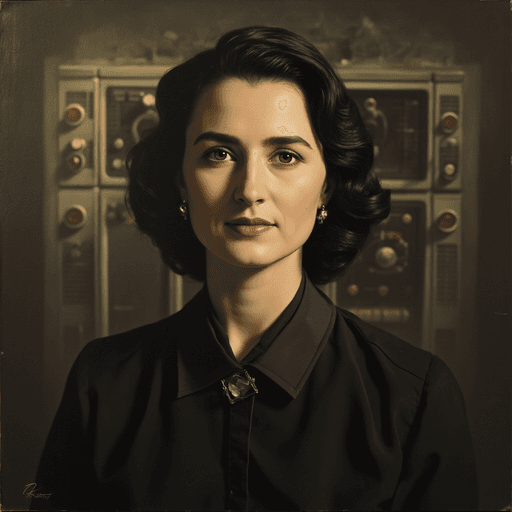
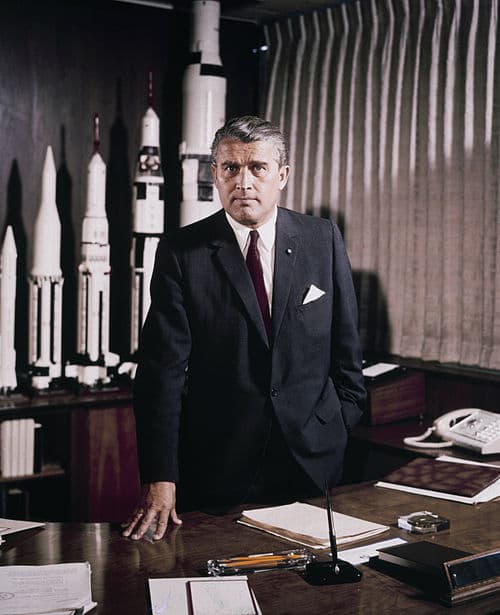
This imaginary interview was generated by artificial intelligence from sources documented in John von Neumann's profile. It dramatises what the figure might have said based on what we know about them, but does not constitute attested historical testimony. For primary sources and factual documentation, refer to the full profile.