Imaginary interview with John von Neumann
by Charactorium · John von Neumann (1903 — 1957) · Sciences · 6 min read
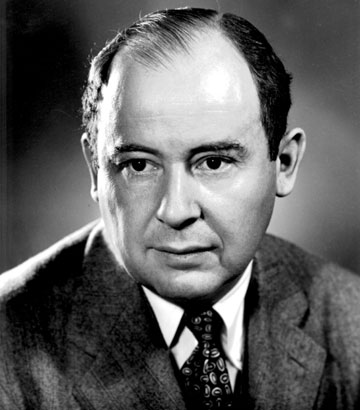
Princeton, winter 1955. In the grand living room on Westcott Road, the radio plays too loudly and a detective novel lies open on the armrest. John von Neumann, impeccably dressed in a three-piece suit despite the late hour, greets us with the smile of a host who loves conversation as much as equations. Even on this evening, he already knows that illness is catching up with him — but his mind, for its part, still races faster than his words.
—They say you could recite the Budapest phone book from memory. Where does this most unusual memory come from?
I was born in Budapest in 1903, into a family where the mind was considered as serious a capital as my father's bank. Very early on, I discovered that pages engraved themselves in me effortlessly, columns of names and numbers included — a parlor game, nothing more, which my friends adored. Someone would hand me a book, and I would give back the page. One day, I was given the first page of Dickens' A Tale of Two Cities: I read it once, then recited it word for word. Understand me: this is not a mystical gift, it is a mechanism — and nothing fascinates me more than a mechanism that retains. That same machinery later served me to hold entire shell trajectories in my head, in the car, between two laboratories.
This is not a mystical gift, it is a mechanism — and nothing fascinates me more than a mechanism that retains.
—How did you come to work on implosion, at Los Alamos?
I was called because I knew how to make explosions speak. The problem of the plutonium bomb was cruel: the material had to be compressed by a perfectly symmetrical shock wave, an implosion, and the slightest flaw ruined everything. At Los Alamos, between 1943 and 1945, I spent my days taming those hydrodynamic equations that no one could solve by hand. We lined up Marchant mechanical calculators, entire teams turning the cranks in parallel like an orchestra of numbers, and I would check with my slide rule what the machines took hours to confirm. This work made Fat Man, dropped on Nagasaki, technically possible. I do not hide it; nor do I glorify it.
We lined up the Marchant calculators, entire teams turning the cranks like an orchestra of numbers.
—What do you say to those who reproach you for having put your genius at the service of the atomic bomb?
I tell them that the mathematician does not choose the century in which he is born. I saw Hitler come to power in 1933, I left Europe anticipating what it would become, and I had no illusions about the nature of the danger. When the USSR exploded its own bomb in 1949, those who still spoke of disarmament seemed to me like children playing at the edge of a precipice. I believe a scientist must look reality in the face, terrible though it may be: the numbers I calculated at Los Alamos were no more moral or immoral than numbers themselves. Responsibility lies in the hand that decides, never in the equation. But I do not always sleep well, if that is your question.
The numbers I calculated were no more moral or immoral than numbers themselves.
—Let's talk about that famous 1945 report. Why did it trigger such a falling out?
In June 1945, I wrote a text I had soberly titled First Draft of a Report on the EDVAC. In it, I set down what I considered obvious: 'An automatic computing system is a (usually highly composite) device, which can carry out instructions to perform arithmetic and logical operations on numbers.' The central idea, the stored program, consisted of lodging instructions in the same memory as data — a machine that reprograms itself without touching a single wire. The misfortune was that this draft circulated without my consent, my name alone at the top. Eckert and Mauchly, who had built the ENIAC with their own hands, saw the architecture named after me. I understand their bitterness; a draft never asked permission to become famous.
A draft never asked permission to become famous.
—What seemed so fundamental to you about this idea of a reprogrammable machine?
Consider what the ENIAC was: to change its task, you had to disconnect and reconnect cables for days, like reorganizing the pipes of an organ. Absurd. My conviction, which I wrote at the time to Norbert Wiener, is that the logical structure of an automaton is more fundamental than its physical realization — reasoning before copper. If the machine can hold its own instructions in memory, on the same level as its numbers, then it ceases to be a fixed tool and becomes a universal organ, capable of embodying any calculation we dictate to it. That is what I wanted to engrave in the report on the EDVAC: not a good machine, but the blueprint for all machines to come. The rest is mere engineering.
Not a good machine, but the blueprint for all machines to come.
—Your Game Theory was born long before the bomb. How did you conceive it?
With the economist Oskar Morgenstern, I published in 1944 that Theory of Games and Economic Behavior which we wanted as rigorous as a geometry treatise. Our ambition fit in one sentence: 'We wish to find the mathematically complete principles which define 'rational behavior' for the participants in a social economy.' At the heart of the edifice is the minimax: in a zero-sum game, the wise strategy is the one that minimizes your maximum loss, assuming the opponent is as skilled as you. This seems cold, and it is. But look at the world: two powers watching each other do nothing but play this game, each calculating the worst the other can inflict. Mathematics there does not describe a pastime — it describes reasoned fear.
Two powers watching each other play nothing but this game: each calculates the worst the other can inflict.
—How does one go from these theorems to the role of government advisor on nuclear strategy?
One goes there because the same equations govern both. From 1947, the Cold War opened a new kind of game, where one did not win but avoided losing, and nuclear deterrence is nothing but a minimax on the scale of nations. In 1954, I was appointed to the Atomic Energy Commission, and I found myself carrying my Princeton chalk into the corridors of Washington. I traveled constantly, by plane, by train, from one committee blackboard to another. My role was not to love the bomb — it was to think the unthinkable coldly, because those who refuse to calculate catastrophe end up suffering it. A game theorist never closes his eyes to the table.
Think the unthinkable coldly, because those who refuse to calculate catastrophe end up suffering it.
—You are described as a dandy, hosting Nobel laureates and politicians at your Princeton home. Was this worldliness a refuge?
Let's say I never believed that austerity was proof of seriousness. At the Institute for Advanced Study, my colleagues cultivated the look of monks; I kept my three-piece suit even in the New Mexico desert, and my wife Klára knew I could demonstrate a theorem with the radio at full volume and twenty guests laughing around. Our home on Westcott Road was a place of parties — I mixed physicists, ministers, and detective novels that I devoured between conversations. I love noise, I love movement, I love driving my Cadillac much too fast. Thought does not need silence; it needs life around it. Contemplation, I leave to others.
Thought does not need silence; it needs life around it.
—You seem to live at high speed. Does this elegance and worldliness say something about your native Hungary?
Everything, no doubt. I grew up in a Budapest where one valued both an open table and a sharp mind, where a cultivated banker quoted the classics between business deals. This taste for bourgeois comfort, for rich Central European dishes, for receptions where people speak loudly, I carried with me across the Atlantic as one carries a mother tongue. My days begin with the newspapers, my eye fixed on world politics; they often end with a dinner I want to be generous. Some see frivolity in this. I see the continuity of a lost world — that before 1914, before the collapse of the Empire — which I recreate, in my own way, in a New Jersey living room. One keeps the elegance one can.
I recreate, in a New Jersey living room, the continuity of a lost world.
—You are now working on the links between the brain and the machine. What do you hope to find there?
It is the subject to which I devote my last strength, and which I fear leaving unfinished. All my life, I have rubbed shoulders with two kinds of automata: those we build in copper and vacuum tubes, and the prodigious one that each of us carries under his skull. I would like to understand in what language both compute. The nervous system, I suspect, mixes two modes of communication — one that does not care about the exact value of a number, the other that depends entirely on it — whereas the digital machine knows only the latter. My own childhood memory, which recited entire pages, was perhaps merely a clue to what we are: machines that record the program, unaware of it. I would have liked to have the time to write it to the end.
We are machines that record the program, unaware of it.
This imaginary interview was generated by artificial intelligence from sources documented in John von Neumann's profile. It dramatises what the figure might have said based on what we know about them, but does not constitute attested historical testimony. For primary sources and factual documentation, refer to the full profile.