Kids interview John von Neumann
by Charactorium · John von Neumann (1903 — 1957) · Sciences · 5 min read
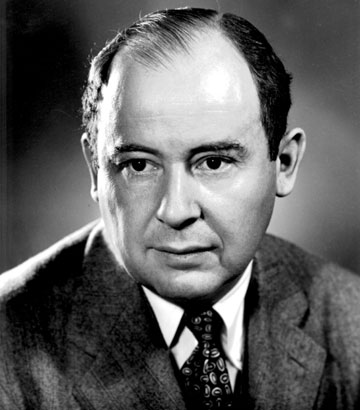
That morning, two young visitors on a discovery class pushed open the door of a large office in Princeton. A gentleman in a dark suit greeted them with a warm smile. His name was John von Neumann, and he had agreed to answer all their questions.
—They say you remembered everything by heart. Is that true?
Ah, you know, it's a strange gift, my child. When I was little, in Budapest, I would read a page just once and it would stay engraved there, in my head. Imagine a whole book stored in a drawer that you can open again years later. One day, to amuse my friends, I recited from memory the first page of a novel by Dickens, A Tale of Two Cities. I had read it only once! I could even recite pages from the phone book. But be careful: having a good memory is not being intelligent. It's only having a big drawer. The most important thing is what you decide to do with it.
A good memory is just a big, well-organized drawer.
—What was it like at your home? Did you throw parties?
Oh yes, I loved that! My big house in Princeton was always full of people. Imagine brightly lit rooms, loud music, laughter everywhere. I invited very serious scientists and important people, and everyone talked until late. The funniest thing? I could think about a math problem in the middle of that noise, with the radio blaring next to me. My wife Klára always laughed about it. I also liked nice cars and detective novels. You know, you can be a scientist and love to laugh, dance, and eat well. The two don't fight.
You can be a scientist and love to laugh, dance, and eat well.
—Is it true that you invented how computers work?
Let's say I helped design the blueprint, my child. In 1945, I wrote a report called the First Draft of a Report on the EDVAC. I explained a very simple but powerful idea. Before, to change what a machine did, you had to disassemble it and rewire wires for days. I proposed storing the instructions in the machine's memory, right next to the numbers. Imagine a kitchen where the recipe and the ingredients are in the same cupboard. Then you can change the recipe without breaking the kitchen! That's called the stored-program concept. Machines still work that way today.
Store the recipe next to the ingredients: then you can change everything without breaking anything.
—But how can a machine understand what we tell it?
Good question! A machine doesn't understand like you and me. It obeys, that's all. In my report, I said it in my own words: a computing machine is a device that executes instructions to perform operations on numbers. But you have to give it those instructions in a form it can read. In my time, we punched holes in cardboard cards — punched cards. Each hole, or each absence of a hole, was a small decision: yes or no. Imagine talking to someone who only knows two words. With patience, by lining up enough yeses and nos, you can still make them do wonders.
The machine doesn't understand: it obeys, with infinite patience.
—Did you really compare the human brain to a machine?
Yes, and it's the last thing that fascinated me, my child. Toward the end, I started a book, The Computer and the Brain. I couldn't finish it. I asked a dizzying question: what if your head, right there, worked a bit like my machines? Your brain sends tiny signals between its cells, like little electrical messages. My machines do the same with their vacuum tubes. But be careful: the brain is a thousand times smarter and more efficient. I just wanted to understand what brings them together and what separates them. It was like holding two clocks side by side to listen to which one ticks better.
What if your head, right there, worked a bit like my machines?
—Did you really work on the atomic bomb? How did that make you feel?
Yes, and it's a heavy part of my life, my child. During the war, I went to a secret laboratory in the middle of the desert, at Los Alamos. We wanted to build a terrible weapon. The problem was mathematical: how to crush a metal ball onto itself, perfectly, from all sides at once? That's called implosion. I found the calculations that made it possible. You know, I traveled across the country for this work. I won't hide something from you: helping to create such a force never leaves the heart entirely at peace.
Helping to create such a force never leaves the heart entirely at peace.
—I heard you always wore a suit, even in the desert?
Ha! That's absolutely true. There, at Los Alamos, my colleagues wore wrinkled shirts and old pants. And me? I arrived in a dark three-piece suit, white shirt, tie, impeccable, even under the New Mexico sun. I think it amused them a lot. During long car trips, I solved trajectory calculations in my head, without paper. My manual estimates sometimes rivaled the big calculating machines! You see, I was raised in a well-groomed family in Budapest, and I never gave up that elegance. It was my way of staying myself, even in such a strange place.
I calculated shell trajectories in my head, in a three-piece suit, in the middle of the desert.
—What is game theory? Can you really play it?
Not with dice, my child, but the idea does come from games! In 1944, with my friend Oskar Morgenstern, I wrote a big book about it. We wanted to find the mathematical rules of what is called behaving intelligently. Imagine two chess players: each tries to guess what the other will do to win. I looked for the best strategy when you can't lose everything at once. It's called the minimax: choose the move that limits the worst that can happen to you. It's not just for games. It's also used when countries face each other and have to decide without trusting each other.
A good player doesn't try to win everything: he first avoids the worst.
—And these game ideas, were they really used by real governments?
Yes, and that's where it becomes serious, my child. After the war, two huge camps distrusted each other and possessed terrible weapons. I was asked for advice. My ideas on strategy fed what is called deterrence: the idea that no one dares to attack, because the retaliation would be too frightening for both. Imagine two children facing each other, each holding a stone, not daring to throw first for fear of receiving the second. It's a fragile and somewhat chilling balance. I would have preferred that my mathematics only serve for chess games. But the world decided otherwise.
Two children face to face, each with a stone, not daring to throw first.
—At the end, you were sick. Was it because of your work?
Probably, my child. In 1955, doctors found cancer in my bones. It's thought to have come from my exposure to radiation, there, near the tests. But I kept working until the end, with my papers around me. One strange thing: the army had posted guards outside my hospital room. They were afraid that weakened, I might let secrets slip! It was in those last months that I was writing that book on the brain and the machine. I never finished it. You know, an idea you don't have time to finish is not a failure. It's a door left open for those who come after.
An unfinished idea is a door left open for those who come after.
This imaginary interview was generated by artificial intelligence from sources documented in John von Neumann's profile. It dramatises what the figure might have said based on what we know about them, but does not constitute attested historical testimony. For primary sources and factual documentation, refer to the full profile.