Imaginary interview with Julian of Norwich
by Charactorium · Julian of Norwich (1342 — 1500) · Spirituality · Literature · 6 min read
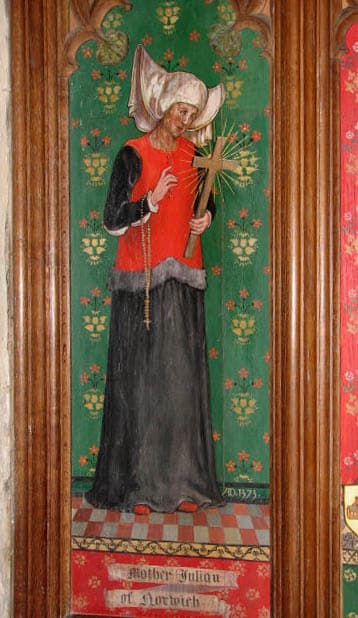
Norwich, a grey Norfolk morning, around the year 1400. Behind the wall of St Julian's Church, a voice answers through the narrow window of a cell where a woman has been walled in for years. She has seen, she says, the suffering Christ; she has spent twenty years understanding what she saw. People listen through the stone.
—How did it all begin, in that year 1373?
I was about thirty years old, and I thought I was at death's door. The fever had taken me for three days; my body was already cold, my eyes fixed upward, unable to look to the side. A priest held a crucifix before my face, telling me to fix my gaze on it since I could see nothing else. And it was there, in May 1373, that the showings began: sixteen revelations of Christ in his Passion, the fresh blood flowing under the crown of thorns, warm and abundant as raindrops falling from a roof. I dared not look away from the cross, for as long as I gazed upon it, I knew myself safe. The next day, against all expectation, I was healed — but nothing inside me was ever the same again.
As long as I gazed upon the cross, I knew myself safe.
—What exactly did these sixteen visions show?
They showed not glory, but pain — and yet, in the depths of pain, a joy I cannot name. I saw the Lord's face change colour, the withering of his flesh, and that same flesh become a source of life. I was made to understand that suffering does not have the last word. One saying above all stayed with me: He did not say “you shall not be tormented, you shall not be tried, you shall not be afflicted”, but He said: “you shall not be overcome.” That is what my revelations are — not the assurance of being spared, but the promise of being held. Each showing was like a sealed letter that took me years to open fully.
He did not say: you shall not be tried; He said: you shall not be overcome.
—Why did you write two versions of your Revelations, twenty years apart?
Because a vision is received in an instant but not understood in a day. Soon after my illness, I set down on parchment a brief, almost bare account — what is now called the Short Text. It was direct testimony, still trembling. But I kept returning to it, like turning a stone in the sun to see every face. Twenty years later, around 1393, I wrote the Long Text, in which I finally dared to say what I had taken two decades to dare: that God is our Mother as much as our Father, that He carries us as a mother carries her child. It was not shown to me all at once. Meditation had to carve its bed in me, patiently, year after year, by the light of a single candle.
A vision is received in an instant, but not understood in a day.
—Yet you call yourself uneducated. How do you reconcile that with the scope of your work?
I called myself a simple creature unlettered, and I still believe it. I did not attend the schools where clerics dispute in Latin. But what I did not receive from masters, I received otherwise, and I wrote it in the language of my people, vernacular, the tongue spoken by the women of Norwich at market and in their kitchens. They tell me I am the first woman to write a book in English; I did not seek that. I only wanted the consolation I received not to remain locked in my cell. Vernacular does not lower truth — it makes it accessible. That God should use an ignorant woman should surprise no one: it is His way.
Vernacular does not lower truth — it makes it accessible.
—You live as a recluse, walled in a cell. What does such a life mean?
It is called enclosure. The bishop celebrated a funeral Mass over me, for to the world I am dead: I crossed the threshold of this cell adjoining St Julian's church never to leave it until my last breath. But this tomb is also a birth. My cell has three windows: one, the hagioscope, opens towards the altar and lets me follow Mass and see the elevation of the host; another, onto the street, through which my bread and water are passed; the third, for those who come seeking counsel. Three narrow openings, and through them passes the whole world — God through the first, my body through the second, my neighbour through the third. I am a recluse, not a prisoner: the door, I myself willed it closed.
This tomb is also a birth.
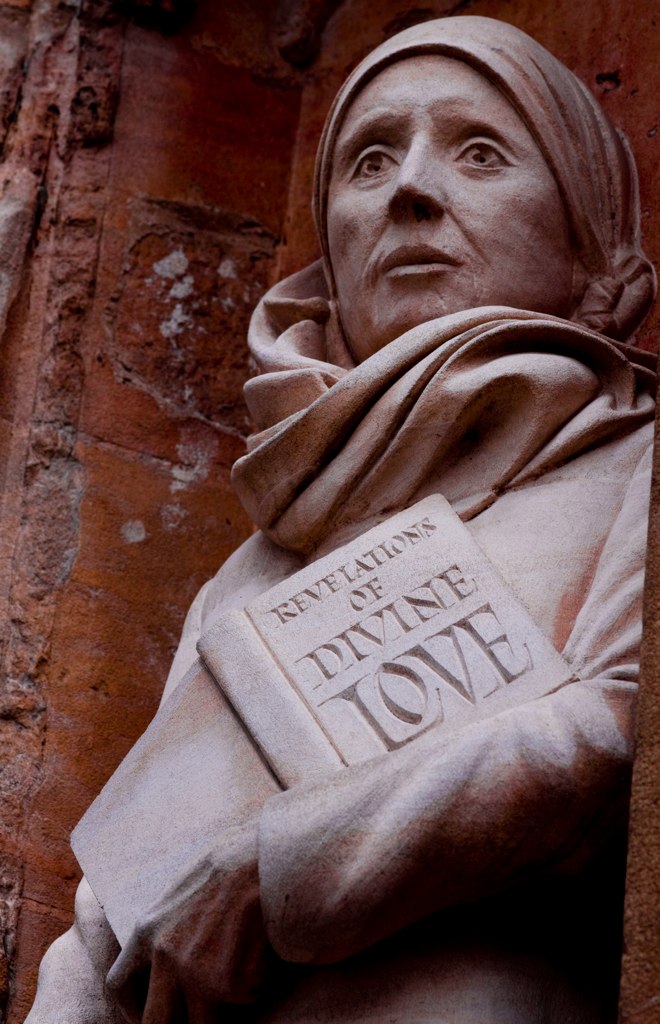
—What are your days like in such a narrow space?
They follow the rhythm of the hours. Before dawn, I rise for matins and lauds, which I recite looking towards the altar through my window. The morning is spent in meditation on Scripture, in the silence of stone. In the afternoon, sometimes there is a knock at the outer window — a pilgrim, a troubled soul — and I give what counsel I can. Then vespers, compline, and when night comes, writing. I wear the dark, rough habit of a recluse, without ornament, for I am dead to the world; my food is passed to me through the window, bread and vegetables, fish on permitted days. A few square metres, a bed, a prie-dieu, a candle. One might think it poverty itself. But I have never felt cramped.
—How dare you proclaim that "all shall be well" in a century of plague and war?
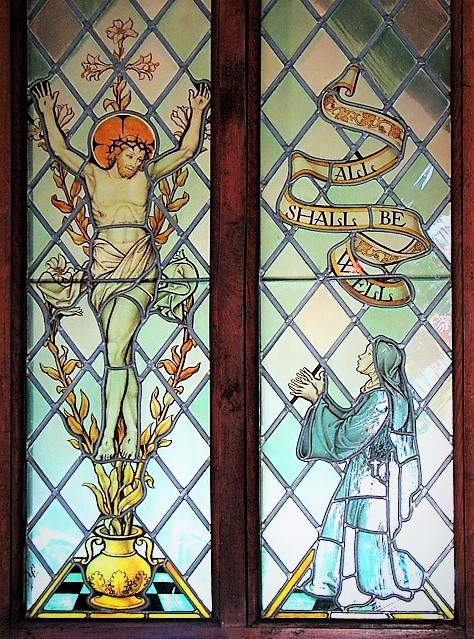
I know my century. The plague mowed down Norwich twice in my lifetime, in my childhood and around 1361, so thickly that there were not enough arms to bury the dead. War between the kingdoms never ends, peasants have revolted, and two popes contend for Christendom. It is not I who speak of hope in this turmoil — it is He. He said to me, and I say it again because I heard it: “All shall be well, and all shall be well, and all manner of thing shall be well.” All shall be well, and all shall be well, and every kind of thing shall be well. Not that evil is nothing — but that evil will not prevail. Before the mass graves, this saying is not naivety; it is the only thing strong enough to stand.
Before the mass graves, this saying is not naivety.
—An image recurs in your writings, that of a hazelnut. What do you mean by it?
In my revelations, a little thing was placed in the palm of my hand, round, no bigger than a hazelnut. I looked at it and wondered: what can this be? And it was answered: it is all that is made. I marvelled that such a small thing did not fall to dust, so fragile it seemed. And I understood three truths: that God made it, that God loves it, that God keeps it. There is the whole world held in a hazelnut, and what holds it is love. In a time when everything seems to collapse — kingdoms, harvests, bodies — this little thing in my hand tells me that nothing that exists subsists by itself, but by the love of Him who made it.
The whole world held in a hazelnut, and what holds it is love.
—They say another woman, Margery Kempe, came knocking at your window. Do you remember?
Yes, a woman from Lynn came, not long ago, sitting for several days before my outer window. They call her Margery. She wept much, sometimes cried out, and wondered whether her tears and visions came from God or from illusion — for those around her called her mad, or worse. She opened her soul to me and the grace she thought she felt in it. I told her what I believe to be true: that the Holy Spirit never moves the soul against charity, and that if her tears carried her towards it, she should hold them as a gift and not fear them. Persevere, I told her, do not let yourself be turned aside. Two women speaking of God through a window, in this century — I did not think it would be remembered.
—What does this role of counsellor mean to you, you who never leave your cell?
It is the only commerce I have left with the living, and it passes entirely through a window a hand's breadth wide. They come, one after another: a widow, a merchant gnawed by scruples, a young man who doubts. I am neither priest nor doctor; I have only what was shown to me. But I have learned this, which I repeat without tiring: God does not look upon sin with the anger people attribute to Him; His mercy is greater than our faults. Many arrive crushed by shame and leave, I think, somewhat lightened. A strange office for a walled-up woman: unable to go to anyone, I let the world come to me through this narrow opening — and sometimes, the word received long ago on my deathbed passes thus to another.
Unable to go to anyone, I let the world come to me through a narrow opening.


This imaginary interview was generated by artificial intelligence from sources documented in Julian of Norwich's profile. It dramatises what the figure might have said based on what we know about them, but does not constitute attested historical testimony. For primary sources and factual documentation, refer to the full profile.