Imaginary interview with Kaguya-hime
by Charactorium · Kaguya-hime · Mythology · 6 min read
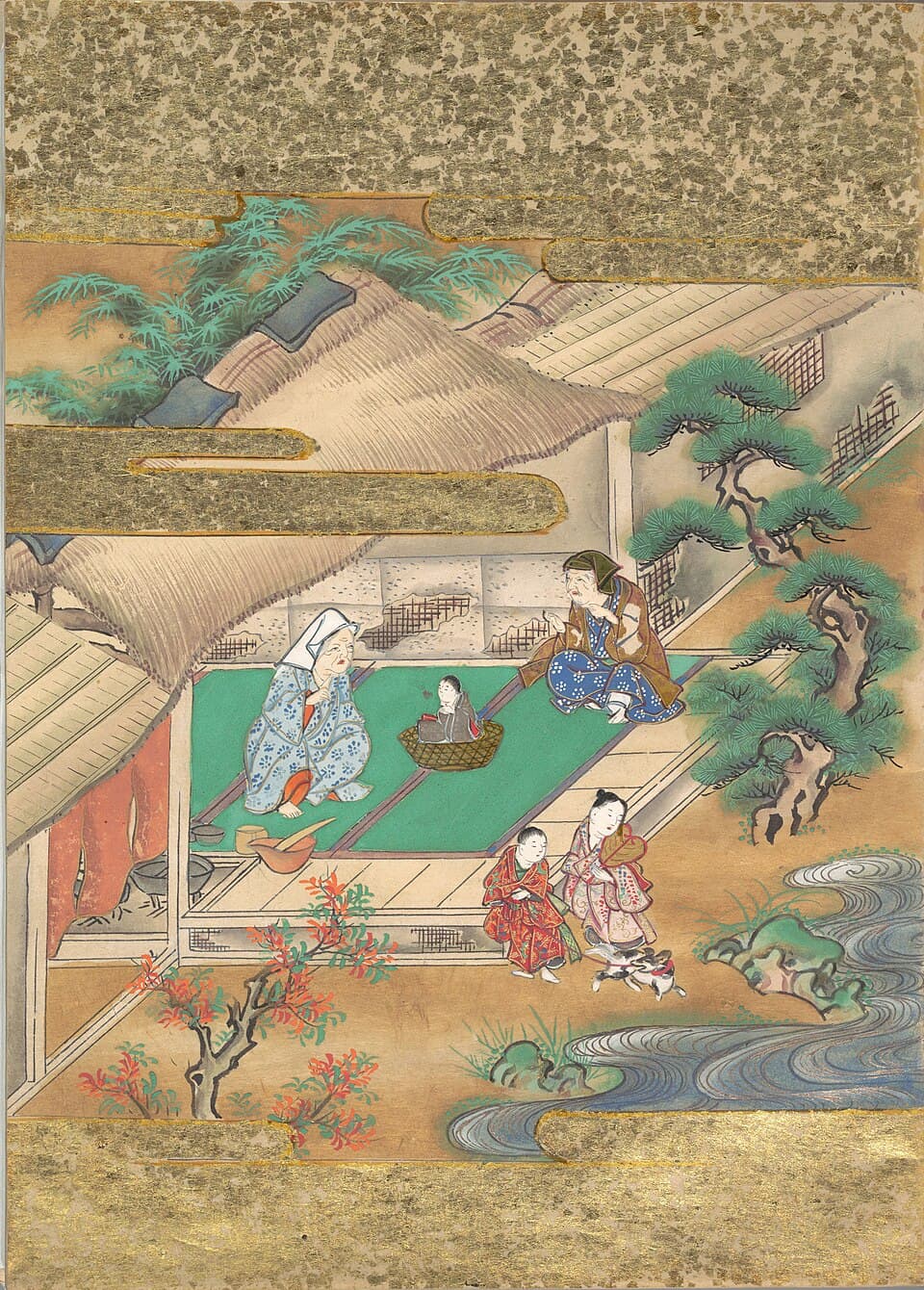
One full moon night on the heights of Heian-kyō, in a dwelling that wealth has embellished without making it less foreign to its inhabitant. Behind a slatted bamboo blind, a silhouette in pale silk gazes at the sky. She has agreed to speak, in a low voice, as one confides a secret already nearing its end.
—How did you come into the world of men?
I was not born, I was found. An old man, the Bamboo Cutter, was cutting wood in his forest as usual when a stalk began to glow with a light not of this world. He split it open, and there I was, no taller than three inches, nestled in the hollow of the cane like a pearl in its shell. Bamboo is like that: straight, hollow, pierced with light — a channel between what is below and what watches above. The old man took me in his trembling hands and carried me to his wife. They had no children; they thought Heaven had blessed them. I knew already, without being able to say it, that I was not a gift, but a loan.
I was not born, I was found — placed in the bamboo like a pearl in its shell.
—What did the light in which you were discovered mean to you?
That brightness, the villagers took for a wonder, a sign from the kami. To me, it was simply the color of the place I came from, still clinging to my skin like dew on the grass at morning. In a few months, I grew from a tiny child to a grown woman; what takes girls here fifteen years was accomplished in a single season. The old Bamboo Cutter kept finding, in every stalk he split, nuggets of gold — as if my keep on earth was being paid in advance. His thatched hut turned into a mansion. But gold did not illuminate me as much as the moon in the evening, when I sat by the blind and felt, without knowing why, my eyes grow wet.
—Do you remember your first days in the peasant house?
In the morning, we drew cold water from the well, cooked rice and vegetables from the garden — pumpkins, beans, whatever the land would give. In the afternoon, I spun and wove alongside my adoptive mother, and our hands looked alike then, two humble women among the bamboo fields. I loved that simplicity more than people think. When the chests filled and they wrapped me in silk kimono, adorned my hair with jade ornaments, I felt that each finery took me a little further from those two old people who had raised me on nothing. The beauty they attributed to me was a distance. I would gladly have stayed the weaving girl, if I had been given that choice.
Each finery took me a little further from the two old people who had raised me on nothing.
—Why did your beauty become, they say, legendary?
I cannot say for myself, for a mirror does not know its own brightness. But word spread from hut to palace, and people came from afar to see me as they come to see the first snow. Courtiers would stop before the polished bronze mirror in my room, adjusting their headdresses, convinced that their reflection would suffice to seduce me. They did not understand that what they took for beauty was only the trace of my other homeland, that cold light I carried despite myself. On full moon nights, I withdrew to my inner chambers, composed a few verses, gazed at the sky. Men saw a woman to be conquered; I was only a traveler counting the nights she had left.
Men saw a woman to be conquered; I was only a traveler counting the nights she had left.
—Why did you impose impossible trials on your suitors?
Five of the most powerful nobles presented themselves, laden with gifts, certain they could buy me like a rare fabric. I could not dismiss them with a word — a woman of my time does not refuse a prince without perishing for having offended him. So I asked each for the unfindable: the stone bowl of the Buddha, the branch of the jewel tree from the island of Hōrai, the robe of the fire-rat's skin, the jewel from the dragon's neck, the shell that the swallow hides. Things that exist only in tales. It was not cruelty, but the only language that allowed me to say no without saying it. All failed — one by exposed lie, another by cowardice, another nearly lost his life. My heart was not for the earth.
I asked for the unfindable: it was the only language that allowed me to say no without saying it.
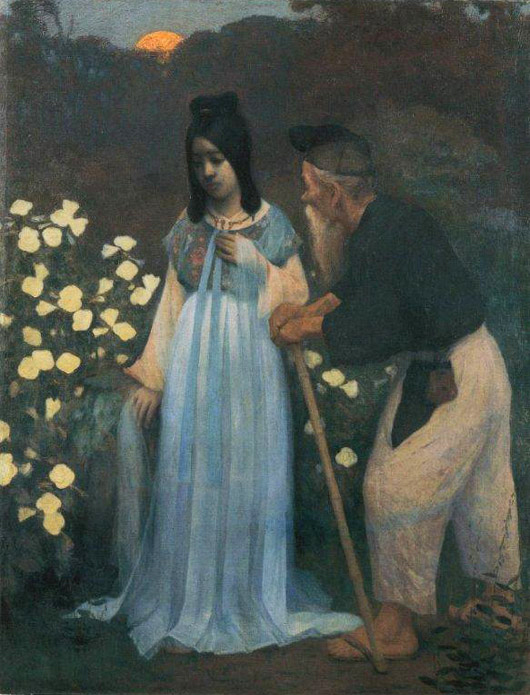
—Was it not audacious, for a woman of the Heian period, to refuse marriage like that?
I was reproached enough for it. At the court of the Fujiwara, a girl was an alliance, a bridge between two houses, sometimes a step toward the throne. To refuse was to place oneself outside the world — and that is precisely what I was, without yet admitting it. I saw those suitors pile up trials as one piles up proofs of a love that was not love: they coveted the prestige of possessing me, not my person. The Taketori monogatari will say that I held my destiny in my hands; the humbler truth is that I knew my destiny was written elsewhere, on the moon, and that no earthly wedding could erase that line. I was not brave. I was faithful to what I was.
—What would you say about your encounter with the emperor himself?
The Mikado heard of me as one hears of a treasure that no subject should possess before his sovereign. He sent for me; I refused to appear. So he came himself, under pretext of a hunt, and surprised me in my dwelling. For an instant, they say, my form wavered and became light in his hands — for one not of this world does not let himself be seized by the power of this world. The emperor understood that no palace of Heian-kyō, no crown, could hold me. We exchanged, over the years, poems carried by messengers. It is the only tenderness I have known here: made of distance and ink, never of possession. Even the master of all Japan had to learn that there are beings one does not marry.
Even the master of all Japan had to learn that there are beings one does not marry.
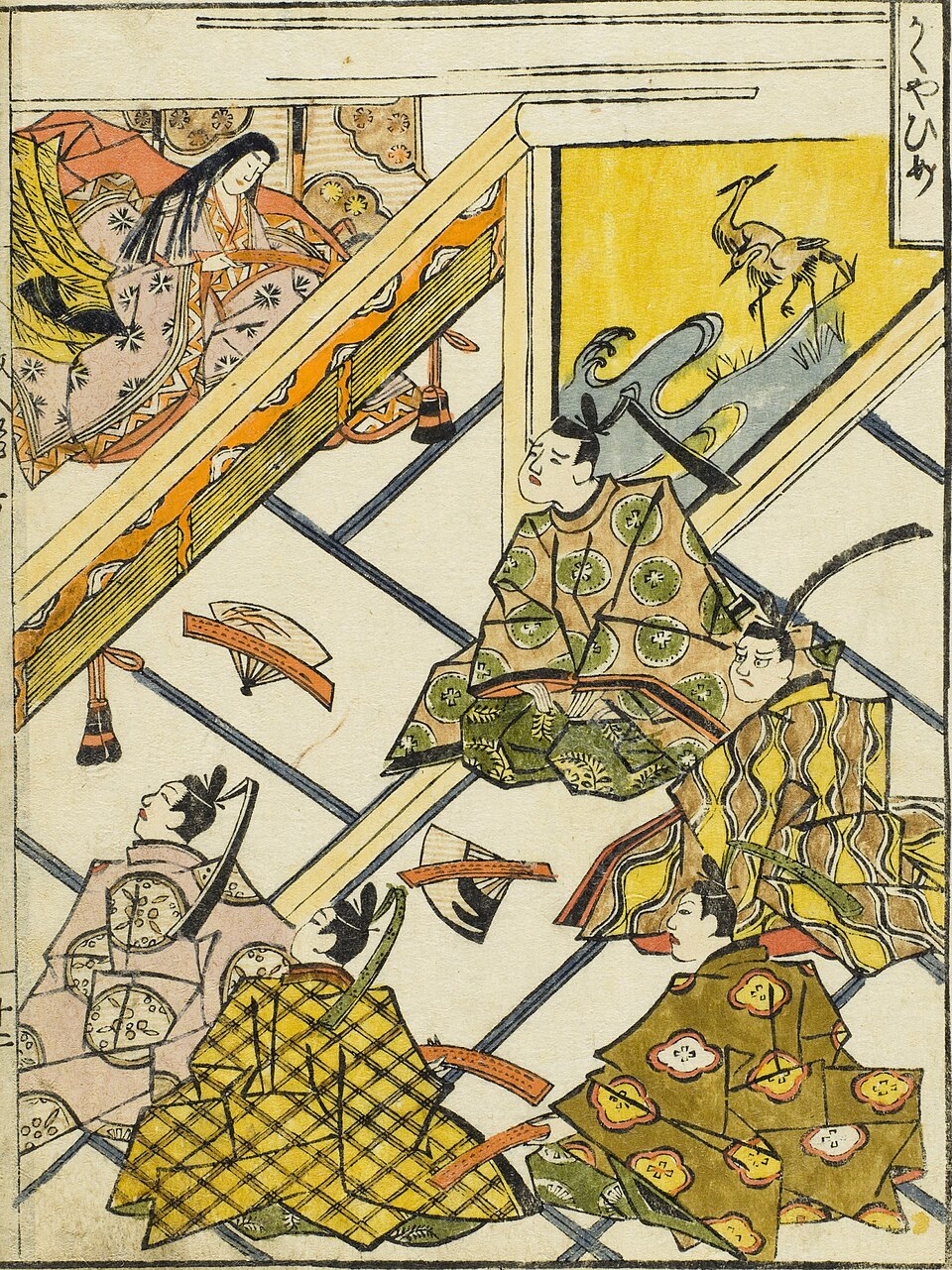
—It is said that a gift from you reached the summit of Mount Fuji. What about it?
Before leaving, I left the emperor a letter and a vial — a little of the elixir of immortality that my people had given me. It was my last gesture toward this world: to offer him the eternity I was about to regain. But what good is living forever when the only face you long to see again has vanished into the sky? He understood it better than I. He ordered the vial to be taken to the mountain closest to the sky and burned there, so that the smoke might rise to me. They say that since that day, the summit of Fuji smokes without ceasing, and the mountain bears the name of refused immortality. That is what remains of us: not a kiss, but a smoke that seeks the moon.
That is what remains of us: not a kiss, but a smoke that seeks the moon.
—How did you know that the time of return had come?
It began with tears, without apparent cause, every evening when the moon grew full. My adoptive father worried; I could not answer him. Then one spring, I could no longer remain silent: I told them I was not of this earth, that I was born of the Moon, and that on the fifteenth day of the eighth month, at the full of the orb, my people would come to take me back. The old Bamboo Cutter who had drawn me from a shining stalk wept like a child. He posted guards; the emperor sent two thousand soldiers to surround the house. Poor weapons of men: against the light that descends, no arrow can be drawn. I knew it. I let them believe I could be defended, out of tenderness for their useless courage.
—What does it feel like to leave a land where you have been loved?
When the celestial procession descended on its cloud, they handed me the feather robe and the cup of elixir. I had been warned: to put on that garment is to forget everything — sorrow, but also love, and even the memory of those two old people. That was the true trial, far more than the five I had imposed. I had time to write one last letter, to lay my hand one last time on this world, then the feather robe enveloped me and everything became distant like a dream life. Buddhists call it impermanence — that nothing lasts, that everything returns to its source. I am that law made woman: a gleam lent to the bamboo, taken back by the moon. Do not weep for me. Weep rather for what, in you, does not yet know that it must depart.
I am impermanence made woman: a gleam lent to the bamboo, taken back by the moon.
Read further

This imaginary interview was generated by artificial intelligence from sources documented in Kaguya-hime's profile. It dramatises what the figure might have said based on what we know about them, but does not constitute attested historical testimony. For primary sources and factual documentation, refer to the full profile.