Imaginary dialogue between Le Mikado (l'empereur du Japon) and Kaguya-hime
by Charactorium · Kaguya-hime · Mythology · 5 min read
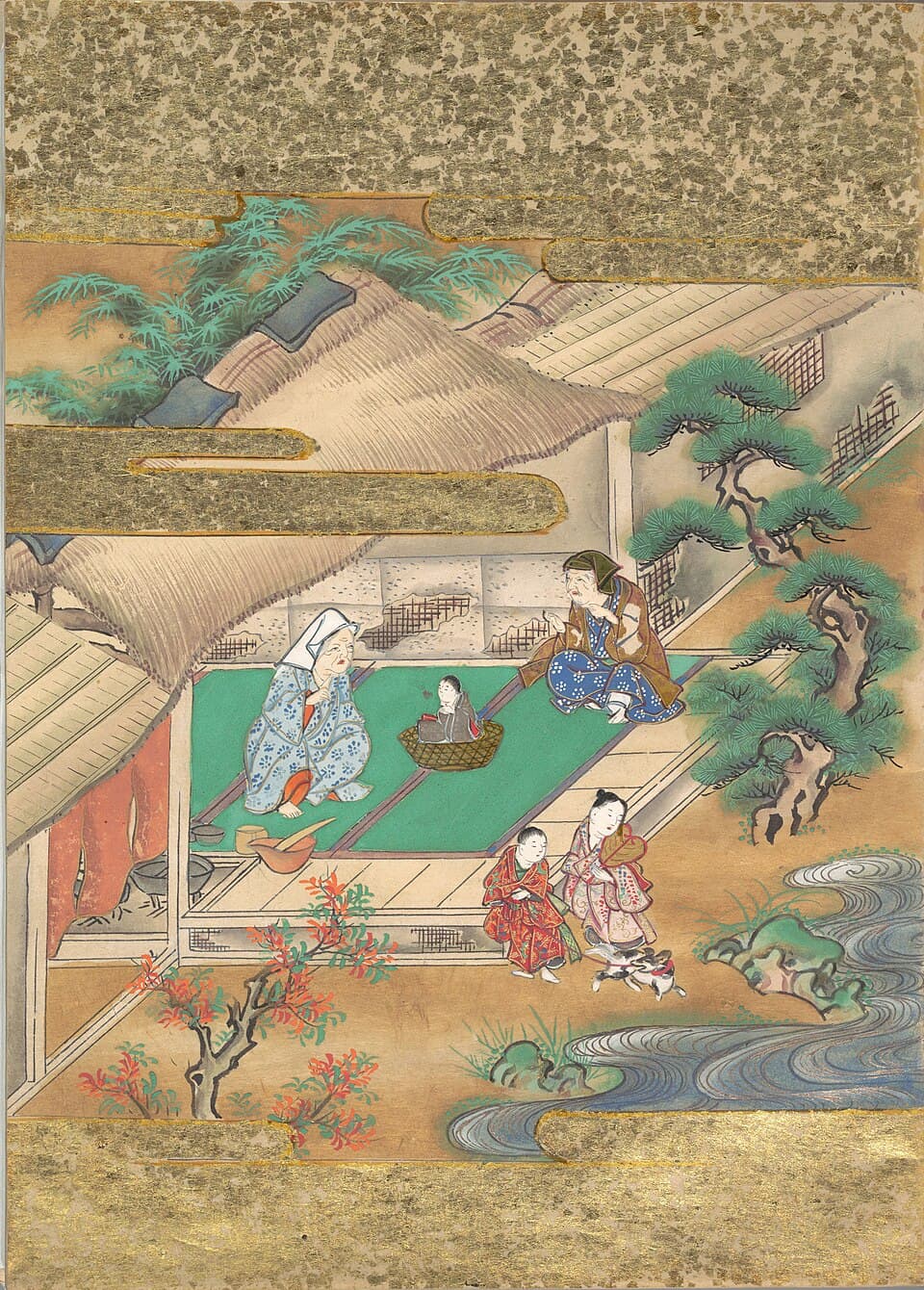
It is in the inner chambers of the enlarged home of the old Bamboo Cutter, somewhere in the countryside near Heian-kyō, that one autumn evening the Mikado comes to speak with Kaguya-hime. The moon illuminates the silk screens and the bamboo fields rustle outside. They know each other: the emperor courted her, exchanged poems with her, and could never keep her. He comes this evening not as a sovereign, but as a man who senses that she will soon elude him.
—Princess, they say the old man found you as a child in a shining bamboo stalk. That night, do you even remember coming into the world that way?
Sovereign, I do not remember the moment the old man opened the stalk — but I know the story he tells. Cutting bamboo in his forest, he saw an extraordinary light burst from a stalk, and found me within, a little girl three inches tall. He took me in the hollow of his hands as one takes a treasure from the sky. That light was not from the wood: it was a sign, the passage of the marvelous into the world of men. Bamboo bends without breaking, it connects the low earth to the heights — that is why I came through it. The old man saw only a child to love. I already knew I was a loan to him.
I was a loan to him, not a treasure given.
—You lived in a simple thatched house, among peasants, spinning and weaving. How could such splendor grow in that humble home?
It is in that humble dwelling that I grew up, and I am not ashamed of it. In the morning, I drew cold water and shared the household tasks; in the afternoon, I spun and wove like the country girls. My adoptive parents loved me with a simple love, and rice and seasonal vegetables were enough for us. Then my beauty became legend, and the house filled with silks, offered kimonos, polished bronze mirrors. But beneath these ornaments, I remained the one who gazed at the moon in the evening. The marvelous needs no palace to be born; it grows as well under a thatched roof, between bamboo fields.
The marvelous needs no palace to be born.
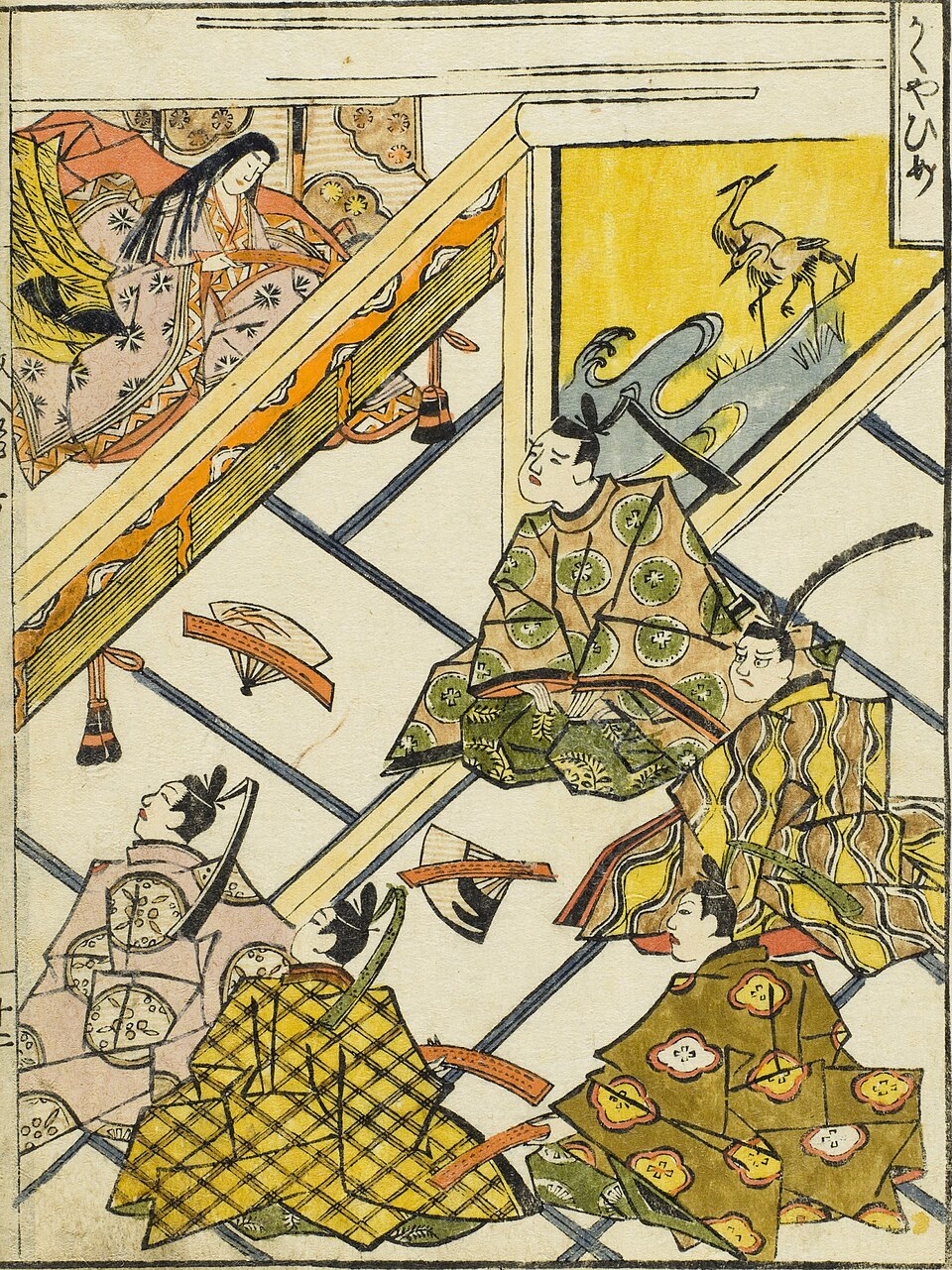
—Five nobles covered you in gifts to marry you. You imposed impossible trials on them. Were you determined to belong to no one?
Those five lords came with lavish gifts, convinced that a woman is won like land. I did not drive them away: I asked them for the impossible, treasures no mortal can attain. Thus each revealed himself as he was, and none succeeded. It was not cruelty, sovereign, but truth — I knew I belonged to no one, and to claim otherwise would have been a lie. A woman of the Heian court has little right to refuse; I had it, and I exercised it. My heart was not free to give itself: it was already promised elsewhere, higher than any earthly promise.
I asked them for the impossible so that each would reveal himself as he was.
—And me, Kaguya-hime? When I came to see you, hoping to keep you by my side at the palace, why did you reject me like the others?
You, sovereign, were not like the five suitors. You did not come with coffers or demands, and our exchanged poems, I keep them. I did not reject you out of disdain — how could I disdain the one to whom no one in Japan can refuse anything? But that is precisely my pain: even supreme authority, even the emperor, cannot hold me. If I had given myself to anyone, it would have been to you; and that is why my refusal cost you, and cost me more. My destiny does not obey the throne of Yamato. You rule over men, but not over what, in me, belongs to the sky.
If I had given myself to anyone, it would have been to you.
—In the evenings, they say you withdraw to compose poems and gaze at the moon. What do you seek there, you who always seem elsewhere?
You noticed, sovereign, for you observe me more than you admit. In the evening, after the simple meal shared with my parents, I withdraw and watch the moon rise above the bamboos. Others see beauty; I hear a call. Each full moon tightens my heart with a melancholy I cannot name to humans. I then compose a few verses, not for the court, but to soothe what draws me up there. You saw me sad without understanding the cause — it is that I sense, month by month, the hour when they will come to take me back.
Others see beauty; I hear a call.
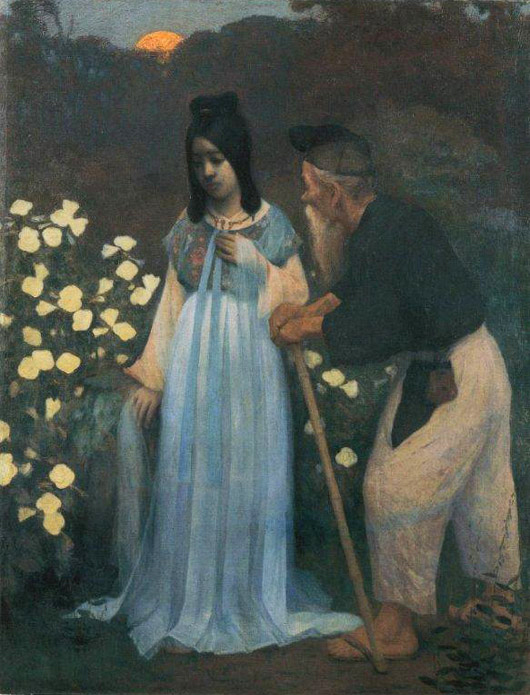
—You speak of the moon as a homeland. Do you mean that this world, and all who love you here, are but an exile for you?
Do not take it that way, sovereign. The Moon, Tsuki, is my true home — I descended from it, and I will be called back soon. That does not make the earth a prison: I have known the old man's love, the seasons, your poems. But everything here passes and decays, as the sages teach: nothing remains, and it is in this fragile world that I learned the value of things. Up there, one neither weeps nor ages, but neither does one love as you love. My return is not a flight: it is a law that neither you nor I can change.
Everything here passes and decays — it is in this fragile world that I learned the value of things.
—It is whispered that you will leave behind an elixir of immortality. To whom do you intend it, and why such a gift to me?
Before ascending, I will leave a final token to this earth — and it is to you, sovereign, that I wish to entrust it. An elixir that prolongs life beyond all mortal measure, a link between your world and the one I come from. But know this: what is an endless life worth if the one you love has gone to the moon? I fear you may not want this eternity without me. Keep it, or do nothing with it — it will be your choice as a man and emperor. I leave you what I can: not my presence, which is forbidden me, but a memory that will not fade.
What is an endless life worth if the one you love has gone to the moon?
—When those beings of light come for you, will you be able to remember us, or will everything be erased?
That is what I fear most, sovereign. They say those from the Moon make departing ones put on a celestial robe that erases all earthly attachments — sorrow, regret, even the memory of those loved. Once that garment is placed on my shoulders, I will weep no more, for I will no longer know why to weep. That is why these last months are so precious and so cruel to me. I want to engrave your face, the old man's face, the rustling of the bamboos, before they strip me of it all. Remember me in my place, since I will soon no longer have the power to do so.
Once the celestial robe is placed, I will weep no more — for I will no longer know why.
—Never, in our tales, had a woman held the heart of a story as you hold yours. Do you know what you inaugurate?
I do not know what will become of tales after me, sovereign — I am not their judge. But I know that I did not want to be the maiden saved or married according to men's will. I chose my trials, refused my suitors, and even before you I kept my destiny in my hands until the end. If storytellers retell me one day, let them at least say this: that a woman in the monogatari can be the heart that decides, not the shadow that endures. The rest — beauty, the marvelous — are but the garments of the tale.
A woman can be the heart that decides, not the shadow that endures.
—Before losing you, tell me: what would you like to be remembered of you, when the Taketori monogatari is passed from mouth to mouth?
You press me like a man who knows the hour is near, and you are right. Let this be remembered: I came from a bamboo stalk and will return to the moon, and between these two lights I was loved and I loved in my own way. Let them not make of me a mere marvel, nor a haughty princess. I was a foundling child who became a free woman in a world that hardly allowed it. If I am retold, let it be as one who passed among men without belonging to them, and who left, in leaving, more regret than answers. That, sovereign, will suffice for my memory.
I passed among men without belonging to them, and left more regret than answers.
Read further

This imaginary interview was generated by artificial intelligence from sources documented in Kaguya-hime's profile. It dramatises what the figure might have said based on what we know about them, but does not constitute attested historical testimony. For primary sources and factual documentation, refer to the full profile.