Imaginary interview with The Lady of the Lake
by Charactorium · The Lady of the Lake · Mythology · 6 min read
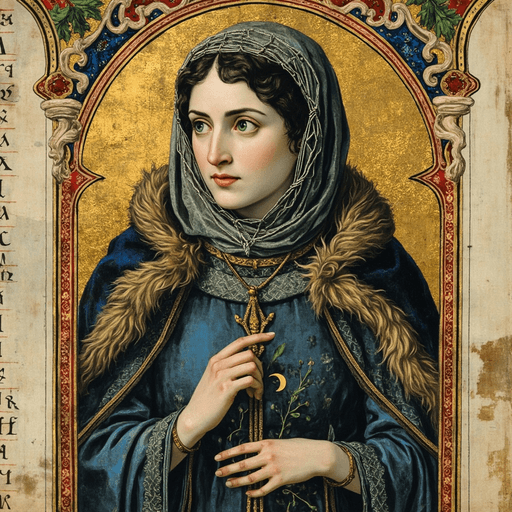
They say you must wait for twilight, when the mist settles on the water, for the lake's surface to open like a door. On the edge of a pond in Brocéliande, where oaks plunge their roots into black mud, a woman dressed in blue and green stands on the water without sinking. She agrees to speak, she says, because men have already written so much about her that a little truth can do no harm.
—How did the giving of the sword to the young Arthur go?
I rose from the depths that day, until only my arm broke the surface. Excalibur raised toward the sky, water streaming down the blade as if the lake itself refused to let it go. The boy waited on the shore, still unsteady in his kingship. I spoke no grand speech: I let the sword speak. A weapon that rises from the waters is not mere iron; it is an oath. In taking it, Arthur accepted that his power came from elsewhere than himself, that he answered to something higher than the barons of Britain. The storytellers have made this moment one of their favorites, and I understand them: there was in it all the promise of a reign, and already, in the shimmer of the blade, its shadow.
A weapon that rises from the waters is not mere iron; it is an oath.
—Why did you also keep the scabbard, and not just the blade?
Men look only at the blade; they forget that the scabbard is worth more. As long as Arthur wore it, no wound could drain his blood: that was the true gift, that of invulnerability. I remained its guardian, and I had my reasons. A sword cuts, but a king who believes himself invincible endangers himself more surely than any enemy. When he failed in his knightly duties, I took back what I had entrusted. It was no whim of a fairy: to entrust power is to keep the right to withdraw it. The lake's waters taught me that patience — they give and take back, without anger, according to a justice that mortals too quickly call cruelty.
To entrust power is to keep the right to withdraw it.
—Do you remember the child Lancelot, and how you raised him?
He was brought to me just after his father died and his mother wept on a shore. I took him beneath the water, into my kingdom under the lake, where no mortal suspects that one can laugh and grow. I fed him, taught him, trained him in arms and good manners, but also in things not learned in castles: honor that is unseen, loyalty that costs. For this, I am called the tutrix, and that is a title I prefer to many crowns. Lancelot of the Lake — he carries my water in his very name. I shaped the greatest knight of the Round Table, and I always knew I would return him to the world of men, where he would break. A water mother knows that the child always eventually rises to the air.
Lancelot of the Lake — he carries my water in his very name.
—What did you want to pass on to that child that the castles could not have given him?
In courts, a boy is taught to strike and bend the knee. I taught him to see. Beneath the lake, appearances dissolve: a fish is not what it seems, a gleam can deceive. I gave Lancelot that eye that pierces lies, and that uprightness that cannot be bought. The storytellers of the Lancelot-Grail understood this well: they made me a figure capable of shaping the greatest. But no master decides everything. I placed in him a measure, and the world of men, with its loves and broken oaths, threw it off. That is the fate of all that is raised in pure water: the silt from outside eventually mixes in.
—They say you learned magic from Merlin before imprisoning him. How did that come about?
Merlin came to me as all wise men come to what they desire: believing they teach in order to seduce. He gave me his secrets one by one, the charms, the hidden names, the art of binding and unbinding. I drank them as the lake drinks the rain. And when I knew as much as he — perhaps more — I used against him what he had given me. An invisible prison, a tree, a cave, depending on the tale: there he remains, conscious, unable to tear himself away. They judge me cruel. But consider: a wizard who knows everything is a danger to the balance of all Britain. I did not kill the greatest of magicians. I simply prevented him from continuing to know everything, and say everything, and undo everything.
He gave me his secrets, believing he taught in order to seduce.
—Do you feel no regret for having imprisoned the one who was your master?
Regret is a human thing, for those who measure time in seasons. I see differently. Merlin had woven so many destinies that a hand was needed to stop his fingers. The storytellers are moved by this tale; they see a pupil's betrayal of the master; I see a transmission carried to its end. A knowledge never turned against the one who gave it is not truly acquired. He rests there, in his enchantment, and they say his voice sometimes still rises from the stone. I do not hate him. I loved him enough to learn everything from him, and enough not to let him destroy everything. Fairies have no remorse: they have reasons that mortals call spells.
Fairies have no remorse: they have reasons that mortals call spells.
—What would you say about that final crossing, when you came to fetch Arthur after Camlann?
The Battle of Camlann had taken everything. When I arrived, the king lay there, his side open, his gaze already turned toward the other shore. We were three queens in the boat, veiled, and we laid him between us as one lays a child being brought home. This time, the lake gave nothing back: it took. We glided toward Avalon, the island where time no longer bites, where wounds wait without worsening. I did not lead him to death — I led Arthur to a sleep. As long as he sleeps there, Britain keeps a king in reserve, a sleeping promise. That is my last office: not to weep for the ended reign, but to seal its possible return in waters that do not age.
I did not lead him to death — I led Arthur to a sleep.
—Why Avalon, and not a burial among men?
A tomb encloses; Avalon keeps. To put Arthur in the earth would have been to admit that everything ends, and I am not made for endings. My domain is that in-between that your scholars call the marvelous: not quite the world of the living, nor that of the dead. There, the wounded king rests in a light that never fades, on an island that no mortal boat can find. The storytellers understood that I thus offered the kingdom a form of immortality — not of the body, but of hope. As long as his tomb is not shown, men can believe he will return. And believing that a king will return, you see, is already to stand a little straighter in the waiting.
—Tell us about the place where you rule. What lies beneath those waters that no one crosses?
Beneath the surface where you see only reflections, there is a palace. Not of damp stone as you imagine, but of bright halls, gardens where flowers grow that the air outside would wither in an evening. It is my domain, a threshold between your world and that of the fairies, accessible only by magic. In the morning, I consult the waters and the signs; they tell me what is brewing in Arthur's kingdom better than any messenger. The Forest of Brocéliande watches above, cradle of the tales woven about Merlin and me. Men seek the entrance and find only mud. That is well: a refuge that can be reached is no longer a refuge.
A refuge that can be reached is no longer a refuge.
—Living thus between two worlds, is it a privilege or a solitude?
Both, like all deep water. I do not age, I do not die ordinary deaths, and from my lake I see far — what kings plot, what knights fear. That is great power. But the one who dwells on the threshold belongs nowhere. I raised a child whom I returned, gave a sword that I took back, received a king whom I hold asleep. Always between. When evening comes, I withdraw into my liminal dwelling, far from the affairs of mortals, and prepare tomorrow's enchantments. They think me cold because I do not weep like the women of castles. But a fairy who has seen so many reigns pass learns to love differently: from afar, and for a long time.
The one who dwells on the threshold belongs nowhere.
Read further
This imaginary interview was generated by artificial intelligence from sources documented in The Lady of the Lake's profile. It dramatises what the figure might have said based on what we know about them, but does not constitute attested historical testimony. For primary sources and factual documentation, refer to the full profile.