Kids interview The Lady of the Lake
by Charactorium · The Lady of the Lake · Mythology · 5 min read
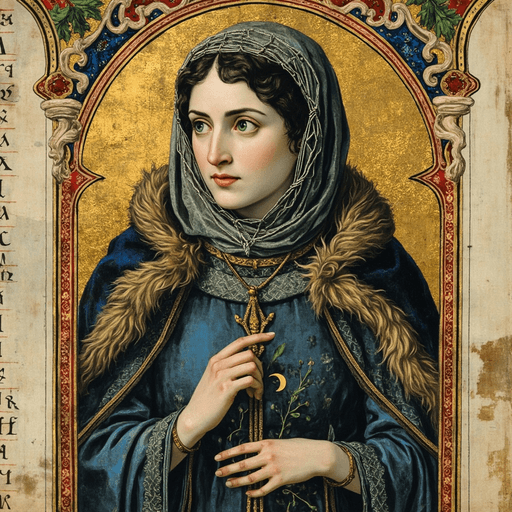
Two twelve-year-old visitors stop at the edge of a very calm lake, on a school trip near the forest. The water ripples, and a lady in a light dress appears on the surface. She smiles at them: it is the Fairy Viviane, the Lady of the Lake.
—Do you really live at the bottom of the lake? What's it like there?
Yes, my child, I live underwater. Imagine diving, and instead of drowning, you discover a luminous palace where it's mild. My domain is not on any map. It is called Avalon, and ordinary sailors cannot go there. All around lies the forest of Brocéliande, in Brittany, full of springs and very old trees. It is a place between two worlds: that of humans and that of magic. In the morning, I consult the lake waters as one reads a book. They show me what is happening in the kingdom. That is why I am called the Lady of the Lake.
My domain is not on any map: it is between two worlds.
—Is it true that you gave the magic sword to King Arthur?
It is true. Picture the scene: a young king stands on the shore, anxious. The water stirs, and an arm rises from the lake, holding a sword that gleams. That sword is Excalibur. I kept it long in my domain before entrusting it to him. You know, giving a sword is not giving a weapon to fight with. It is telling that boy: “Now, you can be King of Britain.” Without that gesture, no one would have recognized him. I also gave him the scabbard, the sheath of the sword, which protected him from wounds. A fairy can decide who becomes king.
Giving a sword was not giving a weapon. It was giving a kingdom.
—Why did you take the scabbard back later?
Good question, you are attentive. The scabbard is the case where the sword is kept. Mine was magical: whoever wore it could not be wounded. That was an enormous gift, almost too much. But a king who never risks anything forgets to be just. When Arthur failed in his knightly duties, I took the object back. You see, I am not just a kind protector. I watch over balance. A magical gift must be earned, and it can be lost. It is harsh, but that is how my world works.
A king who never risks anything forgets to be just.
—They say you raised a great knight as if he were your own child?
Yes, my little one. His father was dead, and the child was in danger. So I took him into my kingdom beneath the lake. There, I raised him like a mother, I trained him in noble values: courage, loyalty, respect for the weak. That is what is called chivalry. That child became Lancelot of the Lake — his name comes from me! They say I am his tutrice, that is, the one who raises a child not her own. Imagine: the greatest heroes of King Arthur grew up in my hands. A fairy does not only cast spells. She shapes hearts.
A fairy does not only cast spells. She shapes hearts.
—What was it like raising a child all alone at the bottom of the water?
It was gentle and quiet. Imagine a house where no battle noise enters, just the lapping of water above you. I taught him to ride a horse, to hold a sword, but also to be good. In the evening, I told him about the world of men, up there, which he did not yet know. You know, the hardest part is that one day you must let them go. I trained him to become the greatest knight of King Arthur, at the court of Camelot. And then I let him rise to the surface, toward his life. Raising someone is preparing them to leave you.
Raising someone is preparing them to leave you.
—Wait... was it you who imprisoned Merlin the great wizard?
In some tales, yes, it was me. And that always surprises! Merlin was the most powerful of enchanters. He taught me everything: spells, hidden secrets, the art of enchantments, that is, magical charms. But by dint of learning, I became as learned as he. Then I held him prisoner in a tree, or a cave depending on the version — an invisible prison from which he could no longer escape. Why? To keep the balance of power in Britain. You see, the student can surpass the master. And sometimes, it is the student who decides when the master must stop.
The student can surpass the master — and decide when he must stop.
—Were you afraid of him when he taught you magic?
Afraid, no. But wary, a little. You know, when someone very powerful gives you all their knowledge, you must ask why. Merlin taught me with passion, and I listened, I noted everything in my memory like a great book of spells. I wanted to understand every secret to the end. In the end, I knew as much as he. That is the whole lesson: knowledge does not stay with the one who first has it. It passes to the one who learns best. A young girl who listens can become stronger than the oldest of sages.
Knowledge does not stay with the one who has it. It passes to the one who learns best.
—What do you eat, as a fairy? And do you sleep at night?
Ah, you wonder about that! That is cute. I am not like you: I do not depend on bread and soup. I feed mostly on subtle things, linked to water and magic. But I sometimes taste fine dishes from my time: freshwater fish, rare fruits. In the evening, I do not really sleep like a little girl. I withdraw to my enchanted dwelling to meditate and prepare my enchantments. Imagine a room at the bottom of the lake, softly lit, where time barely passes. A fairy lives outside human time. It is both wonderful and a little lonely.
A fairy lives outside human time: wonderful, and a little lonely.
—Is it true that you came to get Arthur when he was wounded?
Yes, and it is my saddest memory. There had been a great battle, at Camlann. King Arthur was mortally wounded. Imagine an exhausted warrior, lying by the water, unable to go on. I came with other queens, in a barge, and we carried him to Avalon, my enchanted island. There, he is not truly dead: he sleeps a magical sleep. You see, I could not save him from the battle. But I could offer him something else: rest, and hope. For they say that one day, he might return.
I did not save him from the battle. I offered him rest and hope.
—Why do you say he sleeps and not that he is dead? Is it so you won't be sad?
You ask the real question, and it is profound. In my world, some things never quite end. Arthur rests in Avalon, outside time, and as long as he sleeps, his story is not over. It is not to comfort myself, my child. It is because great kings, in legends, do not die like others. They wait. Imagine a candle that is not blown out: it keeps watch in silence. My role, as the Lady of the Lake, is to keep that flame. As long as someone tells his story, the king may still return.
As long as someone tells his story, the king may still return.
Read further
This imaginary interview was generated by artificial intelligence from sources documented in The Lady of the Lake's profile. It dramatises what the figure might have said based on what we know about them, but does not constitute attested historical testimony. For primary sources and factual documentation, refer to the full profile.