Imaginary dialogue between Merlin l'enchanteur and The Lady of the Lake
by Charactorium · The Lady of the Lake · Mythology · 5 min read
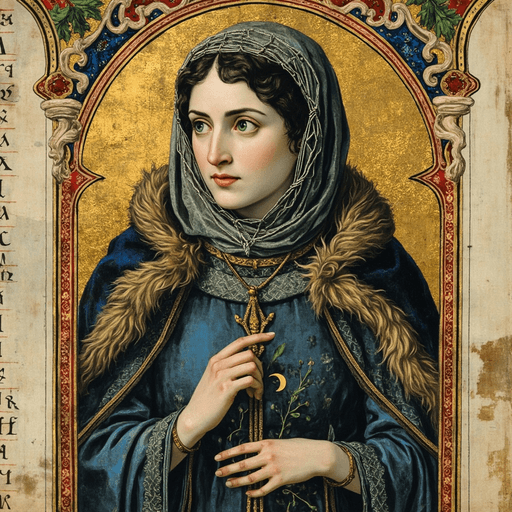
It is at the edge of the Lake, in the green light filtered by the waters, that Merlin meets the one he once called his pupil. The air smells of mud and hawthorn blossom; somewhere, a sword sleeps beneath the still surface. They have known each other since the day he opened his books of spells to her, and today he comes, half-prisoner of his own magic, to ask her to account for what she has done with his knowledge. Between them hovers the memory of a teaching turned to betrayal.
—Viviane, do you remember the day I opened my books to you? I gave you everything of my art. Why did you later imprison me in that invisible cage?
I remember, Merlin, every word you confided to me under the trees of Brocéliande. You taught me thinking you kept the master's advantage, but the pupil listens differently than the master speaks. When I learned to draw the circle from which no one escapes, I drew it around you — not out of hatred, but because your power, unchecked, would have upset the balance of the kingdom. Knowledge as great as yours could not remain without restraint. You who taught me the measure of things know that I only applied your own lesson. I kept you as one keeps a fire too ardent: enclosed, but never extinguished.
The pupil listens differently than the master speaks.
—You say you only applied what I taught you. But when you imprisoned me, did you still love me, or was I just a book you closed?
Do not take me for the cold sorceress of the tales they will tell. I loved you, Merlin, as much as a fairy can love a man who sees the future and cannot change it. It is precisely because I loved you that I could not let you exhaust yourself in the service of ungrateful kings. You would have burned yourself out for Arthur as you burned for me. Restraining you was preserving you from mortal time. They will say I betrayed you; I say I removed you from your own end. Rest in your hawthorn: no one can wound you there, not even oblivion.
They will say I betrayed you; I say I removed you from your own end.
—You know better than anyone the weight of Excalibur. Tell me, the day you handed it to Arthur from the waters, what did you mean to seal?
That day, Merlin, the sword broke the surface of the Lake like a word finally spoken. You who had prepared the coming of this king know that without a sign from the other world, his crown would have been only a human crown. By giving him Excalibur and its scabbard, I bound his kingship to the very magic of the land of Britain. The sword cuts, but the scabbard keeps the blood in the veins: that is what I entrusted to Arthur, strength and protection together. He had to know that this power did not come from him, but was lent to him. The day he forgot it, I would reclaim what was mine.
The sword cuts, but the scabbard keeps the blood in the veins.
—And when Arthur failed in his duties, you took back that scabbard of invulnerability. Were you not afraid of condemning the king we both served?
I do not condemn, Merlin; I render justice. A fairy's gift is not an unconditional favor: it is a pact. As long as Arthur held chivalry sacred, the scabbard protected him from the slightest shed blood. But the king who forgets why he was made king strips himself of his own protection; I merely took back what no longer had reason to remain at his side. You taught me that too: magic is not indulgence, it is a balance. Let the blade remain; the invisible shield returns to the Lake whence it came.
A fairy's gift is not an unconditional favor: it is a pact.
—I have heard that you raised a fatherless child under your waters, Lancelot. You, the fairy, what did you hope to shape in that sunken realm?
I took him in as a newborn, Merlin, when the world of men would have let him perish. Under the Lake, far from wars and grief, I raised him in purity before he knew fault. I taught him the lance and honor, but also the gentleness that men forget when they gird on the sword. They call me the Tutrice of the best knight of the Round Table, and that is my finest work: not having given a weapon to a king, but having given a man to chivalry. What I did for Lancelot, I had begun for Arthur — watching, in secret, over those whom destiny claims.
My finest work: not having given a weapon, but a man to chivalry.
—You speak of raising in secret. I who hid the child Arthur know it: why always conceal your protégés from the world's eyes?
Because what the world sees, the world covets, Merlin — you learned that before me. A child promised a great destiny is prey while weak. Under my waters, no jealous king, no traitor could reach him; he grew sheltered from time itself. Secrecy is not a lie, it is a cradle. You who entrusted Arthur to foster hands far from Tintagel know that one forges a king or a knight only in shadow, then returns him to the light when he is ready. I kept my children as the Lake keeps Excalibur: invisible, until the hour.
Secrecy is not a lie, it is a cradle.
—This dwelling under the waters where you so often received me — how do you live, Viviane, in this world between worlds that mortals cannot reach?
You came often enough, Merlin, to know that my palace is neither entirely under water nor entirely on land. In the morning, I read the waters of the Lake as others read the stars: their ripples tell me of battles to come and the hearts of kings. I live on this threshold where the marvelous touches the world of men without mingling. My robe keeps the color of the wave, my time is not yours. Brocéliande above, silence below: that is where I keep watch. Mortals call it Avalon, or faerie; I call it my home, and you know one enters only by magic.
I read the waters of the Lake as others read the stars.
—You are called the Lady of the Lake. Did the Lake make you a fairy, or did the fairy make the Lake her realm?
A fine question from a magician, Merlin — you always seek the cause behind the thing. The truth is that we made each other. The Lake gave me its threshold between worlds, and I gave it a name and a guardian. Without me, it would be only still water; without it, I would be but a wandering fairy without a realm. My power rises from its depths and descends again, like the moon pulls the tide. That is why I barely leave it, and always return. The Lady and the Lake are one: separate them, and you have neither.
The Lake gave me its threshold between worlds, and I gave it a guardian.
—You built Avalon, that refuge out of time. Tell me, Viviane, what did you seek to save by raising that island that no mortal finds?
I sought to save what should not die with men, Merlin. Kingdoms fall, kings bleed, but Avalon remains outside the wheel of time. It is the isle of apple trees where wounds heal and sleep is not death. There I keep the secrets that Camelot's court could not bear, and I prepare a refuge for the hour of great griefs. You built your glory in the world of men; I built mine on the margins, where nothing decays. Avalon is my answer to death: not to deny it, but to suspend it.
Avalon is my answer to death: not to deny it, but to suspend it.
—After Camlann, it was you who came for the dying Arthur. I could no longer protect him; you, what did you carry away in your boat that day?
I carried away more than a wounded king, Merlin: I carried away the hope of a land. When my boat parted the mist of Camlann, we were three queens to receive him, and the silence weighed like a final snow. Arthur was not truly dying; he was entering the sleep of Avalon, from which they say he will return in the hour of great need. You who could no longer watch over him, rest: I took him where your art stopped. Chivalry died at Camlann, but I did not let the flame die out. As long as I keep him, Arthur is not entirely lost to Britain.
Arthur was not truly dying; he was entering the sleep of Avalon.
Read further
This imaginary interview was generated by artificial intelligence from sources documented in The Lady of the Lake's profile. It dramatises what the figure might have said based on what we know about them, but does not constitute attested historical testimony. For primary sources and factual documentation, refer to the full profile.