Imaginary interview with Lakshmi Bai
by Charactorium · Lakshmi Bai (1828 — 1858) · Military · 6 min read
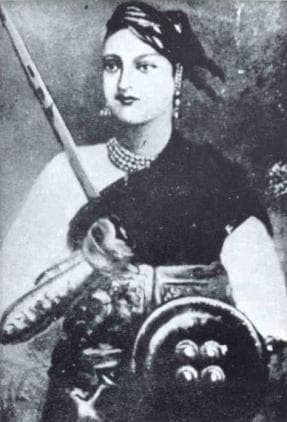
Jhansi, a night in March 1858. The cannons of General Hugh Rose rumble in the distance as the Rani receives us in a low chamber of the fort, lit by a single oil lamp. She already wears the cavalry uniform, her adopted son asleep in a nearby room. Her voice is calm, but every sentence seems forged from the steel of the talwar lying at her side.
—What childhood shaped the warrior you became?
I was named Manikarnika, 'Manu' to those who loved me, and I grew up in Varanasi among the sons of Nana Sahib, where no one thought to confine a girl to the zenana. While other little girls learned to lower their eyes, I learned to hold the reins, to draw a sword, to wrestle in the dust until my opponents begged for mercy. My mornings began before dawn, with prayers to the goddess Lakshmi whose name I bear, then horse riding at daybreak. I believe a body that learns to ride before it learns to embroider can never again be told it is weak. This discipline I kept even as queen: it did not serve to please, but to endure.
A body that learns to ride before it learns to embroider can never again be told it is weak.
—How did you react when the Company refused to recognize your adopted son?
My husband, the raja Gangadhar Rao, died in 1853, and we had adopted Damodar Rao according to Hindu law, properly, before witnesses. That was not enough for those gentlemen of the East India Company. They brandished their Doctrine of Lapse, that invention of Lord Dalhousie which decrees that a throne without a blood heir falls to them like a fruit into a merchant's basket. In that phrase I felt all the contempt of a trading post that fancies itself an empire. A kingdom is not a piece of property in escheat: it is a covenant between a people and their ruler. They thought they were annexing a province; they opened a wound no treaty would heal.
A kingdom is not a piece of property in escheat: it is a covenant between a people and their ruler.
—Before taking up arms, you chose pen and law. Why that path first?
Because no one can reproach a queen for having first exhausted justice. In 1854, I wrote to the Governor-General Lord Dalhousie, point by point, to contest the annexation: Damodar's adoption was legitimate, my sovereignty over Jhansi was not to be decided by a clerk in Calcutta. I pleaded as one defends a fortress, plugging every hole in the argument. They did not answer with law, but with the surveyor and the flag. So the phrase that had burned in my throat for months came out: Main apni Jhansi nahi dungi! — I will not give up my Jhansi. When law becomes the tool of the strong, the queen has nothing left but the talwar. But let no one say I did not extend my hand before raising the sword.
When law becomes the tool of the strong, the queen has nothing left but the talwar.
—You were a widow, bound to the white sari. How did you take that step toward the soldier's uniform?
Hindu widowhood had dressed me in white, without color or ornament, and I was expected to keep the silence of the terraces and the austerity of prayers. I wore that sari with respect, for it spoke of my mourning for Gangadhar Rao. But the day came when Jhansi had to be defended: I folded the widow's cloth and put on the light cavalry armor, the turban, the weapons of Rajput warriors. The English themselves, in their reports, mistook me for a male soldier — and so much the better. Breaking the zenana, ruling openly in the durbar hall, fighting in the open: it was not a queen's vanity, but the only way to remain standing. A white cloth does not hold a rampart; a cuirass does.
A white cloth does not hold a rampart; a cuirass does.
—What does it mean for you to personally lead the defense of a besieged city?
When General Hugh Rose closed his siege on Jhansi in March 1858, I did not watch the battle from a palace window. A queen who asks her people to die must first show her own face on the ramparts. I distributed the cannons, counted the powder, sent soldiers and civilians alike to the walls — blacksmiths, women carrying water. For weeks, the Fort of Jhansi, that 16th-century mass of stone dominating the plain of Bundelkhand, held. They tell me even my enemies judged this defense remarkable. I believe it, for we had neither their artillery nor their reinforcements — only the rage of those defending their own threshold.
A queen who asks her people to die must first show her own face on the ramparts.
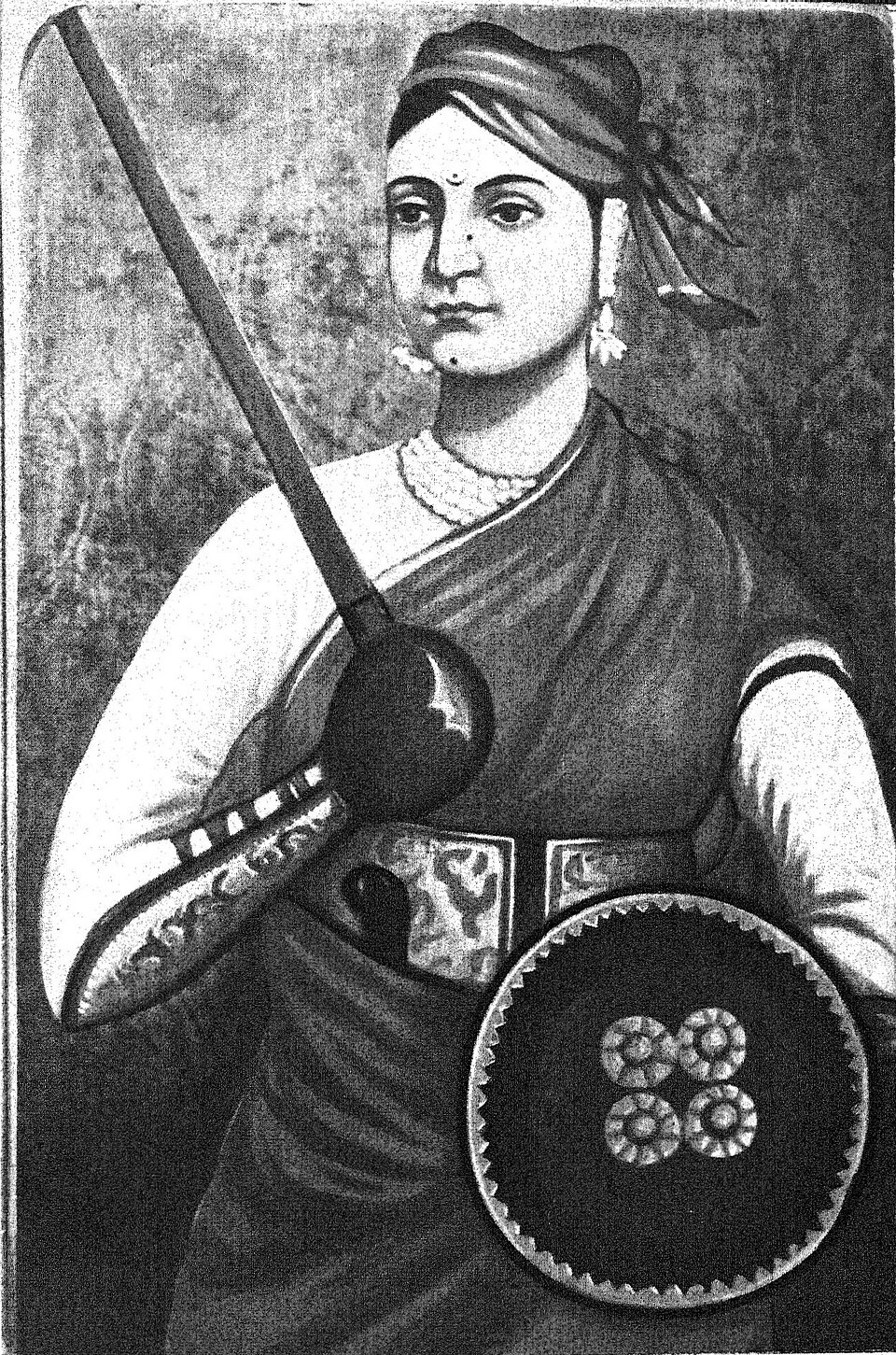
—You speak of commanding from the closest danger. What does that require of a war leader?
It requires that the hand that signs the royal seal be the same as the one that holds the talwar. My afternoons, once, were those of the durbar: dispensing justice, collecting taxes, hearing my subjects' petitions. The revolt did not erase those duties; it hardened them — I had to feed an army and keep order in a city that already smelled of gunpowder. In the field, I shared the soldiers' rations, the same rice, the same dal, no court kitchen. A leader who eats apart commands strangers; a leader who eats the same flatbread commands brothers. That is how you get exhausted men to hold a wall one more night, and then another.
A leader who eats apart commands strangers; a leader who eats the same flatbread commands brothers.
—Tell us about that night when Jhansi fell and you had to flee.
It was April 1858. The fort could hold no longer, the English were in the city, and I was not going to offer them either my surrender or my body. I tied Damodar Rao, my son, against my back, tight as one ties a precious bundle, and mounted Badal. They say I leaped with him from the high wall — legend always exaggerates the height of walls and the bravery of fugitives. What I know is that I crossed the enemy lines in the night, the child breathing against my shoulder blades, not knowing whether the next shadow would be a tree or a British dragoon. To flee was not to give up. To flee, that night, was to carry the war elsewhere.
To flee, that night, was not to give up: it was to carry the war elsewhere.

—What were you seeking by traveling so far to Kalpi?
I was seeking brothers-in-arms still standing. Several hundred kos separated the fallen fort from Kalpi, and Hugh Rose's cavalry were at our heels. But a queen alone is only a fugitive; a queen who joins Tatya Tope and Nana Sahib becomes an army again. At Kalpi, the insurgents were gathering, wounded, starving, but not defeated in spirit. I understood there that our revolt was no longer the affair of a single city: Meerut, Delhi, Kanpur, Jhansi — it was the same fire running under the ashes of the subcontinent. My son finally slept in safety, and I was already plotting, with Tatya Tope, the next strike. One does not weep for a lost fortress; one covets another.
A queen alone is only a fugitive; a queen who joins her brothers-in-arms becomes an army again.
—Why did you bet on Gwalior, and how did that final offensive play out?
In June 1858, Gwalior was the key. Its fortress, its arsenals, its treasury: whoever held it held the heart of central India. The Maharaja Scindia had sided with the English, so we took it, Tatya Tope and I, and for a few days the rebel flag flew over that bastion they called impregnable. In those days, I felt that another ending might be possible — no longer retreating from city to city, but building a foothold from which to push back the Company. Alas, one cannot consolidate in a week what an empire took a century to weave. Hugh Rose was already marching on us. But having taken Gwalior, even for a breath, proved that their invincibility was a tale.
Having taken Gwalior, even for a breath, proved that their invincibility was a tale.
—If you could imagine how you will be read in a century, what would you wish to be remembered?
They tell me that Hugh Rose, my adversary, called me the most dangerous of all the Indian rebel leaders. Coming from an enemy, that is the purest tribute — one not won by flattery. I will fall, no doubt, at Gwalior, dressed as a soldier, sword in hand, and perhaps a cenotaph will be raised at Phool Bagh. But let them not make of me only a glorious corpse. If I am read in a century, let it be to understand that a woman of Bundelkhand refused to let a foreign trading post decide the fate of her people. The rest — the leap of the horse Badal, the child on my back — is only the foam of a single stubborn idea: Main apni Jhansi nahi dungi.
Let them not make of me only a glorious corpse, but a woman who refused to let a foreign trading post decide the fate of her people.
This imaginary interview was generated by artificial intelligence from sources documented in Lakshmi Bai's profile. It dramatises what the figure might have said based on what we know about them, but does not constitute attested historical testimony. For primary sources and factual documentation, refer to the full profile.