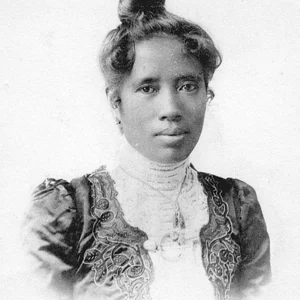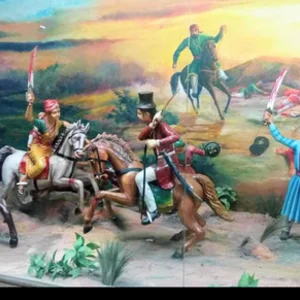

Queen of Jhansi (central India), she became one of the most iconic figures of the Indian Rebellion of 1857–1858 against British rule. Refusing the annexation of her kingdom by the East India Company, she personally led the fighting and died on the battlefield at age 29.
Lakshmi Bai(1828 — 1858)
Lakshmi Bai
Inde
8 min read
Frequently asked questions
Key Facts
- Born in 1828 in Varanasi, she married Raja Gangadhar Rao, ruler of Jhansi, in 1842.
- Upon her husband's death in 1853, the British applied the “Doctrine of Lapse” and refused to recognize her adopted son, annexing Jhansi in 1854.
- In 1857, during the Sepoy Mutiny, she took command of the armed resistance and defended Jhansi against the British assault.
- She escaped the besieged city of Jhansi in 1858, rode to Gwalior, and continued fighting alongside the insurgents.
- She died in battle on 18 June 1858 at Gwalior, becoming an enduring symbol of Indian resistance to colonization.
Works & Achievements
Lakshmi Bai personally organized and led the military defense of Jhansi against the troops of General Hugh Rose, mobilizing soldiers and civilians for several weeks in a battle widely regarded as militarily remarkable.
At the head of the kingdom following the outbreak of the Sepoy Mutiny, the Rani assumed the role of head of state, maintaining order, levying taxes and organizing the army, demonstrating exceptional governing capabilities.
Alongside Tatya Tope, Lakshmi Bai took part in the capture of the strategic city of Gwalior from Maharaja Scindia, a British ally, providing the rebels with a major stronghold for a few days.
A political document in which the Rani legally and diplomatically contested the annexation of Jhansi, arguing for the legitimacy of adoption under Hindu law — a testament to her political acumen.
Anecdotes
Born Manikarnika Tambe around 1828, the future Lakshmi Bai received an unusual education for a girl of her time: she learned horse riding, weapons handling, and wrestling alongside the sons of Nana Sahib. This exceptional character would earn her the affectionate nickname 'Manu' and forge her reputation for fearlessness from childhood.
When her husband Raja Gangadhar Rao died in 1853, the East India Company refused to recognize their adopted son Damodar Rao and annexed the kingdom of Jhansi. Lakshmi Bai is said to have declared passionately: 'Main apni Jhansi nahi dungi!' — 'I will not give up my Jhansi!' — a phrase that became the symbol of Indian resistance against colonization.
During the fall of Jhansi in April 1858, Lakshmi Bai escaped the besieged fort in the dead of night, her adopted son strapped to her back, leaping on horseback from the ramparts. She traveled several hundred kilometers to join Tatya Tope's forces at Kalpi, despite being pursued by the British troops of General Hugh Rose.
Lakshmi Bai fell in battle at the Battle of Gwalior on June 18, 1858, dressed as a soldier, sword in hand. According to tradition, British General Hugh Rose himself paid tribute to his adversary, calling her 'the most dangerous of all the Indian rebel leaders'. She has since been celebrated as one of India's first national heroines.
Legend has it that she leaped with her horse Badal from a wall several meters high to escape the siege of Jhansi, a feat that fueled epic tales passed down from generation to generation across central India. Whether this episode is accurate or partly mythologized, it testifies to the immediate popular admiration her resistance inspired.
Primary Sources
The Rani of Jhansi formally protests against the Doctrine of Lapse applied to her state following the death of her husband and the adoption of Damodar Rao, asserting the legitimacy of her son and her sovereignty over Jhansi.
"The Rani of Jhansi was remarkable for her beauty, her intelligence and her perseverance. She was the most dangerous of all the Indian rebel leaders."
An eyewitness to the uprising, this Marathi priest describes with precision the siege of Jhansi, the Rani's combat and her heroic escape, in an account written in Marathi considered a major primary source on the Revolt of 1857.
British parliamentary documents compiling dispatches and reports on the insurrection of 1857, explicitly mentioning the resistance of the Rani of Jhansi during the siege and the Battle of Gwalior.
Key Places
Capital of the kingdom of Jhansi, Lakshmi Bai's stronghold. Jhansi Fort was the site of the famous 1858 siege during which the Rani personally led the defense against British troops.
City where Lakshmi Bai died in battle on 18 June 1858. A cenotaph dedicated to her stands at Phool Bagh, a landmark site of memory in the Indian anti-colonial resistance.
Likely birthplace of Manikarnika Tambe, where she spent her childhood alongside the sons of Nana Sahib, developing her equestrian and martial skills.
Rally point for the insurgents after the fall of Jhansi. Lakshmi Bai joined Tatya Tope and Nana Sahib there to coordinate the continuation of the resistance in 1858.
Massive 16th-century fortress overlooking the city of Jhansi, from which the Rani organized the defense and, according to legend, escaped on horseback from the ramparts.
Typical Objects

A curved blade characteristic of 19th-century Indian cavalry, which Lakshmi Bai reportedly wielded until her death in combat at the Battle of Gwalior.

Lakshmi Bai fought dressed in the manner of Rajput warriors, wearing light armor adapted for cavalry, which allowed her to be mistaken for a male soldier according to British accounts.

Her war horses, notably Badal ("cloud"), became legendary: according to oral tradition, she leapt with her mount from the ramparts of Jhansi to escape the siege.

An administrative instrument symbolizing the Rani's sovereign authority over her state; her refusal to hand it over to the British East India Company came to embody resistance to colonial annexation.

Accounts of the 1857 revolt describe the Rani carrying firearms in addition to her sword, illustrating the blend of traditional Indian weaponry and modern arms introduced by the Company.

A widow by Hindu custom (white sari), Lakshmi Bai broke social convention by exchanging her mourning garb for military dress — a deeply symbolic act in 19th-century India.
School Curriculum
Vocabulary & Tags
Key Vocabulary
Tags
Daily Life
Morning
The Rani began her day before dawn with Hindu prayers dedicated to the goddess Lakshmi, whose name she bore. She would then practice horse riding and weapons training at daybreak, maintaining strict military discipline even in times of peace.
Afternoon
Afternoons were devoted to audiences (durbar) where she administered justice, received petitions from her subjects, and oversaw the kingdom's administration. After the British annexation of 1854, this activity also became an exercise in political resistance.
Evening
Evenings brought the court together around readings of Sanskrit or Hindi poetry, classical Indian music, and sometimes wrestling training. Lakshmi Bai, widowed since 1853, led a more austere life than the traditional splendor of the Jhansi court.
Food
Her diet followed Hindu prescriptions: vegetarian and sattvic (rice, dal, vegetables, ghee, fruits), avoiding garlic and onion according to certain royal traditions. On military campaign, the Rani shared the soldiers' rations, which strengthened her prestige among the troops.
Clothing
As a Hindu widow, Lakshmi Bai wore the traditional white sari, without ornaments or bright colors. In combat, she abandoned this attire to wear a cavalry outfit — men's clothing, light armor, and a turban — which represented a powerful symbolic break with the social codes of the era.
Housing
The Jhansi palace, integrated into the fort, combined Mughal and Maratha architecture: ornate inner courtyards with columns, private apartments (zenana) separated from the audience halls, and terraces overlooking the Bundelkhand plain. During the flight in 1858, the Rani was forced to abandon this setting for the camp life of the insurgents.
Historical Timeline
Period Vocabulary
Visual Style
Style inspiré de la peinture de Company (fusion indo-britannique du XIXe siècle) avec les couleurs chaudes du Bundelkhand : ocres, rouges profonds et dorés, architecture moghole en toile de fond.
Sound Ambience
L'ambiance sonore de Jhansi en 1858 : le fracas du siège militaire mêlé aux sons d'une cour royale indienne, entre galops de chevaux, canonnades et ordres lancés en hindi depuis les remparts.
Liens externes & ressources
Références
Œuvres
Résistance au siège de Jhansi
Mars-avril 1858
Administration de Jhansi pendant la révolte
1857-1858
Prise de Gwalior avec les forces rebelles
Juin 1858
Lettre de protestation à Lord Dalhousie
1854