Kids interview Lakshmi Bai
by Charactorium · Lakshmi Bai (1828 — 1858) · Military · 6 min read
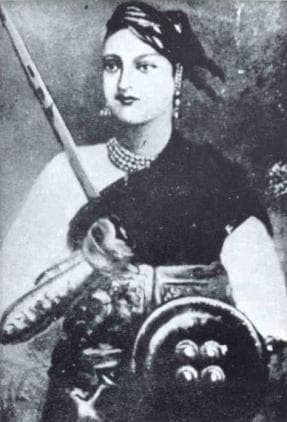
Two young visitors, each twelve years old, enter a large canvas tent in the middle of an Indian camp. A woman in riding clothes awaits them, a sword resting beside her. She smiles: at last, children who want to listen to her.
—How old were you when you were taught to ride a horse and fight?
You know, my child, I was very small. They called me Manu back then, because my real name was Manikarnika. I grew up in Varanasi, a holy city on the banks of a great river. There, I learned to ride and handle weapons alongside the sons of Nana Sahib. Imagine a little girl who, instead of staying cooped up, gallops and wrestles with the boys. That was very rare for a girl in my time. But it forged me. When my hands first gripped the reins, I didn't yet know: one day they would grip a sword to defend an entire kingdom.
A little girl who gallops will become a queen who does not bend.
—What was your home like when you were a child? What did it smell like?
Ah, what a lovely question! Imagine a house with no engine noise, just the hooves of horses on the earth and the bells of temples. At dawn, we recited prayers to the goddess Lakshmi — that's who my queen's name comes from. It smelled of ghee, that clarified butter used in everything in the kitchen, and incense from prayers. We ate simply: rice, lentils called dal, vegetables. No meat. I was a child like you, curious about everything. But I spent more time outside, on horseback, than sitting quietly inside the women's quarters.
At dawn, prayers; by morning, already on horseback.
—Why did the English want to take your kingdom after your husband died?
It's an unfair story, my child. My husband, the raja Gangadhar Rao, died in 1853. We had adopted a son, Damodar Rao, to rule after him. But the English had invented a rule, the Doctrine of Lapse. Simply put: if a king died without a son born to him, they took his kingdom. Adopted children didn't count for them. Imagine being told, “Your little brother isn't a real brother, so your house belongs to us.” That's what they did to me with Jhansi in 1854. A law written by them, for them.
They invented a rule to steal what wasn't theirs.
—Did you try to negotiate before fighting, or not at all?
Of course! I didn't go straight to war. First, I wrote. In 1854, I sent a letter to the English governor, Lord Dalhousie. I explained, with arguments, that according to our Hindu law my adopted son was legitimate. That Jhansi belonged to me by right. You see, I first fought with words, with law, not with the sword. They say I declared: “I will not surrender my Jhansi!” That phrase, the children of India still repeat it today. But the powerful don't always listen to letters. So something else was needed.
I first fought with words, before fighting with the sword.
—When the revolt broke out, was it hard to govern an entire city all alone?
Yes, very hard, and I alone had to decide. In 1857, the sepoys — the Indian soldiers of the English army — rose up everywhere. In Jhansi, I had to take back the reins of the kingdom. Imagine: feeding people, dispensing justice at the audiences called durbar, levying taxes, organizing an army. All at once. In the morning, I trained with weapons; in the afternoon, I listened to my subjects' complaints. Ruling is not just commanding. It's carrying on your shoulders the bread and the fear of thousands of people. I was barely thirty years old to do all that.
Ruling is carrying the bread and the fear of thousands of people.
—There was a massacre in Jhansi. Was it you who decided that?
I'm glad you ask this difficult question, my child. In June 1857, English soldiers and their families were killed in Jhansi. It's terrible, and I don't hide it. But do you know something? Even today, historians argue about whether I gave that order or not. Some say yes, others say the city was in chaos and I couldn't prevent anything. The truth is, in wartime everything becomes confused and dark. I want you to remember this: even for a heroine, History keeps shadowy areas that aren't settled so quickly.
Even for a heroine, History keeps shadowy areas.
—What was it like to command soldiers as a woman in those days?
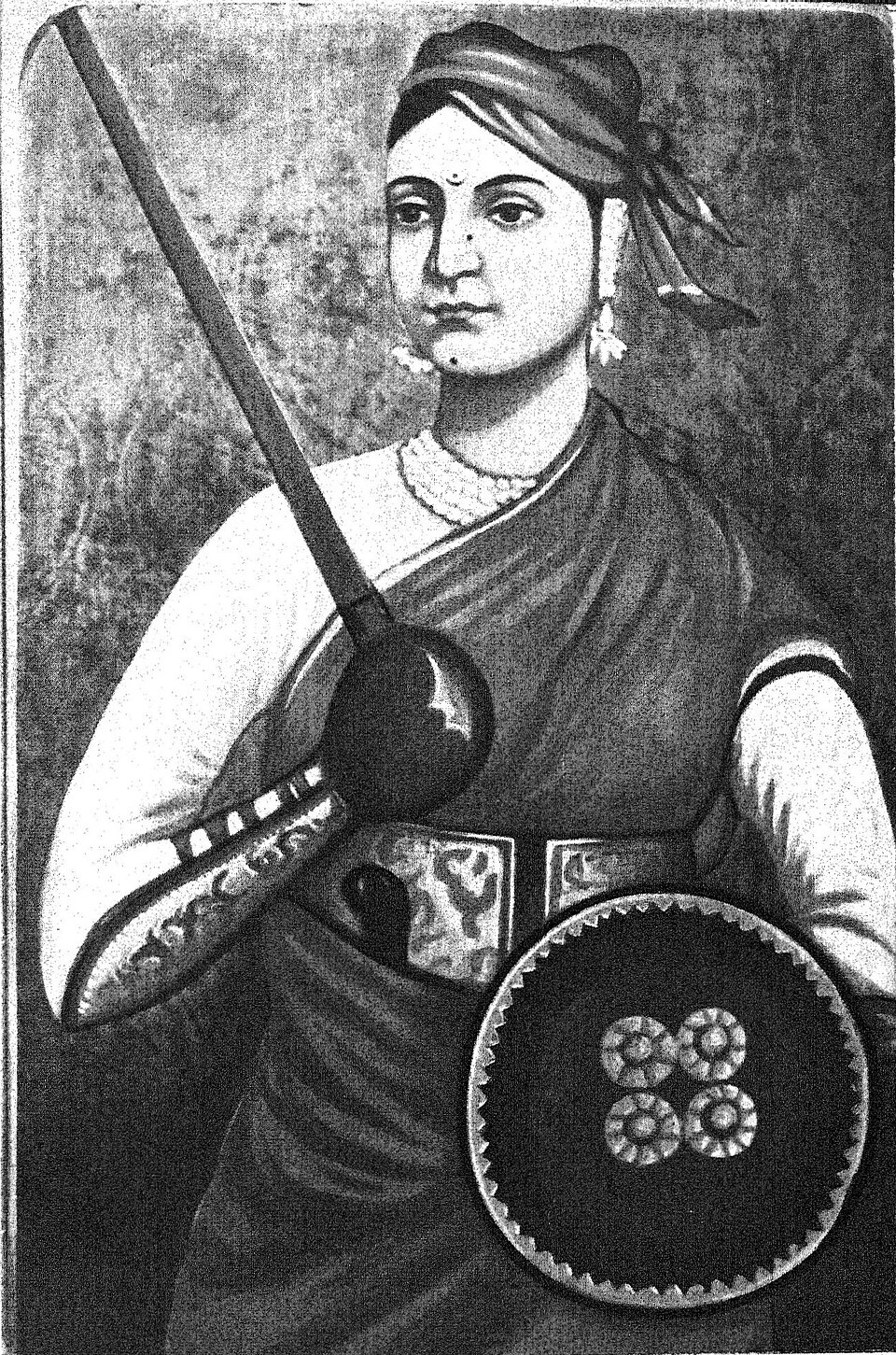
Imagine the English surprise! I was a widow, and a Hindu widow wore a white sari, without color, and stayed apart. I put aside that mourning sari. I put on cavalry armor, a turban, and took my talwar, that curved sword of ours. On the battlefield, they sometimes mistook me for a male soldier! During the siege of Jhansi, in March 1858, I personally directed the defense against General Hugh Rose. Breaking the rules of my time was almost as brave as fighting. A queen can hold a sword as firmly as a scepter.
A queen can hold a sword as firmly as a scepter.
—Were you afraid the day the English attacked the fort?
Of course I was afraid, my child. Whoever says they were never afraid is lying. The fort of Jhansi was a huge stone fortress, but General Hugh Rose's cannons pounded day and night. I heard the walls tremble. But do you know what you do with fear when you are responsible for an entire people? You turn it into strength. I would go see the soldiers on the ramparts, share their ration of rice, the same as mine. That gave them courage. Fear doesn't disappear. But you can decide to walk anyway, straight ahead.
Fear doesn't disappear, but you can walk anyway.
—Is it true that you jumped from the ramparts on horseback, with your son on your back?
Ah, here you are at the most beautiful of my stories! When Jhansi fell, in April 1858, we had to flee or die. So, in the dead of night, I tied my little Damodar Rao on my back, like a precious bundle. I leaped on horseback from the fort's walls. They say my steed, Badal — his name means “cloud” — jumped from the top of the walls. Is it entirely true, or a bit embellished by storytellers? I leave that for you to judge. But that night, I really galloped hundreds of kilometers, pursued by the English, to join my allies in Kalpi.
My son tied on my back, I leaped into the night.

—Why didn't you just hide to stay alive?
Because hiding was not living, my child. After my escape, I could have disappeared far away, in silence. But I joined Tatya Tope, a great rebel leader, and together we captured the stronghold of Gwalior in June 1858. I knew the English were more numerous, better armed. I knew I risked my life. But there are things for which you accept to give everything. Imagine your house is stolen and you are asked to smile in silence. I couldn't. Better to stand with my talwar than to bow my head in hiding.
Hiding was not living.
—What did the English, your enemies, say about you?
It's strange, but my enemies paid me great tribute. After the battle of Gwalior, on June 18, 1858, where I fell sword in hand, General Hugh Rose wrote a report to his superiors. He said I was remarkable for my intelligence and tenacity, and that I was “the most dangerous of all the Indian rebel leaders.” Can you imagine? The one who fought me recognized my worth. Remember this: sometimes, the truest compliment comes from your adversary's mouth. They respect those who stand tall to the end.
Sometimes your adversary pays you the truest tribute.
—Today, in India, how are you remembered?
It touches me that you ask. I died young, at twenty-nine, on a battlefield. But my story did not end there. In 1947, when India finally became free, I was elevated to the rank of national heroine. In Gwalior, there is a monument to my memory at Phool Bagh. Children like you still learn my name and sing of my courage. You see, you can lose a battle and win the memory of your people. My body disappeared in 1858, but the idea I carried — never accept injustice — lives on.
You can lose a battle and win the memory of your people.

This imaginary interview was generated by artificial intelligence from sources documented in Lakshmi Bai's profile. It dramatises what the figure might have said based on what we know about them, but does not constitute attested historical testimony. For primary sources and factual documentation, refer to the full profile.