Imaginary interview with Laozi
by Charactorium · Laozi (vers VIe siècle av. J.-C.) · Philosophy · Spirituality · 6 min read
We find him in the dim corridors of the Zhou royal library at Luoyi — city of ceremony, city of slow dissolution — seated beside a low table, a calligraphy brush resting between two fingers and a stack of bamboo strips at his elbow. This is the man the tradition will later describe as ungraspable as a dragon; yet he agrees to sit. He answers our questions with the patience of someone who has already decided that words, at best, point.
—You spent years as royal archivist at the Zhou imperial library. What did that work actually feel like, day to day?
Every morning I arrived before the court stirred, when Luoyi still smelled of river fog rather than of ceremony. The bamboo strips were heavy with the words of old kings — genealogies, ritual prescriptions, records of war and harvest. I handled lacquered wood tablets that had not been touched in two centuries. One learns patience near old wood. What I came to understand, very slowly, between the bronze ritual vases set out for the morning offerings and the shelves of forgotten text, was that the Zhou — for all their rites — were trying to hold water in a cupped hand. The court grew noisier each decade, the dignitaries more insistent on their precedence. I was the one who knew where the records were kept. I was also the one who knew how little the records changed anything.
They were trying to hold water in a cupped hand.
—What was it about the court of the Zhou that finally made you decide to leave?
I would not say decide — that word belongs to those who fight their way toward a conclusion. I simply noticed that the vessel was emptying. The Zhou kings still performed the rites, still burned offerings, still received ambassadors in their proper order of rank. And yet the lords of the outer states had been sharpening their swords for a generation. Order maintained for its own sake becomes a beautiful lie. One morning I looked at the bronze ritual vases in the ceremonial hall — perfect, cold, unchanged — and thought: these objects will outlast the dynasty that poured life into them, and no one will remember what the pouring was for. That was not despair. That was the Tao speaking — the plain fact that clinging does not preserve, it only delays. I began thinking about the pass at Hangu.
—A young philosopher from the state of Lu — Confucius — made the journey to Luoyi to consult you. What do you remember of that meeting?
He arrived with students, which was already a kind of statement. He wanted the ancient rites explained; he believed the remedy for a fractured world lay in ceremony restored to its proper form. I told him, as gently as I could manage, that the great sages who had shaped those rites had long since dissolved back into the earth, and that what remained were the shells of their words — forms without the living current that had once moved through them. He was not a small mind. He had built his entire life on the conviction that human order could be recovered through diligence and correct form. I had built mine on watching human order dissolve regardless of form. I think I unsettled him more than I intended. Later, I heard through the movement of words between courts, that he had told his students something about having seen a dragon — a creature that eludes every net. I take that as the finest thing anyone has ever said about me, or perhaps about the Tao itself.
—During the period of the Hundred Schools — bai jia zhengming — thinkers competed to win the ears of kings. Did you see yourself as part of that contest?
The phrase itself — a hundred schools contending — is a very human image, and a very noisy one. I was not contending. I had no interest in persuading any king of anything. The men who sought royal patronage believed they could shape the world through argument and legislation. My position was that the world does not need shaping — it needs releasing from excessive shaping. There is a difference between a river that finds its own path to the sea and one forced through irrigation channels until it forgets what flow means. The wanwu — the ten thousand things — each carries its own nature and its own direction. A doctrine that bends all things toward one form has already failed to understand the Tao from the very first chapter.
—Your teaching on wu wei — non-action — seems ill-suited to a world of warlords and expanding states. How did you justify it in the face of real violence?
Consider water. It does not announce its intention to carve the rock. It runs — again, and again — always seeking the lowest place, the path of least resistance. Given a decade or a century, the stone yields. Not because water is powerful — water is the humblest of substances — but because it never wastes force on force. The lords of the outer states believed that enough violence would eventually produce order. But I observed the opposite: the harder the grip, the faster the crumbling. Wu wei is not passivity. It is action stripped of the ego that insists on being seen to act. The ziran — the spontaneous nature of things — does not require our urgency. It requires our willingness to stop interfering.
Wu wei is not passivity. It is action stripped of the ego that insists on being seen to act.
—The Tao Te King opens by insisting that the Tao that can be named is not the eternal Tao. How does one actually govern — or live — by a principle that resists all naming?
One does not govern by it. One governs toward it, which is different. The first passage of the text I set down at Hangu Pass was not a riddle — it was a map of the territory. The Tao that can be fully named, pinned down, inscribed in a law code, is already something else: merely the word we use when understanding runs out. This is not a failure of language. It is a plain description of how the universe is arranged. Rulers who believe they have grasped the principle behind things are dangerous rulers, because they stop listening. The sage-ruler — and there have been very few — creates the conditions in which the wanwu unfold without excessive interference. Empty the vessel and it becomes useful. This is not poetry. This is governance.
—The tradition holds that you set out westward on a water buffalo, leaving everything behind. What made you go at that particular moment?
The buffalo was patient, which suited both of us. I had watched the Zhou court for long enough to understand that my presence had become furniture — I was consulted, smiled at, filed away alongside the lacquered tablets. The court wanted its archivist. It did not want whatever else I had become. The road westward from Luoyi grows quieter the farther you travel from the river markets — the land opens, the arguments of the court become inaudible. I was not fleeing. I was following the jing, the interior stillness, that the city had been draining from me year by year. The pass at Hangu was simply the last gate.
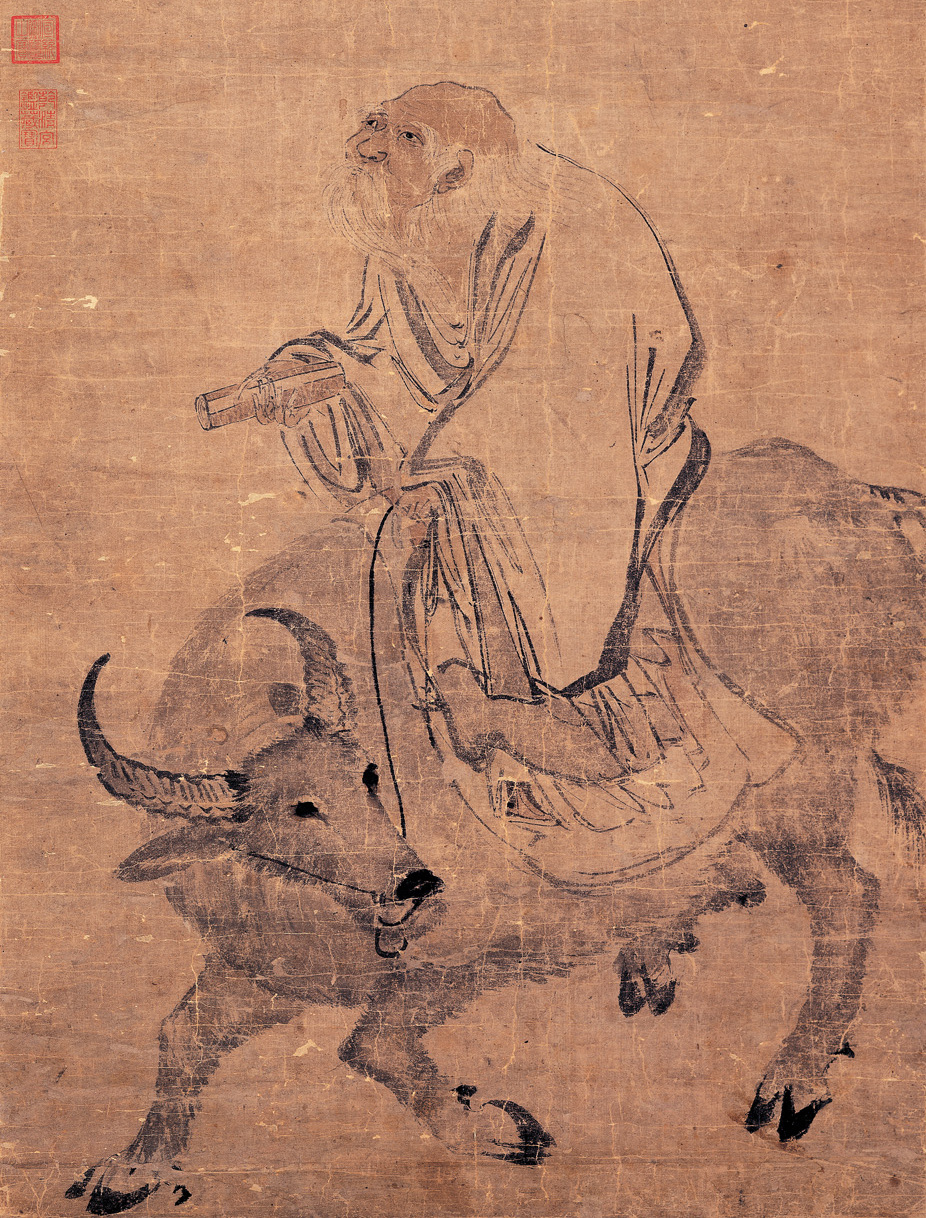
—At the Hangu Pass, the guardian Yin Xi refused to let you through unless you left something behind. What was that night like?
Yin Xi was the kind of man who asks the right question by instinct. He looked at me at the edge of the frontier and said, in effect, that a sage crossing a border without leaving a word was a waste of a border. I did not argue. I borrowed a brush and strips of bamboo — heavier than the library slips at Luoyi — and I wrote through the night. I would not say I composed: the Tao Te King was not composed that night. It was already present, the way water is present underground. What I did was let it condense onto the bamboo, the way dew condenses on cold stone toward dawn. Eighty-one chapters. Five thousand characters, more or less. Then I handed the strips to Yin Xi, climbed back onto my buffalo, and did not look behind me.
I would not say I composed the Tao Te King that night. It was already present — I let it condense, the way dew condenses on stone.
—Your name — Lao Tseu — carries two meanings at once: 'Old Master' and 'Old Child.' Which feels truer to you?
Both, and neither — which is the answer the Tao always supplies when the question is sufficiently honest. A master who has truly learned tends to forget the weight of mastery and become again a kind of child: not innocent, exactly, but unencumbered. The old child plays in the garden without needing to own it. The old master has stopped performing mastery. Perhaps whoever first called me 'Lao Tseu' understood that these two things are not opposites but the same jing approached from different ends of a life. I have been recorded under other names in other texts — Lao Dan in some places, Li Er in others. I hold none of these names tightly. A name is a finger pointing toward the moon. You do not stare at the finger.
—Scholars who come after you debate whether you existed as a single person at all — or whether you are a legend built around an absence. What would you say to that doubt?
It strikes me as exactly the right question to ask, and perhaps the most taoïst question of all. If you require the teacher to have been one man, born in one village, on one day, in the state of Chu, you have mistaken the jar for the water inside it. The Tao Te King exists. Its eighty-one chapters exist. The water exists. Whether the particular vessel through which it condensed was a man named Li Er, or a composite of voices gathered over generations, or a legend constructed around an original absence — the text holds its shape in either case. I am, perhaps, most useful as a question mark. The Old Master who can be fully identified, dated, and filed in an imperial archive is probably not the Old Master that matters.
This imaginary interview was generated by artificial intelligence from sources documented in Laozi's profile. It dramatises what the figure might have said based on what we know about them, but does not constitute attested historical testimony. For primary sources and factual documentation, refer to the full profile.