Imaginary dialogue between Confucius and Laozi
by Charactorium · Laozi (vers VIe siècle av. J.-C.) · Philosophy · Spirituality · 6 min read
It is in the royal archives of Luoyi, sometime around 500 BC, that Confucius seeks out the old keeper of the Zhou library for what both men sense may be a final meeting. Morning light enters through the latticed screens in slow, oblique bars, catching the dust that rises from stacks of bamboo strips — the accumulated records of dynasties. The two men have met before: the younger came expressly to ask about the rites, and left so shaken by the reply that he could not speak for a day. Today Confucius returns not as a suppliant but as a near-equal, carrying questions he has never written down.
—Old Master, you guarded the Zhou archives at Luoyi for decades. What did those records teach you that the court itself never learned?
The court learned names and precedents. The archives taught me something else: that every dynasty which tried to hold the world by force eventually cracked like clay left too long in the sun. I read the histories of the Zhou from their earliest campaigns — the confidence, the rituals, the bronze vessels polished to mirror-brightness — and I watched the same dynasty, in my own lifetime, splinter into quarreling lords who had forgotten why the vessels existed in the first place. The wanwu, the ten thousand things, do not hold their form forever. The archivist who truly reads the records does not come away believing in permanence; he comes away understanding that yielding outlasts every attempt at control.
—Your name — Lao Tzu, 'Old Master,' or perhaps 'Old Child.' You have never given us another. Was that a deliberate choice?
You have always loved names, Kong Qiu — the rectification of names is, as I recall, the very foundation of your program of governance. But consider: if a name pins a thing down, a man who can be fully named can be fully bounded. I have no quarrel with being called the Old Master. I have equally no quarrel with being the Old Child — wisdom and innocence are not so far apart as convention suggests. A name is a door, not a room. Those who push through it into the silence on the other side will have understood me better than any biographer. Those who remain in the doorway arguing about the inscription on the lintel will have mastered the door, and nothing more.
A name is a door, not a room.
—When I came to you here asking about the rites, I left unable to speak for a full day. What did you see in me that I could not yet see in myself?
I saw someone who had thought about human beings more carefully than almost anyone alive — that is not a small thing. I also saw a man who had decided, in advance, what the world ought to be, and was arranging his entire life to make the world conform to that decision. The rites are real, Kong Qiu — I do not dismiss them. But when a man loves the rite more than the impulse that first gave rise to it, he is painting the river rather than drinking from it. What I saw in you was tremendous capacity held inside a very particular shape. Whether the capacity would one day overflow the shape — that was the question I could not yet answer.
—You return again and again to water wearing down stone. Why water specifically — not fire, not wind?
Fire is spectacular and leaves ash. Wind cannot be caught, but it also cannot bear weight. Water does all things quietly. It seeks the lowest places — the places no one disputes with it — and precisely there it becomes irresistible. The hardest rock in the Henan gorges has been carved not by armies but by a current that never once chose to fight. This is wu wei as I mean it: not passivity, not absence, but action so perfectly attuned to the nature of things that it does not announce itself as action. You have walked the length of the Zhou states trying to persuade lords to govern virtuously. I do not mock that effort. But I ask: does the river advise the canyon, or does it simply flow?
Does the river advise the canyon, or does it simply flow?
—Wu wei is a discipline I find difficult to separate from plain inaction. How does the sage know the difference?
That is the right challenge, and I expected it from you. Wu wei is not laziness dressed in philosophy. The lazy man does nothing because effort costs him something; the practitioner of wu wei does nothing that is unnecessary because he is paying exact attention. Ziran, naturalness, requires more discipline than any ritual calendar, because it cannot be scheduled. You rise each morning knowing precisely which texts to study, which students to instruct, which lord to petition. I do not call that wrong. I only ask: on the morning when nothing is required, are you able to do nothing at all? That capacity — to be still when stillness is what the moment asks — is where the practice truly lives, and it is not simple.
—When I visited you here, the court's decay was already visible. What finally made you choose to leave it all behind?
I did not break — that is the wrong word. Breaking implies resistance, and I had very little left to resist. What happened was quieter: I looked around the archive one morning at the bronze vessels we were cataloguing, objects intended for ceremonies that had not been performed sincerely in two generations, and I understood that the Zhou court had become a museum to its own former virtue. The rituals continued; the Te, the inner force they were meant to cultivate, had long since departed. An archivist can preserve the record of life. He cannot breathe life back into the record itself. When I understood that fully, the road westward was no longer a choice — it was simply the only honest response remaining.
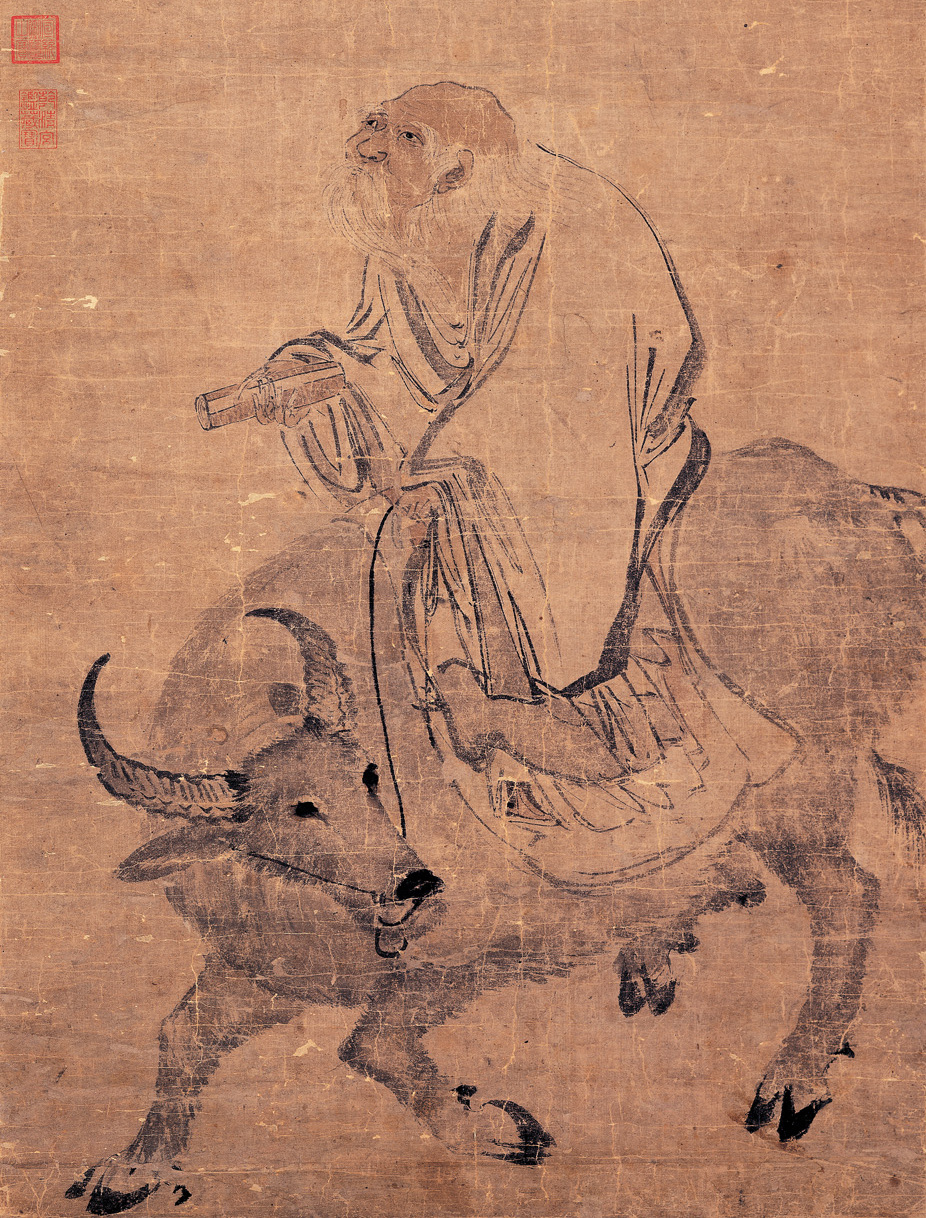
—The day you mounted the water buffalo and left Luoyi — did you say farewell to anyone? Did anyone know?
To whom would I have said it? The court was already gone from itself. My few students understood, I think, that a departure of this kind does not require an announcement. The water buffalo is patient — he asked no questions. We traveled west through the states I had spent decades reading about in the archives: places I knew only as names inscribed on bamboo strips, which I was now finally seeing with my own eyes. There is a particular relief in that: arriving at a place you have only ever known as a word, and discovering that the mountains do not resemble the word at all, and that this is entirely correct. The Tao that can be stored in an archive is not the Tao that meets you at the edge of the known world.
—Yin Xi at the Hangu pass refused to let you leave without your teaching written down. Did those five thousand characters come easily?
Yin Xi was a sincere man — I saw that immediately, and sincerity opens something that argument never reaches. I had carried those eighty-one meditations in silence for so many years that the act of writing was less composition than release. What was harder was accepting that a text can only carry so much. Words are fingers pointing at the moon; the Tao Te King is a set of fingers. I wrote it, handed it to him, and rode on — because to remain and explain it further would have been to mistake the finger for the moon. Whether anyone has since found the moon through those words, I cannot honestly tell you. That is no longer my concern, and I mean that without sadness.
Words are fingers pointing at the moon. The Tao Te King is a set of fingers.
—I have recorded every principle of conduct for hundreds of students. You left eighty-one brief passages and vanished. Which of us builds something that lasts?
You are asking me to compete, Kong Qiu, and competition is very much your nature — the nature of someone who believes the strongest argument should win. I do not think in terms of lasting. The sage does not plant a forest in order to see it from his window in old age. What I know is this: the Tao Te King is short because the Tao itself resists elaboration. Your teachings are long because human society is complex, and you are right that it is. Both of us were answering the same fractured world — the same warring lords tearing the Zhou realm apart — and we reached different conclusions about what the world most needed. I chose silence and water. You chose music and rites. Perhaps the world, in its vastness, required both of us.
—Some will say, long after we are gone, that Lao Tzu was never a real man at all. Would that trouble you?
Not at all — and here, for once, I think you and I would agree completely. If the Tao Te King is true, it does not require my birth record to remain true. The text either opens something in the reader or it does not. If future scholars decide that Lao Tzu was a name given to a current of thought rather than to a man who rode a water buffalo westward at dusk, they will have understood something important: that the Tao belongs to no one, and that a teaching which depends entirely on the authority of its author has already placed a wall between the reader and the Tao itself. I am content to dissolve into the question. You might say — and you would be right — that this too is wu wei.
This imaginary interview was generated by artificial intelligence from sources documented in Laozi's profile. It dramatises what the figure might have said based on what we know about them, but does not constitute attested historical testimony. For primary sources and factual documentation, refer to the full profile.