
Chinese philosopher, founder of Taoism
Laozi(vers VIe siècle av. J.-C.)
Laozi
dynastie Zhou
7 min read
Frequently asked questions
Key Facts
- Lao Tseu (« Vieux Maître ») aurait vécu au VIe siècle av. J.-C., contemporain présumé de Confucius, sous la dynastie Zhou
- Il est considéré comme le fondateur du taoïsme et l'auteur présumé du Tao Te Ching (« Livre de la Voie et de la Vertu »), texte fondateur de la pensée taoïste
- Selon la tradition, il aurait été archiviste ou bibliothécaire à la cour royale de Zhou, ce qui lui aurait permis d'accéder à une vaste culture
- Sa pensée repose sur le concept central du Tao (la Voie), principe universel invisible qui gouverne l'ordre naturel du monde
- Son existence historique est incertaine : certains historiens le considèrent comme une figure légendaire ou composite, ce qui en fait un cas d'étude sur les sources de l'Antiquité
Works & Achievements
Founding text of Taoism composed of 81 short chapters and approximately 5,000 characters. It expounds the central concepts of Tao (the Way), Te (Virtue), and wu wei (non-action), and remains one of the most translated texts in the world.
Anecdotes
According to tradition, Laozi is said to have met Confucius, his contemporary, who visited him to ask questions about ritual rites. Confucius came away so impressed that he reportedly told his disciples: 'I have seen a dragon!' — comparing Laozi to an elusive and mysterious being.
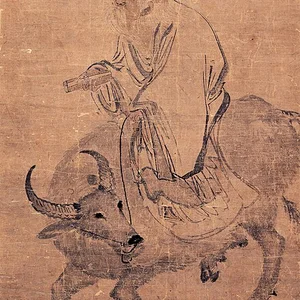
Legend has it that Laozi, weary of the corruption at the royal court of Zhou, decided to leave China riding a water buffalo westward. At the border, the keeper of the mountain pass, Yin Xi, asked him to write down his wisdom before departing. Laozi is said to have composed the Tao Te Ching in a single night, then disappeared forever.
Laozi taught that the weakest can overcome the strongest, illustrating this principle with the image of water: soft and yielding, it nonetheless carves through the hardest rock. This idea, called 'wu wei' (non-action), invited one not to force things but to follow the natural course of the world.
Even his name is a mystery: 'Laozi' means in Chinese 'the Old Master' or 'the Old Child'. Some historians believe he was not a real person but a legendary figure, a symbol of ancient wisdom that no one has been able to date or locate with any certainty.
Primary Sources
The Tao that can be named is not the eternal Tao. The name that can be named is not the eternal name. That which is nameless is the beginning of Heaven and Earth.
Laozi was a native of Qu Ren village, in the canton of Li, district of Hu, in the state of Chu. He was an archivist at the royal library of the Zhou.
When Lao Tan died, Qin Shi came to offer his condolences, cried out three times, and left. A disciple asked him: 'Were you not a friend of the Master?' — 'I was,' he said. 'Then is it fitting to mourn in such a way?' — 'Yes. At first I believed him to be a man among men; now I know he was not.'
The Tao is that by which the ten thousand beings become what they are. It is that by which beings transform themselves and complete their existence.
Key Places
Capital of the Zhou state where Laozi is said to have served as royal archivist at the imperial library. It is here that he is believed to have accumulated his vast knowledge before choosing exile.
Legendary site where Laozi is said to have handed the Tao Te Ching to the gatekeeper Yin Xi before crossing the border of China to head westward and disappear.
Traditional birthplace of Laozi according to Sima Qian's biography. A temple dedicated to him has stood since Antiquity: the Taiqing Temple, still standing today.
One of the historical cradles of religious Taoism, considered a sacred site directly linked to the tradition initiated by Laozi. Listed as a UNESCO World Heritage Site.
Typical Objects

Philosophical texts of the era were written on bamboo strips using a brush dipped in ink. The Tao Te Ching itself is said to have been written this way by Laozi at the request of the border gate keeper.

The legendary mount of Laozi during his journey westward. The buffalo has become one of the iconographic symbols of the philosopher in traditional Chinese painting.

Precious texts were also copied onto silk scrolls. Versions of the Tao Te Ching on silk were discovered in 1973 in the Mawangdui tomb, dating from the 2nd century BCE.

Royal officials and archivists of Zhou-era China worked in an environment of rituals and ceremonies, where bronze vessels were used for offerings. Laozi, as royal archivist, would have had custody of them.

A classic attribute of Chinese sages and philosophers, the fan symbolized wisdom, lightness and detachment — core values of Taoism.

Common writing surfaces during the Zhou period, used to record laws, registers and philosophical texts in the royal libraries where Laozi worked.
School Curriculum
Vocabulary & Tags
Key Vocabulary
Daily Life
Morning
Lao Tzu, according to tradition, rose at dawn to observe the movement of the sun and nature — in keeping with the Taoist principle of alignment with natural cycles. As a royal archivist, he would go to the Zhou library to consult and classify ancient texts written on bamboo strips. His day began in silence and contemplation.
Afternoon
He spent long hours studying the ritual and historical texts preserved in the imperial library, answering questions from dignitaries and philosophers who came to seek his counsel. Legend holds that figures such as Confucius made the journey specifically to benefit from his wisdom. He also practiced breathing and meditative exercises.
Evening
In the evening, Lao Tzu withdrew into simplicity, refusing the banquets and splendor of the court. He observed the starry sky, meditated on the Tao, and transcribed his reflections. According to the Taoist philosophy he embodied, night and silence were privileged moments for perceiving the Way of the world.
Food
In keeping with the Taoist principles he taught, Lao Tzu favored a frugal and natural diet: vegetables, rice, millet, and medicinal plants. Taoism valued a simple regimen, in harmony with nature, avoiding excess and the refined dishes of the court. This dietary sobriety was regarded as a spiritual practice.
Clothing
As a royal official, Lao Tzu likely wore the robes of Zhou scholars: long tunics of silk or linen dyed in subdued colors (black, brown, gray), held in place by a rope or leather belt. The iconographic tradition depicts him dressed in simple white or gray robes, symbols of detachment and purity.
Housing
At the court of Luoyi, Lao Tzu probably lived in modest quarters reserved for officials and archivists — a house of wood and fired earth, with a garden and bamboo screens. According to legend, he eventually abandoned all comfort to travel alone toward the west, sleeping under the open sky or in roadside inns.
Historical Timeline
Period Vocabulary
Visual Style
Peinture à l'encre de Chine minimaliste et contemplative : vieux sage sur buffle, brumes de montagne, bambous et vide évocateur — l'esthétique du Tao.
Sound Ambience
Une atmosphère de sérénité naturelle dans la Chine ancienne des Zhou — bambous, rivières, flûte en bois et cloches de temple évoquant la quête du Tao.
Liens externes & ressources
Références
Œuvres
Tao Te King (Daodejing — Livre de la Voie et de la Vertu)
Ve–IVe siècle av. J.-C.