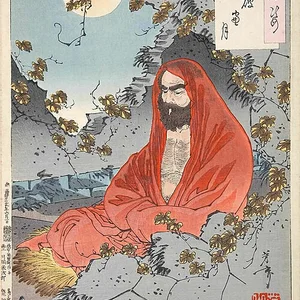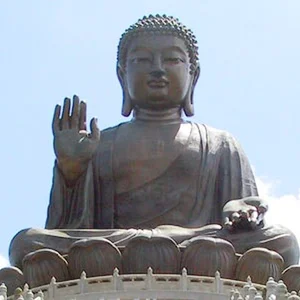

Siddhartha Gautama, founder of Buddhism
Buddha(vers 563 — vers 483 av. J.-C.)
Buddha
Inde
9 min read
Frequently asked questions
Key Facts
- Né vers 563 av. J.-C. à Lumbini (actuel Népal), Siddharta Gautama est issu d'une famille princière du clan des Shakyas.
- Vers 528 av. J.-C., après des années d'ascèse, il atteint l'Éveil (Bodhi) sous un figuier sacré à Bodh Gaya, en Inde.
- Il prononce son premier sermon à Sarnath, près de Varanasi, posant les bases de l'enseignement bouddhiste : les Quatre Nobles Vérités et le Noble Chemin Octuple.
- Il fonde une communauté monastique (le Sangha) et enseigne pendant environ 45 ans à travers le nord de l'Inde.
- Il meurt vers 483 av. J.-C. à Kushinagar, événement appelé le Parinirvana, marquant son extinction définitive du cycle des renaissances.
Works & Achievements
Founding teaching delivered during the first sermon at Sarnath: suffering exists, it has a cause (desire), it can cease, and there is a path to achieve that cessation. These four truths form the heart of all Buddhism.
A practical path in eight stages — right understanding, intention, speech, action, livelihood, effort, mindfulness, and concentration — to liberate oneself from suffering. This ethical and meditative program remains at the core of all Buddhist traditions.
Creation of the first community of monks (bhikkhus), then nuns (bhikkhunis), with precise rules of conduct (Vinaya). The Sangha becomes one of the Three Jewels of Buddhism alongside the Buddha and the Dharma.
A collection of 423 verses attributed to the Buddha, organized into 26 thematic chapters on ethics, meditation, and wisdom. It is the most widely read Buddhist text in the world and an accessible entry point to the Buddha's teaching.
A vast collection of several thousand discourses attributed to the Buddha, organized into five 'Nikayas'. Together with the Vinaya Pitaka and the Abhidhamma Pitaka, it forms the Pali Canon, the textual foundation of Theravada Buddhism.
The doctrine according to which all things are in perpetual change and nothing is permanent, including the self. This revolutionary concept has profoundly influenced philosophy and psychology across the centuries in Asia and, more recently, in the West.
Anecdotes
Before his birth, his mother Maya is said to have had a prophetic dream: a white elephant carrying a lotus flower entered her side. The brahmins consulted interpreted this dream as the announcement of an exceptional being, destined to become either a great universal king or an enlightened sage.
Siddhartha grew up in a golden palace, shielded by his father from the realities of the world. At around the age of 29, during four chariot outings, he successively encountered an old man, a sick person, a corpse, and then a serene monk. These four encounters — known as the 'four sights' — shattered his vision of the world and triggered his spiritual quest.
After years of extreme ascetic practice, Siddhartha was so thin that he could touch his spine by pressing on his stomach. A young woman named Sujata then offered him a bowl of rice milk. This act of compassion made him realize that the middle way — neither luxury nor excessive deprivation — was the key to enlightenment.
Under a sacred fig tree (the ficus religiosa, since called the 'Bodhi tree') in Bodh Gaya, Siddhartha meditated through an entire night. According to tradition, the demon Mara attempted to distract him with illusions, fears, and desires. At sunrise, Siddhartha attained complete Enlightenment and became the Buddha — 'the Awakened One'. He was around 35 years old.
The Buddha's first teaching, given in the Deer Park at Sarnath to his five former ascetic companions, is known as the 'Turning of the Wheel of the Dharma'. In it, he set out the Four Noble Truths and the Noble Eightfold Path, thereby laying the foundations of the entire Buddhist doctrine.
Primary Sources
"This, monks, is the noble truth of suffering: birth is suffering, aging is suffering, death is suffering; sorrow, lamentation, pain, grief, and despair are suffering."
"I teach one thing and one thing only: suffering and the cessation of suffering. Just as the ocean has but one taste, the taste of salt, my teaching has but one taste, the taste of liberation."
"King Priyadarshi, beloved of the gods, has honored all religious sects [...] and the Buddha Shakyamuni is venerated as the great sage who showed the path of the Dhamma."
"Then the Bodhisattva, seated beneath the Bodhi Tree, motionless as a mountain, withstood the assaults of Mara and, at the rising of the morning star, attained perfect and complete enlightenment."
"King Priyadarshi, beloved of the gods, when he had reigned twenty years, came in person and paid homage to this place because it is here that the Buddha Shakyamuni was born."
Key Places
Birthplace of Siddhartha Gautama, attested by the Ashoka pillar erected around 249 BCE. Today a UNESCO World Heritage Site and major pilgrimage destination for world Buddhism.
Site of the Buddha's Enlightenment under the Bodhi Tree. The Mahabodhi Temple, a UNESCO-listed site, marks this most sacred place in Buddhism; pilgrims from around the world come here to meditate.
The Deer Park where the Buddha delivered his first sermon after the Enlightenment, teaching the Four Noble Truths to the five ascetics. The ruins of the Ashoka stupa and the archaeological museum attest to the site's historical importance.
Site of the Buddha's Parinirvana (death), around 483 BCE. The Mahaparinirvana Temple houses a 6-metre reclining Buddha statue, representing his passage into final nirvana.
Capital of the kingdom of Magadha where the Buddha taught for many years and where the First Buddhist Council was held after his death. The surrounding hills contain caves used for meditation by the Buddha and his disciples.
Great Hindu holy city on the banks of the Ganges, near Sarnath. The Buddha stayed there and the region was at the heart of his itinerant ministry for several decades across the Gangetic plain.
Typical Objects

A clay or metal bowl that the Buddha and monks carried during their morning rounds to receive food offered by lay followers. It symbolizes detachment from material possessions and respectful dependence on the lay community.

A simple ochre or saffron-colored garment made of sewn-together pieces of cloth, worn by the Buddha and his monk disciples. Its distinctive color and austerity represent renunciation of the world and belonging to the Buddhist community (Sangha).

The sacred fig tree under which Siddhartha attained Enlightenment at Bodhgaya. This tree has become one of the most sacred symbols of Buddhism; cuttings from the original tree have been planted at holy sites throughout Asia.

An eight-spoked symbol representing the Noble Eightfold Path taught by the Buddha. The wheel evokes the first sermon at Sarnath (the 'turning of the wheel') and is one of the oldest and most universal emblems of Buddhism.
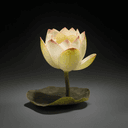
An aquatic flower that grows in mud yet blooms pure and unstained at the surface. It symbolizes the spiritual awakening possible for every human being, even one immersed in the sufferings of the world, and is a constant feature of artistic representations of the Buddha.

Pilgrimage accessories of the wandering monk: the staff aids in walking and in brushing aside insects without killing them (in keeping with the principle of ahimsa, non-violence), while the cup is used to filter water to avoid inadvertently swallowing small living beings.

Ritual objects used in Buddhist ceremonies since the earliest monastic communities. The bell marked moments of meditation and prayer, while incense, imported from India, created an atmosphere conducive to contemplation and symbolized the rising of prayers toward the cosmos.
School Curriculum
Vocabulary & Tags
Key Vocabulary
Daily Life
Morning
The Buddha and his monks rose before dawn to meditate in silence, seated cross-legged on the ground. At sunrise, they would walk barefoot through nearby villages, bowl in hand, for their alms round, accepting without distinction whatever was offered to them.
Afternoon
The afternoon was devoted to teaching: the Buddha addressed his disciples in shaded parks, under trees or in buildings donated by patrons. He adapted his discourses to each person — monk, merchant, king or untouchable — answering questions with parables and dialogues.
Evening
In the evening, after a period of teaching or philosophical debate, the Buddha would meditate at length in the silence of the night. He slept little, often directly on the ground on a simple mat, and devoted part of the night to observing the stars and contemplating the impermanent nature of all things.
Food
The Buddha followed the rule of a single meal before noon, accepting into his bowl whatever laypeople offered him, including meat if the animal had not been killed expressly for him (the rule of the 'three purities'). After a long period of extreme asceticism, he had adopted a simple but sufficient diet, refusing total fasting.
Clothing
He wore a robe (civara) made of pieces of saffron or ochre-coloured cloth, sewn and dyed, without elaborate seams. This garment symbolised the renunciation of social status and wealth. Barefoot most of the time, he could wear simple sandals on long journeys.
Housing
During the nine dry months, the Buddha and his monks led an itinerant life, sleeping in the open air, under trees or in caves. During the rainy season (vassa, approximately three months), they retreated to monasteries donated by royal or merchant patrons, such as the Jetavana in Shravasti or the Veluvana in Rajagriha.
Historical Timeline
Period Vocabulary
Visual Style
Style inspiré de l'art bouddhiste indien ancien (Gandhara, Sarnath) : représentations sereines aux teintes or et safran, lotus, arbre de la Bodhi, lumière douce et atmosphère méditative intemporelle.
Sound Ambience
Ambiance sonore de l'Inde ancienne : forêt tropicale au lever du jour, chants monastiques, cloches légères et sons de la nature sur les rives du Gange, propices à la méditation et au recueillement.
Liens externes & ressources
Références
Œuvres
Les Quatre Nobles Vérités (Catvāri Āryasatyāni)
~528 avant J.-C.
Le Noble Sentier Octuple (Āryāṣṭāṅgamārga)
~528 avant J.-C.
Fondation de la Sangha (communauté monastique)
~528 avant J.-C.
Dhammapada (Paroles du Dhamma)
Ve siècle avant J.-C. (mis par écrit au Ier siècle avant J.-C.)
Sutta Pitaka (Corbeille des discours)
Ve–IIIe siècle avant J.-C.
Enseignement du concept d'Impermanence (Anicca)
~528–483 avant J.-C.